Tupua Tamasese Lealofi III and the Mau at Apia
Tupua Tamasese Lealofi III held one of the four paramount titles of Sāmoa and led the pro-independence Mau from Apia until New Zealand police shot him during the Black Saturday procession of 28 December 1929. He put the case for Samoan self-government in Gagana Sāmoa, the working language of our Samoan translation desk. His movement rested on the primacy of faʻamatai authority and the standing of Samoan custom before an imposed court, the two claims beneath our Indigenous Rights and Self-Determination and Legal and Government files.
The Mau grew from real grievance. A colonial ship brought the 1918 influenza ashore at Apia, killing a fifth of the Samoan population. The movement built on that loss took the plain slogan Sāmoa Mo Sāmoa, Sāmoa for Samoans. Tamasese pressed it without arms. Our heritage desk now restores the titles stripped from Mau leaders under banishment orders to their rightful holders.
His tomb of tiered black stones stands at Lepea beside the western road into Apia, kept by descendants who carry the Tupua Tamasese title into the present Fono. Sāmoa reached independence in 1962 on the foundation his nonviolent resistance laid. The paper of that passage, chiefly-title deeds alongside the petitions carried abroad by the Mau, gives our heritage desk its archival and certified-translation work. His fuller record sits in a standing biography.
The Working Districts of Apia
Apia spreads along the north coast of ʻUpolu as a chain of working villages rather than one downtown. Matautu carries the harbour trade and the customs house, while Fugalei holds the produce market and the buses gathering goods from the inland districts. Business and civic content published for these districts, council notices and service portals, reaches our Gagana Sāmoa localisation desk.
Beyond the town the same clientele reaches across the Samoan archipelago, over the Apolima Strait to Savaiʻi by the Mulifanua ferry and eastward to the villages around Pago Pago in American Sāmoa. One Gagana Sāmoa binds both jurisdictions. A birth record or a matai title drawn in Apia yet lodged in the United States territory holds a single spelling and one set of names under our certified hand. The same paper travels on to the Samoan communities of Auckland and California without losing its form.
The town also gathers the machinery of the state, the ministries and the courts pulling paperwork out of every district of ʻUpolu into a few streets behind the seafront. Commercial filings and tender documents moving through those offices reach our Business and Commerce work in Gagana Sāmoa and English together, a plain requirement for any firm bidding across the two languages of Sāmoa.
Vailima and the Mountain of Tusitala
Robert Louis Stevenson spent his last years at Vailima above Apia. Samoans gave him the name Tusitala, the teller of tales. He learned enough Gagana Sāmoa to set Samoan grievances into print. His short history of the 1889 conflict carried the archipelago to a distant readership in the register kept by our Media and Publishing desk. The problem he met has not moved, a Samoan sense set down for readers who hold no Gagana Sāmoa. The same task meets a subtitle or a dubbed line on screen today.
Stevenson lies on Mount Vaea above the estate. Vailima itself now serves as the official residence of the head of state and the Robert Louis Stevenson Museum. The literary tie gives Apia a written record older than most in the region, correspondence and the epitaph cut on the tomb among it, material carried to Samoan and visiting audiences alike by our Samoan translation and captioning work. The estate and the grave are set out in the town record.
The Apia Observatory at Mulinuʻu
German geophysicists built the Apia Observatory on the Mulinuʻu peninsula in 1902 to record earth magnetism and seismic motion alongside the polar stations of the day. New Zealand took the station with the territory in 1914. It has run without a break since, as the national meteorological and seismic service reading the seismic record for a coast struck by the 2009 tsunami. Its instrument logs and hazard bulletins carry a technical Gagana Sāmoa. Our Samoan translation and Tech and Innovation desks render those warnings for the public.
Over a century of unbroken readings sit in the station archive, magnetic charts and tide gauges among them, one of the longest instrument records held anywhere in the Pacific. That archive now feeds the regional warning chain. When a swell or a quake threatens the coast, our Disaster Response and Emergency Management desk renders the plain-language alerts inside the hour.
The peninsula carries more than the observatory. Mulinuʻu is the old ceremonial ground of Sāmoa and the seat of the Fono. The Maota Fono debates statute a short walk from the seismograph huts. Legislative Gagana Sāmoa drafted on the peninsula reaches our Legal and Government desk for the certified English required by treaty partners. The observatory keeps its own service record as the national weather authority.
The Port of Apia at Matautu
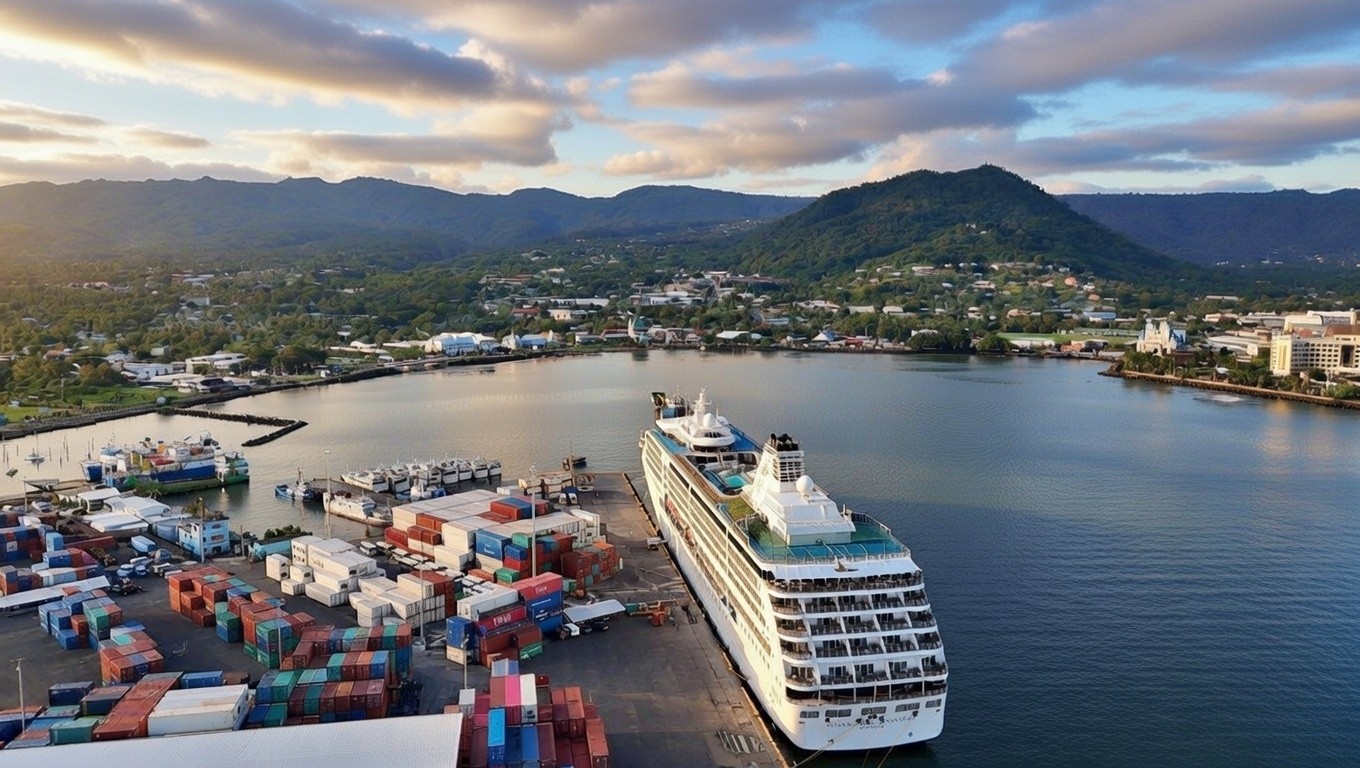
The Apia International Port sits at Matautu-tai on the eastern arm of the harbour and moves close to the whole of Sāmoa’s overseas trade across a single main wharf. The Samoa Ports Authority runs it as a state enterprise alongside the domestic wharves at Mulifanua and Salelologa, holding the pilotage and the tow work in public hands. Cargo manifests and biosecurity papers crossing the wharf, including the supply runs to Tokelau, pass through our Tokelauan translation and Maritime and Ocean Sciences desks.
Open-sea swell reaches the wharf through the harbour mouth and drives the climate-resilient breakwater and basin works staged by the authority over recent decades. For Tokelau the link is absolute, since the atolls hold no airfield and take fuel and freight only by the Apia sailing. The authority sets out its own remit as the national ports body.
The domestic terminal at Mulifanua ties the two main islands together, its car ferry the daily bridge to the villages of Savaiʻi. Crew papers and vessel certificates crossing the port hold their own technical Gagana Sāmoa. Our Samoan translation of a seafarer’s record keeps one spelling of a name across a working life at sea.
The Pacific Environment Secretariat at Vailima
The Secretariat of the Pacific Regional Environment Programme holds its headquarters at Vailima in Apia, the standing environmental body of the Pacific states. It became an autonomous intergovernmental organisation by the agreement signed in Apia in 1993, moving its seat from Nouméa to Sāmoa. Its climate-resilience and ocean-ecosystem programmes generate a steady stream of regional English and French, carried into island languages by our Energy and Climate Infrastructure desk.
Twenty-one Pacific states and territories sit in the Secretariat, Tokelau among the smallest of them. Its guidance reaches communities holding no metropolitan language. Climate briefings and hazard-warning captions drawn up at Vailima pass through our Gagana Tokelau localisation work before they reach the atolls. The body sets out its mandate and membership in its own charter pages.
The host-country agreement keeps the Secretariat rooted in Apia rather than any single funding cycle, a permanence rare among regional bodies. Its reef-monitoring and marine-species output runs into our Blue Economy and Marine Resources files. A coral or fisheries term fixed at Vailima holds the same value in Gagana Sāmoa and Gagana Tokelau across the member states.
The National University of Sāmoa
The National University of Sāmoa, the country’s only national university, was founded by act of parliament in 1984 and now teaches from the Le Papaigalagala campus on the inland edge of Apia. Its Centre for Samoan Studies runs the teaching of Gagana Sāmoa and awards the Master of Samoan Studies, the first degree of its kind anywhere. Course content and research output moving between the campus and its overseas partners reach our Education and Research desk, then our Gagana Sāmoa localisation team.
The campus rose on a Japanese grant and is built around the largest fale Sāmoa standing, with a separate School of Maritime Training that certifies Samoan seafarers to international rule. As the durable seat of Gagana Sāmoa scholarship, the university sets the standard terminology for the field. A legal or medical term settled at Le Papaigalagala carries the same weight in our certified files. The institution lists its faculties and centres on its own university site.
The Centre for Samoan Studies also holds an archive of oral tradition and genealogy, the standing record of faʻamatai knowledge beneath its Samoan-language degrees. That work sits close to our Indigenous Rights and Self-Determination files. A genealogy or a land-title translation prepared for a Samoan claimant leans on the same scholarship held at the Centre.
Samoan Linguistic Matrix for Apia Hub

Huri Translations
Tel. +689 89 205 483
[email protected]
PO BOX 365 Maharepa
98728 Mo'orea
French Polynesia
N°TAHITI 876649


Social