Districts of the National Capital
Spreading inland from the administrative quarter at Waigani, the built-up area absorbs Hohola and the newer housing blocks of Gerehu. The Motu-Koitabu people remain the customary owners of this shoreline, while families out of Hela or the Gulf have filled the suburbs behind it. Over time Tok Pisin became the shared tongue of that mixture, no provincial language being able to bind a labour force drawn from twenty-two homelands.
Konedobu, the older departmental precinct below Touaguba Hill, still houses the ministries and the daily press, while Saraga at Six-Mile grew up around the airport apron. Between the two there are the markets of Gordons and Koki, trading floors of an informal economy fed by crops trucked down from the Highlands. Vendors and buyers transact in Tok Pisin, seldom in English. Issued only in the official tongue, a municipal circular misses its intended audience. Our Tok Pisin localisation puts price lists and health department notices into the vernacular at drafting stage.
Employers drawing crews from the informal quarters at Erima and Eight-Mile confront one instruction and a dozen mother tongues at a time. It is the occupational safety file that decides whether a site retains its permit. After a fatality, inquiries turn on what the crew actually grasped. Our safety and occupational health line handles the permit to dig and the lock-out procedure. The geographic entry for Port Moresby sets out the formal boundaries of the district, coastal villages included.
The Motu Name on the Freeway
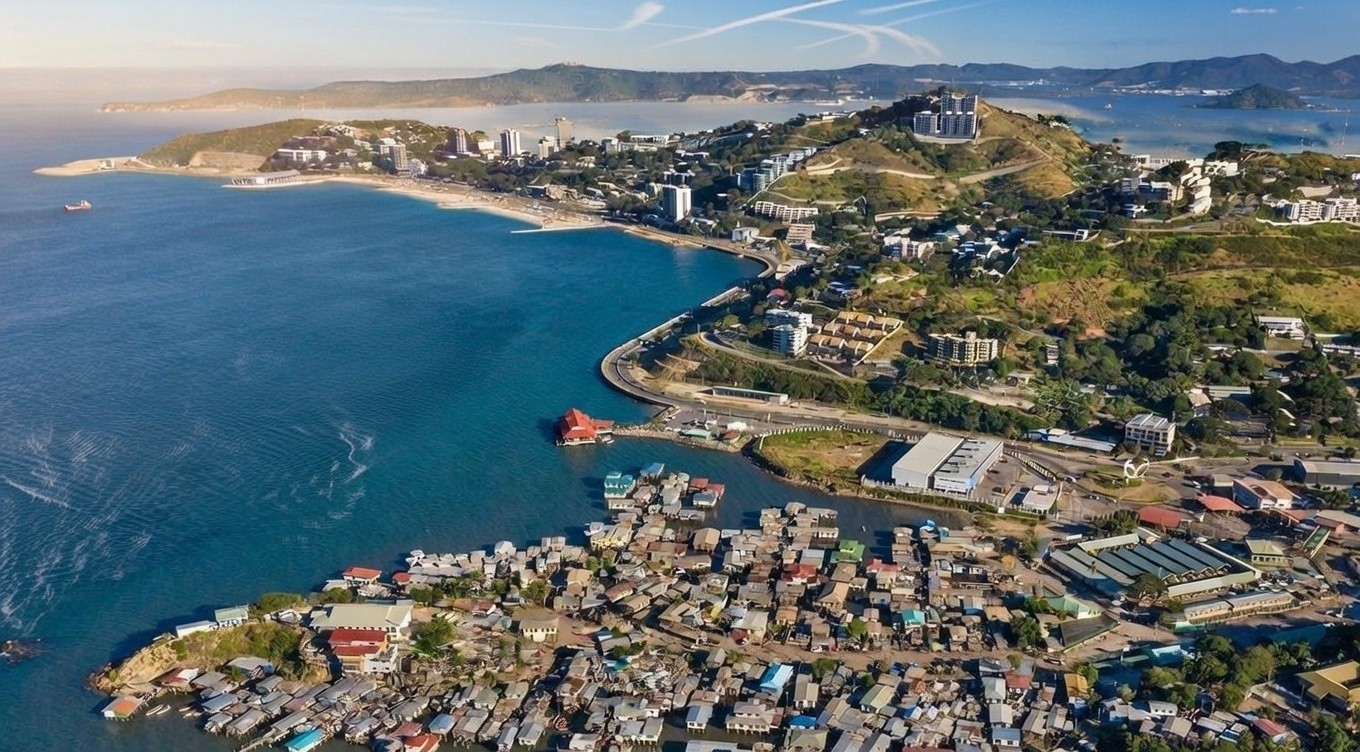
Poreporena, the older Motu name for the shoreline villages of Hanuabada and Elevala, transferred to the expressway joining the harbour front with the airport at Saraga. Design drafts had borne other labels throughout the planning phase: the surveyors had written Spring Garden Road and Burns Peak Road. Neither of those survived the opening. Road signs and traffic bulletins have used the Motu form since, one instance of the Indigenous language revitalisation in our remit.
A commission of inquiry later examined the financing and construction contracts for the freeway. Its members knew that citizens outside the English-speaking minority would never study a report in English alone. Accordingly the commission did append summaries in two vernaculars. Its report gave the public a Tok Pisin digest of the findings. Those appendices remain the template for our public procurement and tender translation.
Motor traffic between Downtown and Saraga has been using that carriageway for three decades. What that decision did was hold a Motu word in daily circulation among speakers of twenty other languages. Descriptive the naming stays along this coast: tai means small and kone means beach. In the survey plans and title deeds those spellings reappear. Our transcription keeps the clan orthography intact. The stilt village beneath it appears in the encyclopaedic article for Hanuabada.
Sir Buri Kidu and the National Court
Born in 1945 at Pari, a Motu village east of the town, Buri Kidu became the first Papua New Guinean Chief Justice in 1980 and remained on the National Court until 1993. While presiding, he heard evidence in Motu or in Tok Pisin translation and delivered judgment in the English of the statute book. Interpretation between the two governed the transcript itself.
His term secured a separate appropriation for the judiciary, removing that budget from the hands of the justice minister. From the whole country came inheritance and boundary disputes, decided on testimony given in vernaculars with no written standard. Converting such testimony into a form admissible in a common-law forum must precede any hearing. Our customary tenure and resource rights translators apply that discipline as strictly as the drafters of ordinary legal documentation. Judges on that court still hear evidence through interpreters.
Outside the courtroom, Kidu took the chancellorship of the University of Papua New Guinea in 1981. A lecture series in his honour, mounted there annually with the national judicial training institute, keeps the man in the legal calendar. Pari remains Motu-speaking inside the capital, with his descendants there still. From the village, heritage and title papers arrive bearing Motu personal names in three competing spellings, a recurring problem for our court interpretation and judicial transcription staff. His career is set out in full under Buri Kidu.
Fairfax Harbour and the Motukea Terminal
Once the ports authority finished a purpose-built container terminal on Motukea Island, traffic for the city left the downtown wharves of Fairfax Harbour. The newer berths take Panamax hulls and roll-on cargo, with bulk wheat and cement discharged at the coastal face. Pilotage here is compulsory. Against crews of mixed nationality, exchanges between the pilot and the bridge happen in maritime English. Berthing plans and pilot instructions for those calls belong with maritime operations.
Port state control inspectors declare a vessel compliant or detained. Their deficiency findings, terse and unglossed, go to seafarers with uneven command of English. On the regional trades, Melanesian ratings commonly answer in Tok Pisin or in Pijin, an inspector recording only the replies he can verify. Wage accounts and repatriation clauses draw the most queries. Our merchant crew and port-state control specialists turn out the crew-facing versions.
Trade between Motukea and Queensland ties Papua New Guinea to our Brisbane node, the nearest metropolitan market for its exports. Twice on one voyage, customs declarations and quarantine paperwork cross a linguistic line. Either the shipper or the agent must produce a Tok Pisin version at the quayside. Huri Translations supplies those stevedore hazard cards. Pilotage and berthing conditions for the fifteen declared ports are published by PNG Ports Corporation.
The Kila Kila Cable Station
The shore station is on the cliff above the eastern approach to the harbour, at Kila Kila. There the fibre from Sydney arrives beside the domestic cable. It is unusual for one building to take two systems of that scale: the Coral Sea pair joins the Australian east coast to Port Moresby and to Honiara, while 5,457 kilometres of the Kumul Submarine Cable Network binds the coastal provincial capitals. Further along, our Honiara page treats the Solomon Islands terminus.
Government portals for tax filing and school enrolment opened in the browser well ahead of any Tok Pisin version. Because the acceptance screens appeared in English alone, uptake stayed low for years, which the operators did not admit publicly. Until a repair ship arrives, a cut on the domestic ring isolates a provincial centre. The outage advisory then goes out in Tok Pisin. Our software and interface localisation team builds the string files and glossaries for those portals.
To trade at all, a carrier must satisfy the quality-of-service conditions published by the national ICT authority, which also polices the spectrum. Its subscriber notices then go to homes with little English. Customer-facing text and fault bulletins originate with our telecoms and network operations linguists. After a cable break the cybersecurity advisories need the identical handling.
Liquefaction at Caution Bay
Twenty kilometres north-west of Port Moresby, at Caution Bay in Central Province, two liquefaction trains receive gas piped seven hundred kilometres from Hela. The overland leg descends from the conditioning plant at Hides to the Omati River, while the marine leg crosses the Gulf of Papua to the shore. State equity in the venture belongs to two national holdings, the second of them dedicated to beneficiary clans.
Upstream paperwork for the licence areas has no English audience. To translate a benefit schedule correctly is the whole of the obligation there, since the deeds are negotiated in Tok Pisin and in the languages of the Hela interior. Once signed, the text binds a lineage for the life of the field, a consequence measured in generations rather than in contract years. Instruments of that order go to our prior and informed consent reviewers.
Expenditure of that size also produces a training obligation towards local staff. At the plant gate apprenticeship modules go into Tok Pisin, and competency assessments, into Huli. Our community engagement writers prepare the summaries of the dividend flow to regional and community entities. Governance of the state stake rests with the national petroleum holding.
The University at Waigani
Acting on the Currie Commission report, the House of Assembly enacted the enabling ordinance in 1965 and opened the doors at Waigani the year after. Schools of Law and of Humanities grew out of that charter, alongside the medical faculty at Taurama. The main library bears the name of the inaugural prime minister. Among its graduates are two prime ministers of Solomon Islands.
Modern writing in Papua New Guinea began in those lecture rooms. A student generation of the late 1960s brought out the founding novels and plays in English, an in-house literary journal supplying the press. Even so, the scholarship still appears in English while its subject matter is oral and Melanesian. Huri Translations prepares abstracts and field questionnaires for research publications.
The university completed a task without colonial precedent: it gathered description of the eight hundred vernaculars of Papua New Guinea into one collection. Degree transcripts and admission files leave Waigani in English, while the supporting school papers from the provinces show mixed drafting. Reconciling the two halves falls to academic institutions. The charter and the current schools are listed at the University of Papua New Guinea.
PNG Linguistic Matrix for Port Moresby Hub

Huri Translations
Tel. +689 89 205 483
[email protected]
PO BOX 365 Maharepa
98728 Mo'orea
French Polynesia
N°TAHITI 876649


Social