David Kabua and the Consular Years
Born in Majuro in 1951 to the first president of the Republic of the Marshall Islands, David Kabua left Xavier High School on Weno in 1971, a Jesuit campus among Chuukese speakers, and went on to the University of Hawaiʻi at Mānoa. Four of his early years belonged to a consular posting in Orange County, the first Marshallese post of its kind on the United States mainland. That office issued arriving families their passports and civil-status papers under the Compact of Free Association, the treaty governing Marshallese entry and residence in the United States.
After he went back to the islands, Kabua won a legislative seat for Wotho Atoll in 2008 and took charge of health four years later. Public health in Marshallese remained one of his subjects, a portfolio joining outer-island clinic notices to the long medical legacy of the nuclear tests. The Nitijeļā elected him president in 2020. Out of office from January 2024, he died in Honolulu in April 2026, his California posting by then a generation behind him.
There is a second record behind most Santa Ana filings, held in Majuro or on Weno. Because Kajin M̧ajeļ uses cedillas and macrons absent from public form fields, the diacritic does change the entry: a name keyed without it breaks the tie between a home-island birth document and a court file. For four years Kabua staffed that junction of two systems, his biographical record detailing the consular period and the presidency. A cedilla typed at the counter closes that gap. Our Kajin M̧ajeļ localization line applies the island orthography from intake through disposition.
Sandstone Courtrooms and the County Ledger
When Orange County separated from Los Angeles County in 1889, Santa Ana took the courts and the records with it. Masons quarried Arizona red sandstone to face the courthouse, which opened its doors in September 1901. The state calls the block Historical Landmark 837, a designation whose landmark listing gives the construction history down to the quarry.
Hearings continued in those rooms six decades. State judges have since decamped to the Central Justice Center a few blocks west. Into that index goes the name as keyed. The archive is in the clerk-recorder’s care, a museum inside the older building. Its ledger shows that a spelling entered once follows a family for two generations.
While preparing a court bundle, our linguists check the Marshallese spelling against the home-island document. Case-management software does not accommodate the cedilla. Only as the field accepts it does a clerk index the entry. It takes two papers to close one matter here, the English filing and the original from Majuro or Weno. Our team supplies the Micronesian side of the pair for court interpretation and judicial transcription.
The Pacific Islands Gallery at the Bowers
Under a bequest from Charles and Ada Bowers, the City of Santa Ana opened its museum in 1936. The Bowers is a civic institution with nine decades behind it, its permanent collection grown past 100,000 objects, with Oceania among the documented strengths alongside the art of the Americas. One gallery, Spirits and Headhunters: Art of the Pacific Islands, puts Micronesian pieces beside the Melanesian and Polynesian holdings, as the institutional history records.
When a carving from Chuuk Lagoon or the Ralik chain enters accession, its indigenous name goes into the description with it, which fixes the wording for the life of the object file. Loan agreements take those records onward into other collections.
To label a Micronesian object means giving the island term as well as the English one. Across the galleries, we supply that Micronesian-language version of exhibition text and of the cultural education material used by school programs, with Chuukese localization for touchscreen displays and audio guides. Visitors are coming to the Bowers from Costa Mesa and Garden Grove, parents finding an object from their own atoll on the wall.
Rails Back on the Fourth Street Line
Pacific Electric interurbans arrived in Santa Ana in 1905, the last red car in 1950. Fourth Street grew into the retail spine of downtown along that string of poles and wire.
The Orange County Transportation Authority owns the old alignment and has laid 4.15 miles of double track along it, with ten stops between the Santa Ana Regional Transportation Center and Harbor Boulevard in Garden Grove. In Sacramento, Siemens built the eight cars for an overhead wire at 750 volts. Federal and state funds account for roughly three quarters of the $649 million capital total, a commitment fixing the line in regional planning for the long term. The authority sets out that split, with the design, on its streetcar overview.
Most of those stops fall inside Santa Ana, the Civic Center among them. At the eastern end, riders can change to Metrolink and Amtrak trains. A public carrier of this size publishes fare rules and safety instructions in the languages of the neighborhoods along its alignment, a duty under Title VI, the federal rule on language access. Our government notices practice takes up the Chuukese and Marshallese versions, from platform signage to service bulletins.
The Blocks Around the Civic Center
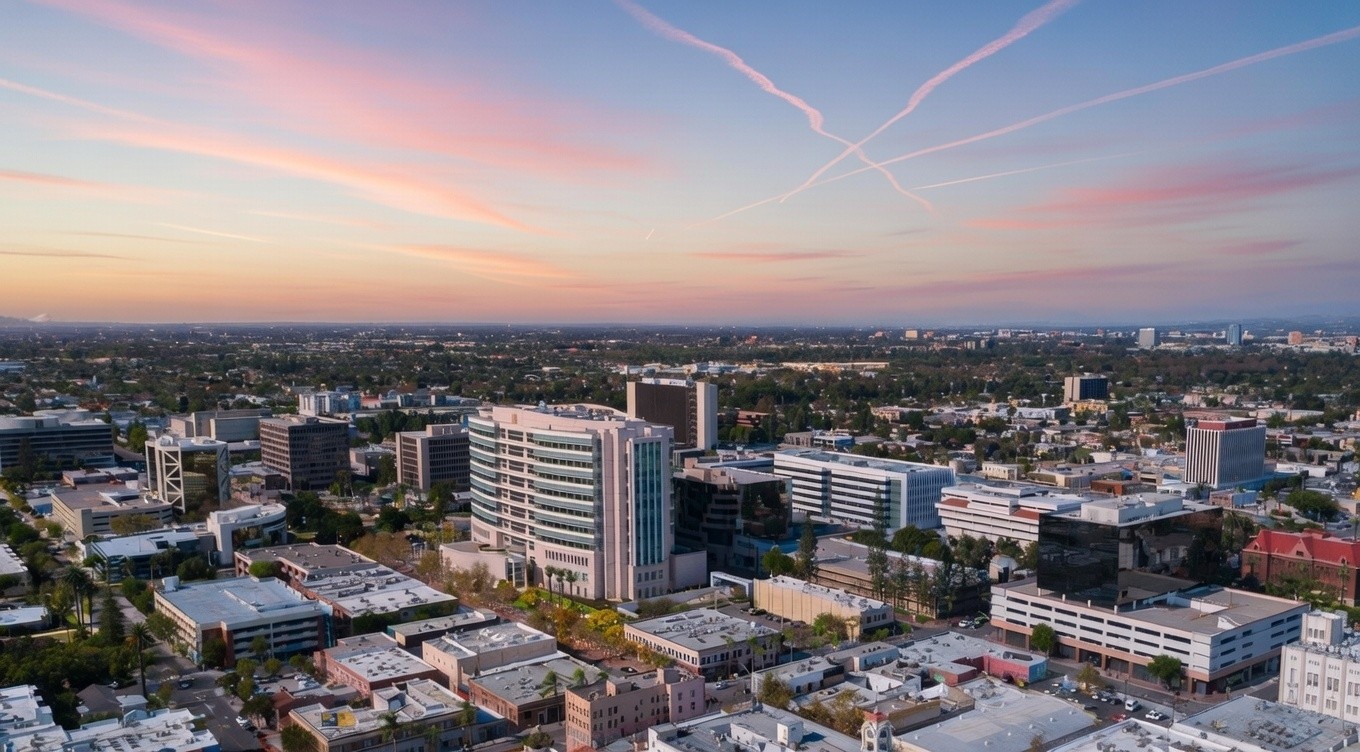
It was study that first brought Marshallese families to Orange County: students who crossed to a local college in the 1960s stayed on, the beginning of one of the older mainland communities. Their descendants clustered toward the coastal cities from the 1970s onward. However, the offices deciding immigration and welfare matters kept to the county seat. City and county buildings occupy a handful of blocks at the Civic Center, one of the larger government campuses in California.
What a family brings back to those blocks is paperwork, the residence file and the school enrollment. Removal and status hearings for the region go forward in the federal building at the western edge of that ground. Because filing lists and fee schedules change with statute, we keep the current checklist on our cross-border and diaspora legal matters page.
Local clinics, plain and monolingual, issue their instructions in English. Huri prepares the patient-facing translation in Marshallese and Chuukese, from intake questionnaires to discharge notes. Across the metro the three California hubs divide the load by subject matter: our Anaheim team takes the resort and convention traffic, our San Diego team the Marshallese population of the bay. Santa Ana holds the courtroom transcript and the clinic notice.
Micronesian Linguistic Matrix for Santa Ana Hub

Huri Translations
Tel. +689 89 205 483
[email protected]
PO BOX 365 Maharepa
98728 Mo'orea
French Polynesia
N°TAHITI 876649


Social