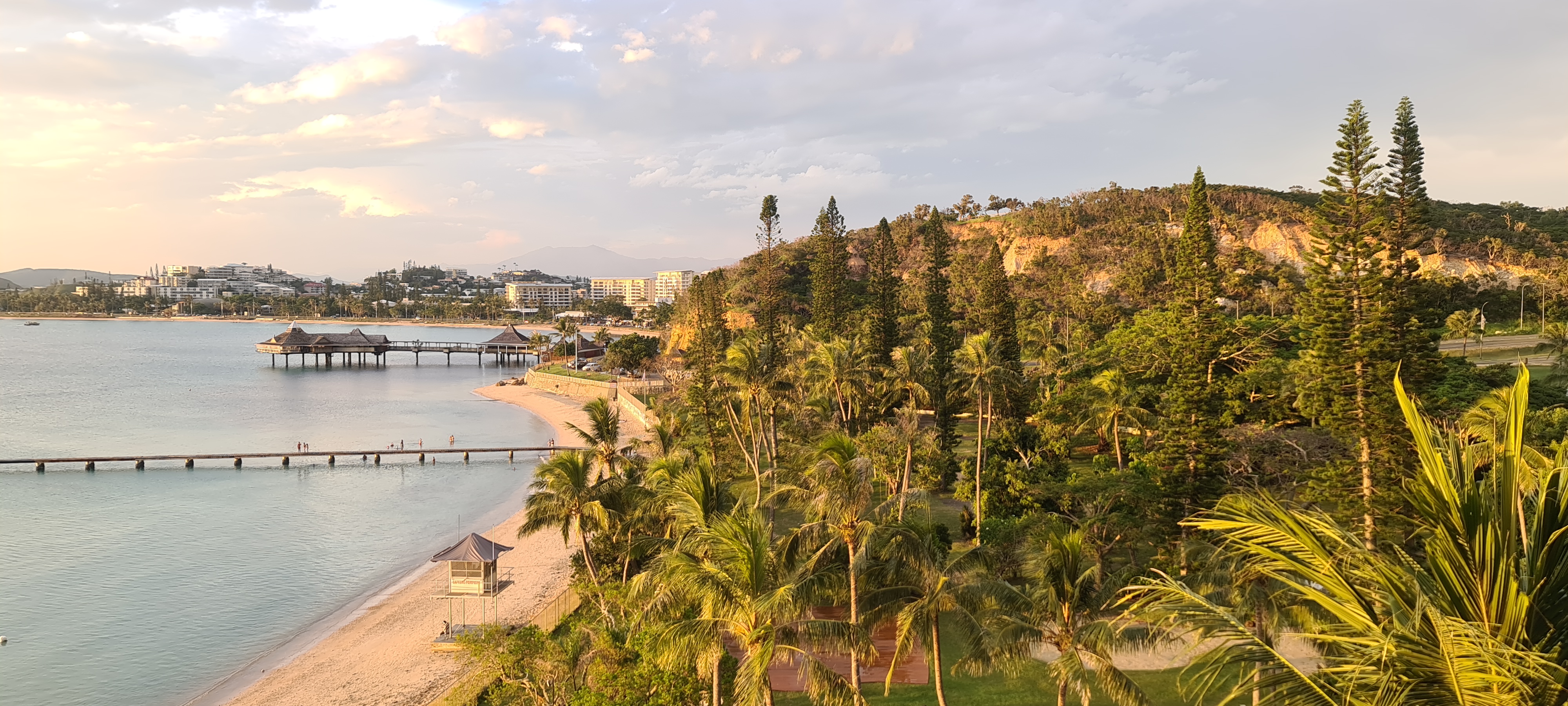
The Name the Town Took in 1866
For its first twelve years the town answered to Port-de-France. Duplication with Fort-de-France in Martinique forced the change. On 2 June 1866 it took the name Nouméa, a French spelling of the Kanak toponym already attached to the headland. The Oceanian form has outlived the colonial one by a century and a half.
Kanak residence was then prohibited under the Indigénat code from 1887 until 1946. Three generations grew up shut out of the port city built on their own ground. What survived that exclusion was the naming. Bays and creeks still answer to pre-colonial words. Beneath the streets, the customary chieftaincies of the South kept their own designations for the soil.
The Académie des langues kanak, a public establishment created in 2007 under the Nouméa Accord, fixes written norms for those words. Its academicians proceed one linguistic area at a time, matching graphemes to phonemes. The founding deliberation of 17 January 2007 gives them the mandate. Huri follows the resulting orthographies whenever a Kanak toponym enters a French or English document, which puts our house at the applied end of language revitalisation.
The Ducos Peninsula and the Southern Road
The nickel boom of the 1960s drew labour out of Wallis and Futuna. Those numbers never returned to the home islands. More Wallisians and Futunans live in New Caledonia today than in their archipelago of origin. Families took up Ducos and Montravel at the outset, then spread south through Rivière-Salée towards Mont-Dore. After two generations, the Uvean and Futunan parishes of the north-west districts are still conducting services in the two Polynesian languages.
Fifteen kilometres down that road lies Saint-Louis, a Marist mission founded in 1860. Its community language is Tayo, the only documented French-lexified creole in the Pacific. The mission drew converts out of the Drubea and Xârâcùù areas, but one shared vernacular emerged from the mixture. Children have spoken it in the village for four generations. Speakers number perhaps three thousand, according to the descriptive literature.
Across these districts, families keep either Faka-ʻuvea or Fakafutuna at the kitchen table and French at the counter. Huri translates in either direction for them, through Wallisian translation and Futunan translation. School reports, tenancy papers and employer correspondence make up the bulk of that traffic.
What Jean-Marie Tjibaou Left in Nouméa
Ordained at Hienghène in 1965 and posted to the cathedral in Nouméa, Jean-Marie Tjibaou spent the following decade between ethnology at the École pratique des hautes études and the cultural politics of Nouméa. He gave up the priesthood in 1972 and built Mélanésia 2000 three years afterwards. The festival lasted five days of September 1975 and drew some fifty thousand spectators. Mélanésia 2000 gave the tribes a city stage, the ground beneath our traditional arts practice.
He negotiated in French, led the FLNKS from 1984 and signed the Matignon accords of 1988, which set a ten-year transition and a deferred vote on independence. A fellow independence militant opposed to those accords killed him at Ouvéa the following May. His speeches and interviews were collected into print soon afterwards. That volume is a primary source on decolonisation and self-determination in the territory.
His life from Tiendanite to Ouvéa ends in 1989, yet Nouméa keeps the surname on its northern skyline. The cultural centre on the Tina peninsula bears a Pije title as well: Ngan Jila denotes the house of riches. Transcribing recorded testimony in Kanak languages is part of that inheritance, and so is the form a customary title takes once it enters publication.
Two Roadsteads and a Compulsory Pilotage Zone
Two roadsteads divide the port. Ore and hydrocarbons transit the grande rade on the north-west shore, along the bays of Numbo and the Dames. Passenger ships and the pilot berths occupy the petite rade below the town centre, beside the maritime station of 1973, today a museum. The establishment governing the whole of it dates from the end of the 1960s, its charter drafted in the middle of the ore rush. Its jurisdiction spans more than a thousand hectares. The port authority publishes a draught limit of 10.5 metres.
The regulation makes pilotage compulsory across the entire New Caledonian lagoon. A pilot must go aboard an arriving foreign ship ahead of any other authority. He takes his oath in front of the Nouméa court. Berth limits and passage plans exist in French only, which is the raw material of charting and pilotage.
Almost all imported goods in the archipelago cross these quays. Air freight does not take up the slack: the airport handles only a fraction of the tonnage. Nickel ore departs the other way, under the safety instructions and consultation records of occupational safety documentation. Crew paperwork and port instructions in two languages are our contribution to it.
The Cable Shore at Ouémo and Nouville
It was 2008 that ended the satellite era for the territory. To reduce a delay of nearly 700 milliseconds, the postal and telecommunications office brought Gondwana-1 ashore on the Ouémo peninsula that September and continued 2,151 kilometres to Narrabeen beach north of Sydney. Latency became negligible.
A second cable leaves Nouville for the international station at Suva. The domestic Picot loop ties the Loyalty Islands into the system, with branches at Lifou and Ouvéa. However, no such system survives on engineering alone: access permits and maintenance schedules cross French and English on all of them, the paperwork behind subsea cable systems.
Huri drafts the technical documentation and the regulatory correspondence around a shore station, from permit dossiers to the bilingual notices issued to fishing crews ahead of a repair vessel sailing. Who receives such notice is set out in the access permit itself, clause by clause, in the two official languages of the consortium.
The Regional Secretariat at Anse Vata
Since 1949 the Pacific Community has kept its headquarters at Anse Vata, in a building abandoned by the American South Pacific command at the close of the war. The organisation itself was founded two years earlier under the Canberra Agreement, first of the regional bodies. English and French have had equal footing there from the beginning.
The Nouméa campus houses the fisheries and public health divisions. Its specimen bank of frozen tuna is inside the laboratory block, kept for institutions abroad. Science produced on that shoreline goes out to the island countries and territories of the membership in two languages, which is fisheries management and research dissemination at once. A statistics division compiles census series for members whose national offices are small.
That a technical report exists twice follows from the bilingual constitution. Huri translates the other version for consultants and delegations orbiting the campus, down to session papers circulated on the eve of a plenary. The English draft goes out first, and the French, a fortnight later.
Reef Laboratories and the Listed Lagoon
One research centre on the Nouméa shoreline predates the ore economy by two decades. Opened in 1946 as the Institut Français d’Océanie, it continues from that stretch of coast for the Institut de recherche pour le développement. There is a research vessel attached to the institute. Its campaigns feed a series of coastal measurements begun in the 1950s.
Under study is the lagoon inscribed on the World Heritage List in 2008, a serial property of six marine clusters, the southern of them stretching from Nouméa towards the Isle of Pines. The reef laboratory subjects live coral to controlled heat stress and acidification. Reef hydrodynamics and terrigenous outflow from the mines are examined together, joining ocean science to oceanography.
When a state-of-conservation report goes to the committee, its French and English versions leave together. Huri translates that traffic, along with the monitoring protocols behind it. To keep one terminology across the pair matters more than speed: a bleaching index renamed midway through a series destroys the comparison.
Papers Crossing Between Matā ʻUtu and the Capital
Until 1961 Wallis and Futuna was administered from Nouméa. Separation ended the administrative tie, but it became evident afterwards that the judicial one would survive. Appeals from the territory’s tribunal are still heard in the Caledonian capital. The islands return a deputy and a senator to the French parliament, campaigns conducted throughout in two languages.
Civil-status documents and pension entitlements cross that water in either direction, alongside the employment files of a population resident here since the ore rush. The spelling of personal names and customary titles out of Faka-ʻuvea or Fakafutuna into French is the recurring task, a job set out under French Pacific civil service postings.
What a given file must contain changes from one revision to the next. The obligation to be legible in two languages does not. Apostille and legalisation steps differ by issuing authority. Those documents originate with the territory, never with us. Huri translates them. Our notarial documentation page tracks the version in force.
Caledonian Linguistic Matrix for Nouméa Hub

Huri Translations
Tel. +689 89 205 483
[email protected]
PO BOX 365 Maharepa
98728 Mo'orea
French Polynesia
N°TAHITI 876649


Social