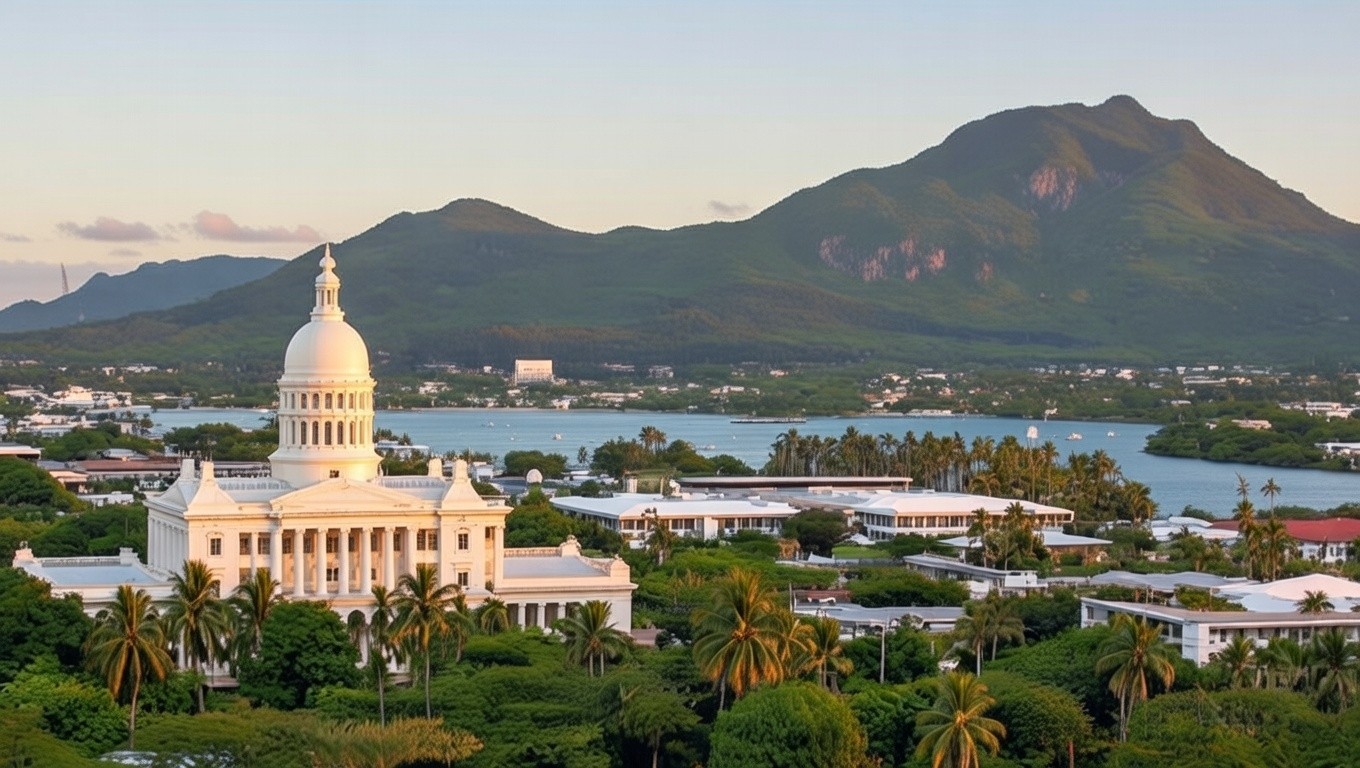
Palikir Inside Sokehs Municipality
Six miles west of Kolonia, Palikir occupies a foothill basin inside Sokehs, one of the five paramount chiefdoms of Pohnpei. In 1989 the capitol went up there, the federal offices leaving Kolonia to the commercial trade and the harbor. Anyone drafting for the ministries therefore addresses two audiences at once: the officials in the basin and the Sokehs families in the valley below.
Nine buildings make up the capitol grounds in two clusters. The congress is in the northern one. The district does not support a business quarter. That function stays with Kolonia, as the settlement record for Palikir shows.
For chiefs and their houses, Pohnpeian keeps an honorific speech whose use narrows or widens with seniority. Our Pohnpeian translators hold those forms on the page rather than flattening them into plain address, since a circular sent to Sokehs in level wording insults the rank it means to acknowledge. Gazette entries and congressional summaries pick up that check inside our government texts lane.
Soumadau en Sokehs and the Rising of 1910
Soumadau en Sokehs, a chiefly title glossed as master of the ocean, belonged in 1910 to a lesser chief named Samuel. Against the German ground reforms and the fifteen days of annual road labor imposed in place of tax, he brought the Sokehs out in October of that year, killing the district commissioner Gustav Boeder and besieging Kolonia. The Germans imported Melanesian soldiers to hunt the rebels down. Outnumbered and shelled from the sea, the Sokehs kept their mountain refuge four months. It was Lepen Palikir, highest chief of the Palikir division, who gave the rising its one ally among the other chiefdoms.
A German firing squad executed fifteen men at Komwonlaid in Kolonia on 24 February 1911. Survivors went into exile in the phosphate camps of Palau and Yap. Only in 1927 did the Japanese administration complete their return. In the late 1980s the federation named Soumadau a national hero and fixed 24 February as a holiday, which is why our decolonization and self-determination material glosses chiefly titles beside the plain name, and why Yapese testimony of the exile arrives in its own vocabulary. The mass grave entry kept by the Pohnpei State Historic Preservation Office dates the burial to that morning, a trail our court interpretation and judicial transcription teams follow when a colonial proceeding comes back into Pohnpeian.
The National College in the Palikir Foothills
Public Law 7-79, enacted by the Seventh Congress in 1992, made the College of Micronesia a public corporation with regents of its own. Its national campus has taught at Palikir since 1 April 1993. State branches in Chuuk and Kosrae answer to that charter.
Seventy-three acres of foothill above the highway make up the campus. Entering classes bring eight Micronesian languages between them, with English as the medium of instruction. Of the four states, Chuuk counts the largest population.
Handbooks meant for its students go to a Chuukese reviewer, never to a Pohnpeian one, since the two languages share no mutual intelligibility. It takes a Kosraean linguist to catch such drift in a Kosraean handout. For that reason, course catalogs and accreditation self-studies belong with our academic institutions files. The campus also administers the Fisheries and Maritime Institute in Yap, the seafarer school of the federation, the national campus profile setting out that arrangement.
Fiber Ashore at Pohnpei
Ninety-five million dollars in grant money paid for the East Micronesia Cable System, a 2,250 kilometer trunk from Tarawa to Pohnpei. Three governments funded it: Australia through its Pacific infrastructure facility, with Japan and the United States alongside. Joining the older HANTRU-1 line to Guam at the Pohnpei terminus, it did close a gap of decades. Neither Nauru nor the state of Kosrae had a fiber connection until it arrived. FSM Telecommunications Cable Corporation owns the federal share.
Fiber changes the language question at Palikir. Ministries once mailed their print jobs north to Guam. However, they are publishing Pohnpeian and Chuukese versions of one notice online today. The burden falls instead on character encoding and screen layout. For the shore plant, our subsea cable systems practice handles the terminology. Our Micronesian hubs at Majuro and Tarawa ride those two systems, Majuro on the HANTRU-1 leg and Tarawa at the far head of the trunk. The project record gives the provisioned channel capacity as 100 Gbps per country.
Tuna Licensing From the Federal Zone
The exclusive economic zone of the Federated States of Micronesia spans nearly three million square kilometers. Under the regional vessel day scheme, foreign fleets buy fishing days in it from the authority seated at Palikir. Eight Pacific parties to the Nauru Agreement price that access together. There is no one-language bundle in that trade: the license condition comes in English, and the observer statement, in Chuukese or Pohnpeian.
Because observers write their field notes at sea, any prosecution folder needs an English version with the original phrasing set beside it. While translating one of them, our linguists mark the fish names in the vernacular, since guessing a species term in English weakens the count. The observer hands the reviewer a field book in Chuukese. Alongside our illegal fishing casework, the vernacular column stays with the translation. What the authority signs at the end is a bilingual instrument, the Pohnpeian text placed against the English clause for clause.
Papers for the Compact Move
Under the Compact of Free Association, citizens of the federation may live and study in the United States without a visa. English, the official language, keeps a passport or a birth entry monolingual from the outset. The stratum underneath is another matter: Japanese entries from the years 1914 to 1945, church books written in Pohnpeian by hand.
As a rule, a family assembling a genealogy or a title claim turns up with a bundle in two scripts. The older sheets our Japanese and Pohnpeian linguists take first, since a mission clerk of 1930 likely spelled Sokehs names by ear. Who wrote a name into that book decides how a genealogy resolves today.
To close a claim of that kind takes two scripts and one linguist trained in either. The American end of the move belongs to our Honolulu node. For the checklist itself, our immigration and labour mobility page tracks the detail, amended whenever the rules change.
FSM Linguistic Matrix for Palikir Hub

Huri Translations
Tel. +689 89 205 483
[email protected]
PO BOX 365 Maharepa
98728 Mo'orea
French Polynesia
N°TAHITI 876649


Social