Fiji Hindi Across the Fraser Delta
Although Viti Levu lies nine thousand kilometres from the Strait of Georgia, Indo-Fijian families left its sugar belt in their thousands after the two coups of 1987. The larger share of those who chose Canada arrived in British Columbia and Alberta. Their home language is Fiji Hindi, a plantation koine grown out of the eastern Uttar Pradesh dialects of the girmitiya labourers who disembarked at Levuka in 1879. Huri does keep that variety on its own Fiji Hindi pages, apart from the standard Hindi of northern India. The encyclopaedic article on the Indo-Fijians supplies the wider background.
Surrey and Delta became the principal municipalities of that migration, with Burnaby and Richmond next in line. Though printed in English on a colonial-era template, a Fijian birth record gives the family name in Fiji Hindi or in the iTaukei orthography of the vanua. Relatives here lodge estate and pension claims against archives in Suva, a traffic handled under cross-border and diaspora legal practice. Our reviewers match that spelling against the Fijian source documents and hand back one form for the whole dossier.
William Nahanee and the Coal Harbour Hawaiians
By the 1860s, Hawaiian men recruited out of Honolulu by the Hudson’s Bay Company had made a small village at the foot of present-day Denman Street, called Kanaka Ranch. William Nahanee was born into it, son of Joe Nahanee, a Hawaiian, and of Mary See-em-ia, a Sḵwx̱wú7mesh matriarch and granddaughter of Chief Capilano. He grew up between ʻŌlelo Hawaiʻi and his mother’s Sḵwx̱wú7mesh sníchim. English belonged to the docks. In 1913 the longshoremen of Burrard Inlet elected him president of their local, seven years after Indigenous gangs there had chartered one of their own.
There are two lanes in the West End bearing the names Eihu and See-em-ia, approved by Vancouver council in 2017 and signposted the following year. Descendants of those Coal Harbour families remain in the Squamish Nation. On the North Shore the surname Nahanee is still in daily use. They have asked to be known as Hawaiians rather than Kanakas, because the older word turned pejorative in Australian usage. The encyclopaedic summary of Pacific Island workers traces the migration itself. Union rolls and church books of the period mix Hawaiian spellings with Sḵwx̱wú7mesh ones. Our heritage-records practice takes such files up alongside seafarer and crew mobility and language revitalisation: the ʻokina and the Sḵwx̱wú7mesh orthography survive the transfer.
Deep-Water Berths on Burrard Inlet
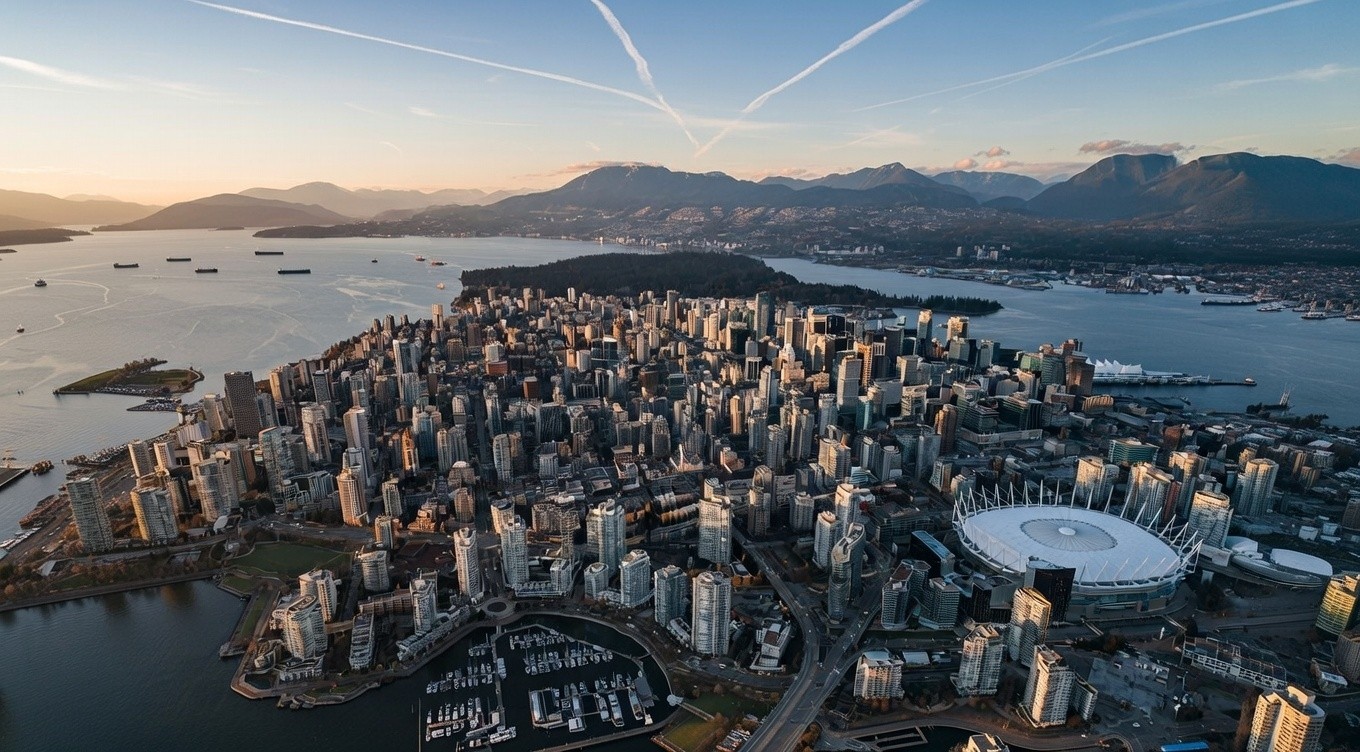
Under the Canada Marine Act, a federal body exercises stewardship over the foreshore and water lots along Burrard Inlet and the Fraser River. Those waters abut sixteen municipalities and intersects the traditional territories and treaty areas of more than thirty-five Coast Salish First Nations, as the port authority’s own statement of jurisdiction makes plain. The terminals on that shoreline load bulk and container cargo bound for the western Pacific. The vessels calling there continue south into Puget Sound, which puts one ship under two port-state regimes. Our Seattle node takes the American leg of the circuit.
Discharging a bulk consignment at one of those berths obliges the shipper to produce a bill of lading and a cargo manifest in English. The document chain behind that obligation is treated in our maritime operations material. Ratings on those ships are Fijian and i-Kiribati, engaged through manning offices in Suva and Tarawa. Port-state inspectors question them in English, the muster list seldom drawn up in Fijian or Gilbertese.
It falls to the vessel’s master to prove that safety notices went out in the crew’s own language. Tok Pisin and Solomon Islands Pijin are the languages of Melanesian ratings on trans-Pacific voyages. Wage remittance and shore-leave clauses inside the maritime labour instruments decide the rating’s entitlement. Those provisions are set out at length under crew welfare and labour at sea. Huri produces the notices in that tongue and returns the English original alongside for the master’s file.
Porphyry Research on Main Mall
Founded in 1989 within the Department of Earth, Ocean and Atmospheric Sciences, the Mineral Deposit Research Unit is an industry-funded consortium on the Main Mall at the University of British Columbia. It specializes in porphyry copper systems and gold deposits, with newer programs in geometallurgy and the mineralization of tailings. Membership is drawn from the exploration houses of the downtown financial district, an arrangement older than most of the orebodies under study.
Porphyry copper is the deposit class beneath Namosi in Viti Levu and beneath Ok Tedi in Papua New Guinea. Geologists wrote the vocabulary of alteration haloes and vein stages twice over. The first was English, and the second, Tok Pisin, fixed at the pit rim by their national counterparts. Glossary building of this kind, one agreed term matched to one geological fact, is described in our technical terminology development entry, together with the environmental impact and compliance chapter. The Bougainville mine at Panguna has been shut since 1989.
It is the consultation package, more than the assay report, that changes language on a Melanesian project. The unit’s published papers explain the geology behind that vocabulary. Under free, prior and informed consent, a proponent must issue its proposal in the speech of the customary owners. A translated summary does not discharge the obligation. The owners sign only the vernacular text. In Papua New Guinea the operative version is the Tok Pisin one.
The Oceanic Collection on Point Grey
To rebuild the Great Hall on seismic base isolators cost the Museum of Anthropology eighteen months and a closure lasting until June 2024. Arthur Erickson designed the building in 1976 on the unceded territory of the Musqueam, whose representatives joined the planning meetings for the upgrade. The museum’s own catalogue lists the country’s principal Oceanic collection beside the Northwest Coast carvings. Sea of Islands, a volume assembled with knowledge holders from across Oceania, tells the object histories in the words of descendants.
What a catalogue line needs is the community’s own term for the object. A Fijian tanoa and a masi barkcloth answer to names in Na Vosa Vaka-Viti. Repatriation correspondence and loan agreements between a museum and an overseas ministry belong in the cultural and intellectual property section. Huri translates those agreements Fijian first and English second, on the instruction of the source community.
Melanesian Linguistic Matrix for Vancouver Hub

Huri Translations
Tel. +689 89 205 483
[email protected]
PO BOX 365 Maharepa
98728 Mo'orea
French Polynesia
N°TAHITI 876649


Social