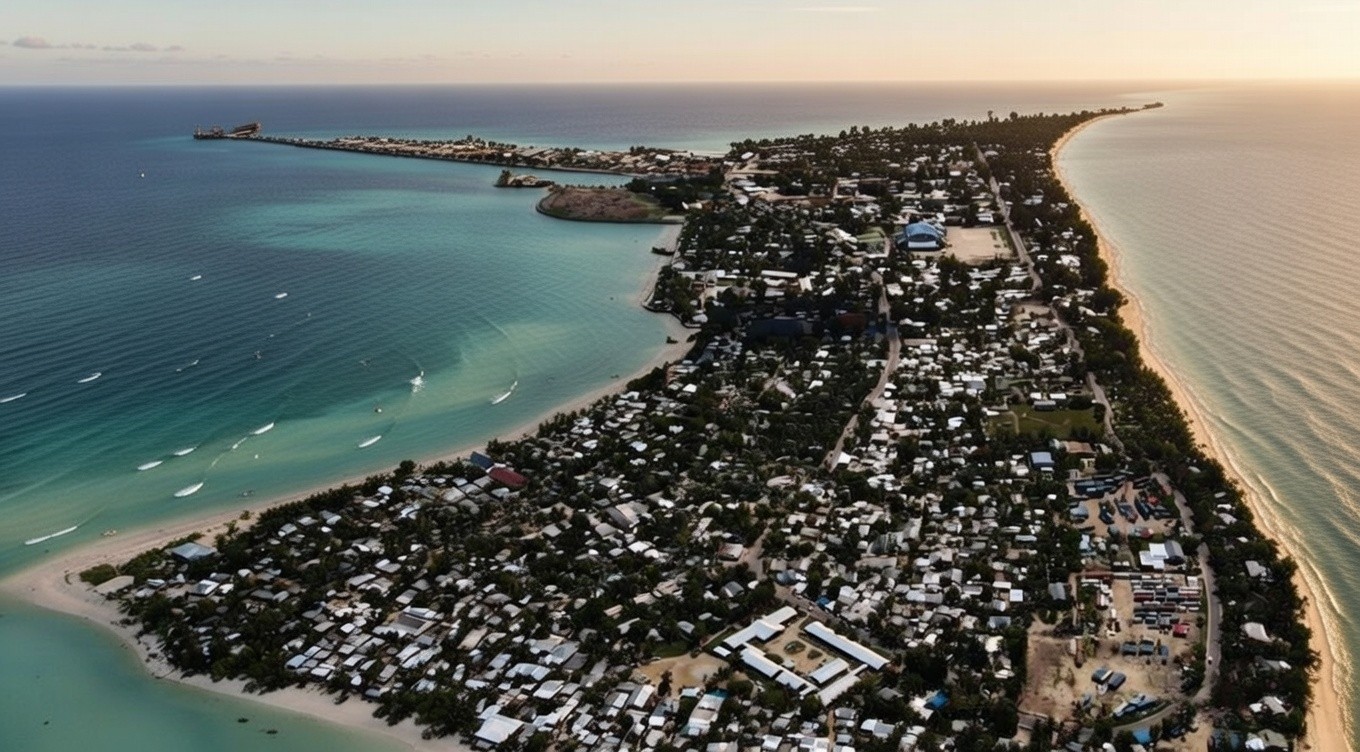
Betio to Tanaea Along the Causeway Chain
Along one road between Betio in the west and Tanaea in the north-east, the urban chain of Tarawa atoll makes a continuous strip of habitation on the southern rim of the lagoon. Causeways joined the islets over several decades. The Japanese Causeway of the 1980s finally tied Betio to Bairiki. No point on the strip lies more than a few metres above the tide. Official duties divide along that strip: the ministries are based at Bairiki, while the Maneaba ni Maungatabu assembles at Ambo.
It is Betio that answers for the oldest administrative history on the atoll, having been the colonial headquarters until the Japanese occupation of 1941 and having governed itself through a separate town council since 1972. Bairiki and Bikenibeu grew afterwards into the ministerial and clinical centres of the Teinainano district. Our translators put council circulars into Taetae ni Kiribati, an obligation detailed in our government notices entry.
North Tarawa lives at another rhythm on the far side of the lagoon, because boats and tidal crossings join its villages instead of a road. Families own plots at Buota and Abaokoro while earning wages in the capital. Clerks in two authorities then write one body of kin terminology and property descriptions into separate paperwork. A spelling accepted at Bikenibeu can differ from the Abaokoro version. Our translators keep only one spelling of those names across the pair.
Reuben Uatioa and the Language of Self-Government
In 1967 Reuben Kiraua Uatioa won the seat for Urban Tarawa and became the first Chief Elected Member of the Gilbert and Ellice Islands colony, a Gilbertese speaker trained as a radio operator in the Phoenix Islands and enlisted in the Fiji naval reserve during the war. He argued for self-government in Taetae ni Kiribati at the maneaba and in English at the council table. Our Gilbertese translation pages and our Taetae ni Kiribati localisation material address the two halves of that split.
There was no separation in his career between the technical trades and the political ones. His first employment was radio operation in the Phoenix Islands and weather observation for the colony. Those two trades still supply vocabulary to our telecoms terminology and our weather and oceanography glossaries. By 1974 he was Speaker of the House of Representatives, the officer answerable for the bilingual transcript of debate behind our legislative drafting.
Uatioa did not live to see independence in 1979, dying at South Tarawa two years earlier. His reputation was contested in his lifetime, since the seamen’s union treated him as too close to the administration and Ellice Islanders judged him unwilling to share power after independence. The encyclopaedia article on Uatioa gives that dispute in more detail. Gilbertese and English versions of the debates from his years survive in parallel. Our archival translation handles that paired public record, a bilingual Hansard already half a century old.
The Maneaba and the Inherited Boti
Raised on coral slabs and thatched with pandanus, the maneaba is the largest structure in a Kiribati village and the site of its decisions. Kin groups hold an inherited sitting position along its sides, the boti, with the unimwane speaking from those seats in an order fixed by descent rather than by election. The national legislature borrowed the institution’s title, calling itself the Maneaba ni Maungatabu. Its house at Ambo takes the shape of a village maneaba.
What a translator faces first in customary papers is the vocabulary of kinship and ground tenure. Te aba means the soil and the people on it at once, while a boti is no chair and no title in the English sense. That difference does matter once a ground claim enters court. Our cultural and intellectual property section and our customary law and statutory integration notes treat those terms once they appear in a statutory file.
Henry Evans Maude published his study of the Gilbertese boti in 1963 and his description of the maneaba in 1980, with the Institute of Pacific Studies issuing the later volume. Those two books remain the reference for clan naming in translation. A courtroom in Betio still hears descent argued in their wording. Kiribati judges turn on those clan terms in a disputed ground title. The encyclopaedia record of the maneaba gives the shorter account.
Betio Wharf and the Marine Training Centre
Because Kiribati has no overland freight, the wharf at Betio takes the whole import trade of the Gilbert group. Copra leaves by those berths, while the fishing fleet provisions there. Rice and building steel come ashore at Betio because no quay of that size exists elsewhere in the archipelago. Purse seiners transhipping inside Tarawa lagoon fly Chinese and Korean flags. Their licence conditions and catch papers arrive in Simplified Chinese. Customs declarations and bills of lading cross the counter in English, though the dockhands behind them speak Taetae ni Kiribati.
It has been Kiribati’s practice since 1967 to train merchant seamen at the Marine Training Centre in Betio, which prepares ratings for deck and engine positions on foreign ships. Wages sent home from those ships are among the largest private earnings in the country. The centre entered the White List under the Maritime Labour Convention, the only Pacific school to do so. Its trainees crew German merchant lines through South Pacific Marine Services. Contracts and medical forms follow the trainee out of Betio. Our seafarer and crew mobility chapter treats those documents in full.
The Marine Division administers the flag-state function for Kiribati ships, with small-craft applications handled at Betio. An inspector under port state control speaks English while the deck hand answers in Gilbertese, a gap addressed in our merchant crew welfare terms. A fisheries observer joins the purse seiner for the whole trip under the regional rule, though Mandarin is the language of the wheelhouse around him. Our Mandarin voice recording supplies those safety announcements. Seafarer files from the wider region also come through our node at Majuro.
Bonriki and the Domestic Air Network
Flying links most of Kiribati to its capital, since no road joins one atoll to the next. United States Navy Seabees cut the runway at Bonriki in 1943. Civil traffic took it over two years later. At 2,011 metres it accepts the international services from Nadi and Nauru. Air Kiribati bases its fleet at that field.
The airline flies to twenty atolls spread across roughly 3.5 million square kilometres of ocean. Freight for the Line Islands crosses two time zones inside one country. Safety placards and cargo manifests must appear in Taetae ni Kiribati for the loaders and consignees on the outer islands. Our cargo freight and dangerous goods sequence sets that wording.
To arrange a medical evacuation from an outer atoll takes plain instructions in the language of the patient’s family. Air Kiribati handles that traffic alongside its scheduled flights. A nurse at the airstrip has minutes to talk the relatives through a consent sheet. Our translators draft that sheet and the flight advisories used at Bonriki.
Desalination at Betio and McKenzie
The freshwater lens under Bonriki being thin and easily fouled by seawater, Kiribati built two reverse-osmosis plants on South Tarawa, at Betio and at McKenzie. The Green Climate Fund backs the scheme alongside the Asian Development Bank. Reverse osmosis, the forcing of seawater through membranes under pressure, produces the second water source for South Tarawa. Those plants draw seawater off the ocean face and return the brine. Plant manuals and maintenance logs arrive in English from the contractor, while the operators on duty speak Gilbertese.
A solar array on the Bonriki water reserve supplies power to that equipment and feeds the national grid besides. The site is fenced, since the runway and the aquifer share one islet. Connection letters and hygiene leaflets go out to the villages in Taetae ni Kiribati. Our community engagement guidance fixes the standard Gilbertese for a public standpipe and for a metered line.
While drafting a tariff notice for the islets, a translator faces two Gilbertese words for that standpipe. A poor choice costs a family a walk to the wrong pipe. Without that discipline, brine outfall appears three ways in one dossier. Our climate adaptation infrastructure reference keeps one Gilbertese label per component in the manual and in the leaflet.
The Kiribati Campus at Teaoraereke
That the regional university maintains a campus on South Tarawa matters for the written form of Gilbertese. Twelve Pacific governments own the University of the South Pacific, Kiribati among them. Its Kiribati Campus has occupied Teaoraereke since 1978 and gained full status in 2006. Students there submit coursework in English while discussing atoll conditions in Gilbertese at home.
The university’s Institute of Pacific Studies, publishing from Suva, released Kiribati: Aspects of History for independence in 1979 and issued the Gilbertese edition, Taruan Karakin Kiribati, as a separate volume. The institute gave the new republic two editions of one history. I-Kiribati contributors wrote throughout. That pairing set the precedent for our own bilingual publishing. Our research publications annex treats the paired-edition method in detail.
Hardest to translate in that output are the reef and fisheries labels in student research, since Gilbertese sorts a species by habit and season, and Latin, by lineage. A grouper has three Gilbertese names between Butaritari and Arorae, one for the juvenile and one for the spawning adult. Our translators compile the species tables for theses at the campus, with the method set out under academic institutions.
I-Kiribati Linguistic Matrix for Tarawa Hub

Huri Translations
Tel. +689 89 205 483
[email protected]
PO BOX 365 Maharepa
98728 Mo'orea
French Polynesia
N°TAHITI 876649


Social