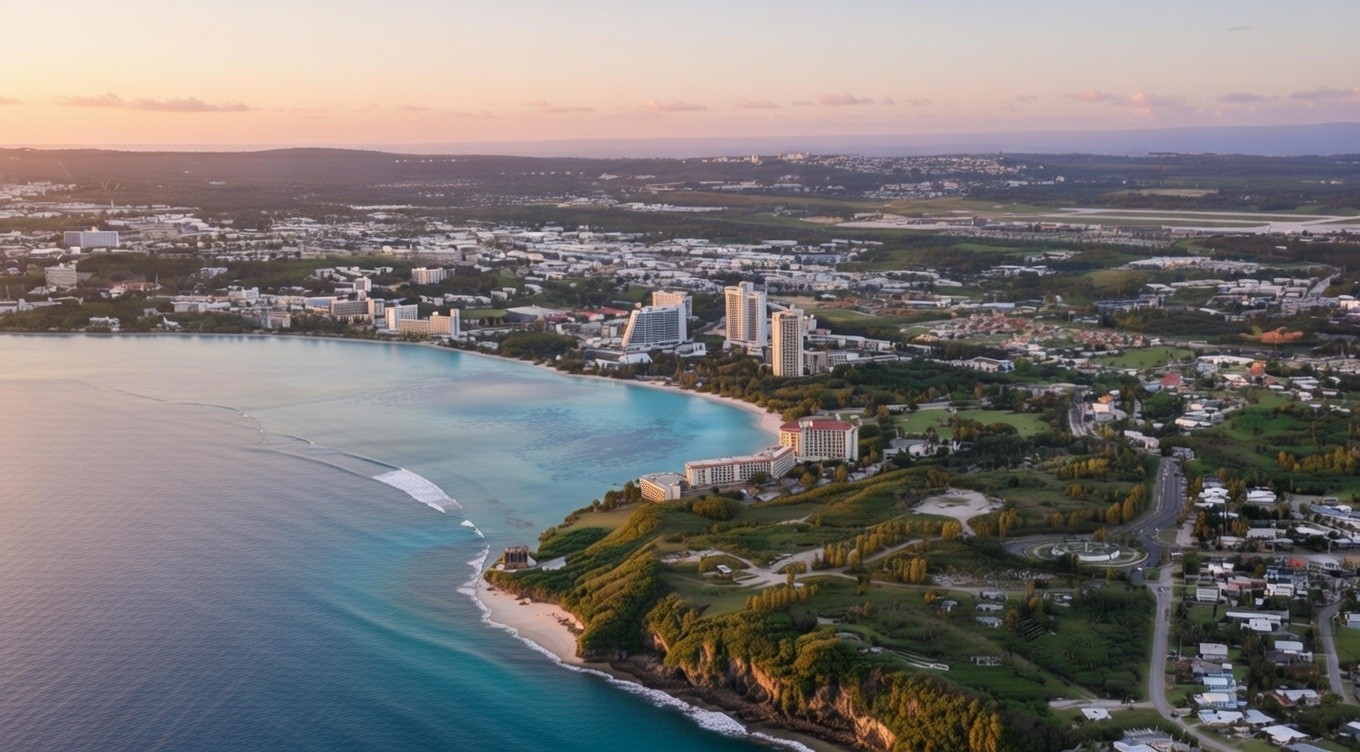
The Hub of Micronesia
As the largest island in Micronesia and a territory open under the Compact of Free Association, Guam draws families from Chuuk and the wider Federated States of Micronesia into its schools and clinics. Their records arrive at the federal counters of Hagåtña, a bilingual capital, a queue widening year by year.
Sustaining Finoʻ CHamoru through this arrival of new languages puts a real weight on land trust applications and preservation files, whose meaning must survive intact in the two official tongues of Guam. Those Austronesian roots place the glottal stops and diacritics of CHamoru outside English spelling logic. Our team makes that structure the first rule of the craft.
The Island’s Working Languages
There is no larger migrant community on Guam than the Filipino population, a quarter of the island’s people and the muscle of its postwar rebuilding. Tagalog fills the wards and worksites of the territory, our linguists turning hospital consent forms and labor contracts into it for families across Guam.
Fastest-growing of these arrivals is the Chuukese community, whose numbers have climbed from a rounding error in 1980 to one islander in fourteen today. Its Chuukese casework crosses the clinics and courts of the capital beside Palauan and Pohnpeian files.
Solutions for Defense and Hospitality
Between the naval wharves of Apra and the runways of Andersen, the United States military funds one of the territory’s largest payrolls in English, the working language its personnel bring from the mainland. Its base orders and family-housing files shuttle between that English and the vernaculars of a Pacific-born workforce.
What draws our engines close to the island’s speech is the tuning of Neural Machine Translation to CHamoru and to the Japanese and Korean of the Tumon hotels. The data behind our projects mirrors the living dialects spoken from Yigo in the north to Merizo in the south.
Hagåtña’s Marine General
A CHamoru teenager pressed into the wartime labor camps, Vicente Tomás Garrido Blaz came out of the Japanese occupation bound for the United States Marine Corps. Three decades in uniform raised him to brigadier general, the first CHamoru officer to earn a general’s rank in the American armed forces. He kept his mother tongue, CHamoru, across a career conducted in the English of the officer corps, then won four terms as Guam’s delegate to Congress, the platform for his push toward commonwealth legislation and the self-determination of the CHamoru people.
Two markings hold his name on Guam’s public map: the Marine Corps base in the north, opened as Camp Blaz, and a Guam highway renamed the Brigadier General Ben Blaz Memorial Highway. A CHamoru name written into official record and military honor asks for legacy and title services of just this order, from citation translation to the CHamoru forms of rank and address. The House of Representatives keeps his congressional biography on its history site, down to the roll-call votes of his four terms.
The Magaʻlåhi of Hagåtña
His authority balanced against the magaʻhåga of his clan, the magaʻlåhi Kepuha led seventeenth-century Hagåtña as elder of its ruling line. He welcomed the 1668 Spanish mission and gave the ground in Hagåtña for Dulce Nombre de Maria, the first Catholic church in the Marianas, a choice still debated today, since his baptism and his gift to the friars came only years ahead of the Spanish-CHamoru Wars. His story feeds the CHamoru localization of cultural memory and the body of customary authority and tenure still upheld in territorial law.
To keep a CHamoru spelling legible in daily memory falls to our name and title records, down to the okina and the å of Magaʻlåhi Kepuha, whose full account is filed with Guampedia.
Linguistic Authority in Hagåtña
It is in the commercial and legal sectors of Guam that our localization gives contracts and filings their footing under American and territorial standards.
Connecting the Marianas
That legal wording can diverge between English statute and CHamoru custom poses the daily challenge for our native linguists, who push the meaning far past a dictionary entry. Under United States sovereignty, the position of Guam binds our filings to federal and territorial statute alike, a discipline upheld by our specialists.
For that reason, the capital’s blend of a military garrison and a civilian population sends its daily federal dealings through interpreters versed in Micronesian languages. Our staff let local ministries and courts address their public in the language a family speaks at home. Across the Pacific Rim, our Hagåtña operation ties into the partner hubs in Manila and Tōkyō, the three sharing one queue.
Pacific Island Linguistic Matrix for the Guam Hub