
The Official Four on Serangoon Road
Malay is the national language of Singapore under the Constitution, a position older than the republic. Schoolchildren sing Majulah Singapura in Malay, including the ones who speak Mandarin or Tamil at home. Mandarin and Tamil share official rank beside English. For a shipping firm on the south coast the consequence is practical: contracts go out in English, while the chandlers and clerks who fill the order answer in Tamil or Malay. Tamil translation and Malay localization follow that division, one for the signed instrument and one for the screen. The screen version ships in Unicode, the signed one on letterhead.
Serangoon Road gathers the Tamil trades, from provision merchants to goldsmiths. Arab Street does as much for Malay, with Geylang Serai further east. Pacific buyers rarely see those addresses. They do see the packing lists and price schedules drafted there, which arrive in Suva in English and go back annotated in the supplier’s own script. The annotated schedule returns to the exporter as a bilingual international trade file, with the Tamil gloss kept in a second column.
While drafting a supply agreement for a Fijian buyer, a linguist has to keep two spellings of one company straight: the Rumi form on the invoice and the Tamil form above the shop door. Field lengths in an accounting system rarely allow for the pair. In practice we deliver the bilingual schedule with a transliteration table attached. An accounts clerk in Lautoka can then match a payment to a supplier without guessing. The transliteration table, produced by a Tamil localization review of the finance system, outlives the agreement itself.
Munshi Abdullah and the Mission Press
Abdullah bin Abdul Kadir, the Melaka-born scribe known as Munshi Abdullah, taught Malay to the Indian soldiers of the garrison and later to the missionaries and merchants of the young port. He grew up with Arabic and Tamil in the house. Malay he studied under the scholars of his birthplace. From 1815 he translated the Gospels for the London Missionary Society, an assignment lasting decades. He arrived in Singapore after 1819 as an interpreter and stayed to teach Malay to a generation of British officials.
It was the mission press here that put his Hikayat Abdullah into circulation in 1849, printed in Jawi and sold commercially. Composed across the early 1840s, the book gave the town its first account of daily life from a local pen. Malay schools kept it as a set text into the 1970s. The colonial surveyor John Turnbull Thomson issued an English version in 1874. Critics have long noted his admiration for British administration. His companion volume on the Kelantan voyage does little to soften the charge.
Munshi Abdullah Avenue keeps his name on the city plan. Jawi manuscripts of his period still come to us for transliteration into Rumi, along with family papers kept by Malay relatives across the Pacific. Historic orthography is no museum question for a translator: the script turns up in title deeds and inheritance claims throughout the Malay archipelago. A wrong vowel changes a surname. Files of that kind belong with our research publication and language revitalization entries. The encyclopedia record for Abdullah bin Abdul Kadir dates the Melaka childhood and the death at Jeddah in 1854.
Tanjong Pagar, the Cape of Stakes
Tanjong Pagar means cape of stakes in Malay. The stakes were kelong, the palisade fish traps built along that shore. Orang Laut, the sea people of the straits, drove them into the seabed and piloted vessels through the channels around them. The cape itself is inland today, under reclaimed ground. Coleman’s town map of 1836 marks a road called Tanjong Passar leading to the fishing village, a probable source of the modern spelling. The Sejarah Melayu tells it differently, crediting a barricade of banana stems against a shoal of garfish. Either telling sets the toponym centuries deep in the Malay seafaring past.
In the 1860s dock companies took the wording. The rail terminus at the foot of the district was for decades the southern end of the Malayan line. Container handling has since gone west, yet the Malay original stays on the financial quarter. Colonial administrations renamed a great deal in this region. This one they left alone. Those deeds, dry and unglamorous, become the evidence in a Pacific cultural and intellectual property claim. Conservation inventories hold the term in daily use.
To keep a toponym intact through a database migration takes equal care in Oceania. Papeʻete puts a comparable test on a typesetter. Strike the okina from a database field and the place is misnamed. Malay spellings ask for that care in Rumi. The h in Johor and the ng in Tanjong stay put through Malay localization of a mapping application or a customs portal. Older records call the promontory Salinter. The encyclopedia entry for Tanjong Pagar lists that older label beside the modern one.
Bunker Fuel Bound for the Islands
Because Pacific utilities generate from imported diesel, the fuel trade between Jurong Island and Oceania is a public-service question. Refineries there load the product. Safety data sheets and cargo manifests follow it out of the anchorage. Customs in French Polynesia ask for those documents in French. A generator in Tonga stops for want of a mistranslated additive specification as surely as for want of diesel. Utility engineers do not separate bunker paperwork from the power systems and grids record. Fiji and Tonga draw base load from that import chain.
It has been the rule since 2020 that sulfur content appear against the 0.50% ceiling under MARPOL Annex VI. Months after a transfer, a chief engineer in Suva may still query a bunker delivery note. The note has to state the grade and the quantity pumped, in figures a port state inspector can verify. Error in a fuel specification stops being a stylistic matter and becomes an engine failure, argued out later in an arbitration bundle. We draft those bundles against the maritime operations terminology.
At the anchorage, crew changes bring I-Kiribati and Tuvaluan seafarers onto ships fueled here. Our Manila hub treats that mobility at length, alongside the seafarer mobility pages. The ship gets English, the family at home Gilbertese. What we supply on this side of the wharf is the fuel file, from bunker analysis to quality disputes. Standards for the discharge itself belong to the International Maritime Organization.
Tuas Takes the Boxes
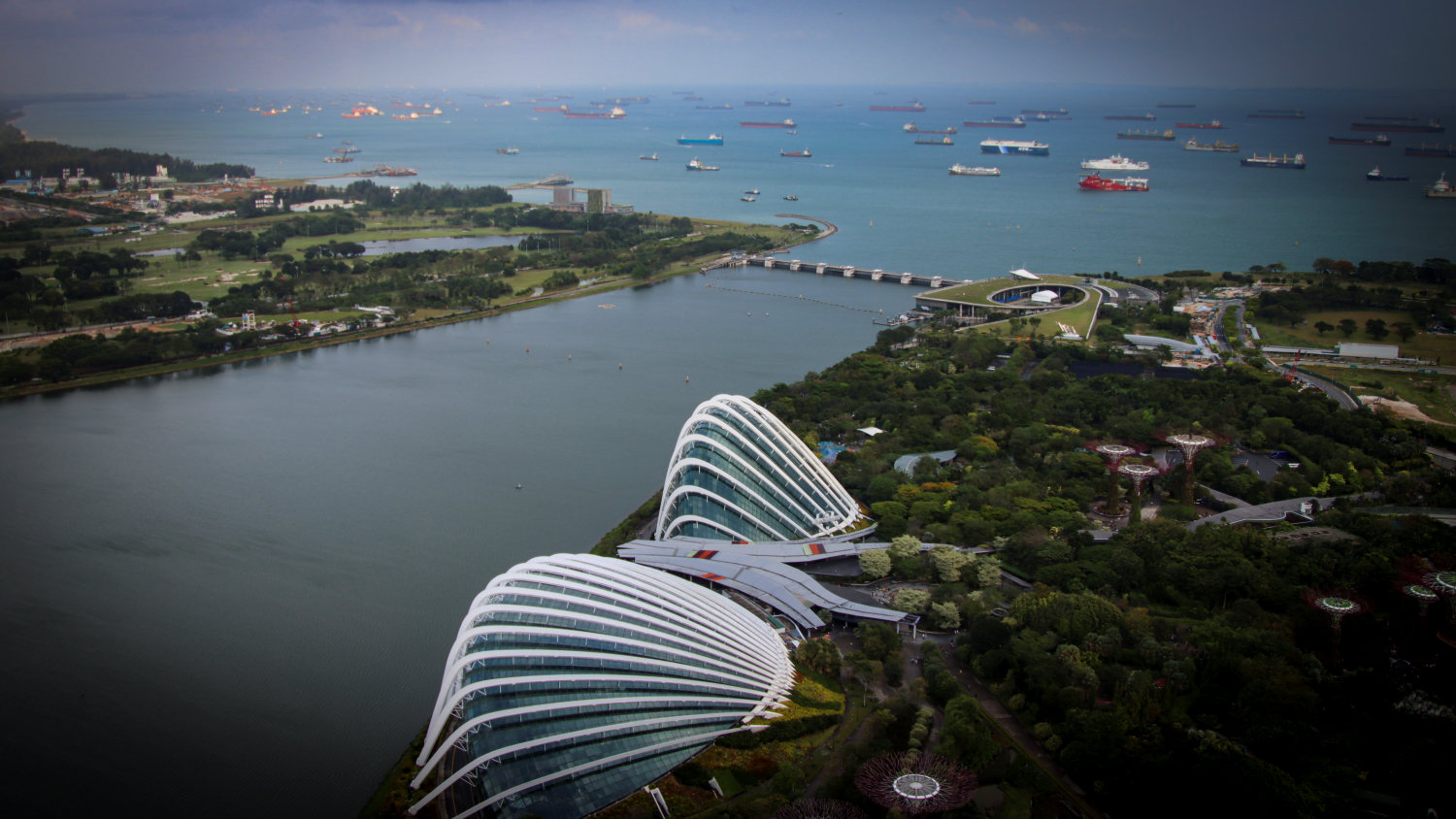
Under the Maritime and Port Authority, reclamation for Tuas Port began in 2015, its opening berths taking boxes from 2022. Four phases will add 66 berths along 26 km of quay, with a planned capacity of 65 million twenty-foot units a year in the 2040s. Driverless carriers and remote cranes do the lifting. A caisson wall of that size has a design life measured in decades.
PSA will relocate handling from Tanjong Pagar and Keppel by 2027, with Pasir Panjang following a decade or more later. For island shippers the change is one of address rather than function. There is a new interface behind the consolidation: berth windows booked through a digital portal, gate instructions on a screen. Meanwhile the manuals are going multilingual, putting Traditional Chinese localization beside technical documentation on one job ticket. Gate staff still take the printed version.
Relayed here from mainline vessels, boxes bound for Port Moresby or Honiara take the last leg on a feeder. A container may change hands three times between the deep-sea ship and the final quay, picking up a slot booking and a demurrage claim along the way. Regional owners draft in Chinese. Buyers in the islands reply in English through a broker. Bid packs prepared for procurement and tenders have to come through the round trip with the figures intact. The port authority of Singapore gives shippers the phasing schedule and the berth counts.
Two Names for One Plant
Documenting tropical flora has been the business of the Singapore Botanic Gardens since 1859. The botanist Henry Ridley devised the herringbone tapping cut there in the 1890s. Rubber stock left the nursery for plantations across the region. UNESCO inscribed the site in 2015, the first tropical botanic garden on the World Heritage List. The listing for the Gardens states that it qualified on two cultural criteria. Its herbarium holds pressed specimens from islands whose forests have since been logged.
Southeast Asian nurseries send ornamental stock into the Pacific through the year. Quarantine services in Apia and Port Vila inspect those consignments on arrival. Import permits and treatment records accompany the shipment, naming the fumigant and the dose applied. A pest given only its Malay label will stop a container at the quarantine gate for a week. Consequently the biosecurity protocols page fixes the reference wording, while this hub supplies the consignment documents in Malay translation.
Labeled twice on a herbarium sheet, a plant appears once in Latin and once in the vernacular of the collector. Tamil and Malay terms for one species diverge from the Fijian equivalent. An extension leaflet written in Suva cannot be dropped onto a Singapore supplier’s catalog unedited. Growers in Sāmoa know the plant by a third term again. Even so, the Latin binomial reconciles them. Glossaries for academic institutions build outward from that index to give a grower one term per plant. The second column keeps the Fijian and Sāmoan wording side by side.
Southeast Asian Linguistic Matrix for Singapore Hub

Huri Translations
Tel. +689 89 205 483
[email protected]
PO BOX 365 Maharepa
98728 Mo'orea
French Polynesia
N°TAHITI 876649


Social


