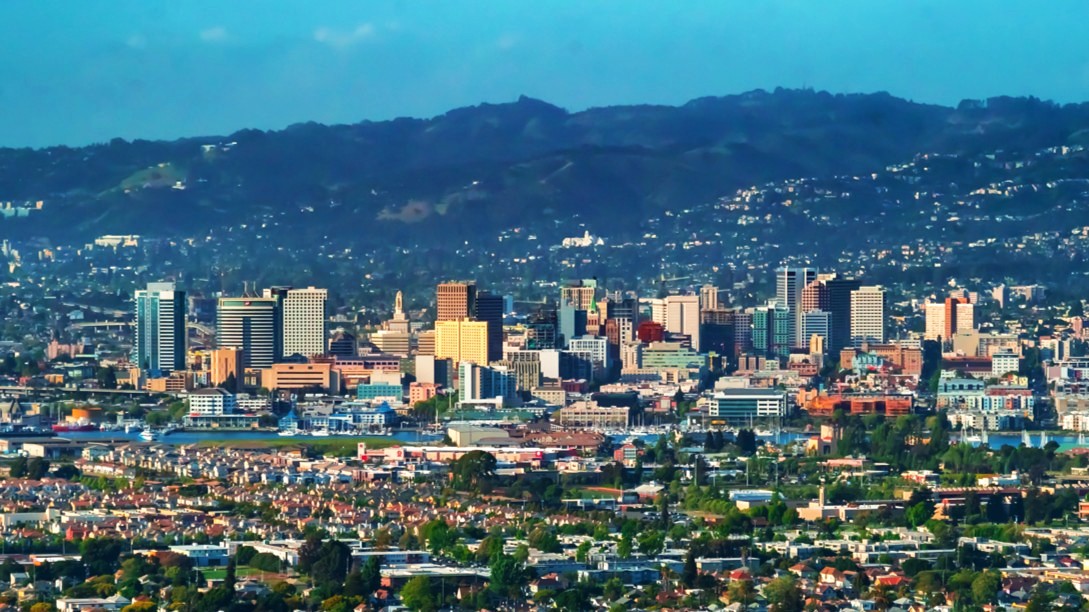
Container Terminals on the Estuary
Along nineteen miles of shoreline, a commission seated in 1927 governs the Oakland waterfront without drawing on the general fund of the city. Dredging had given the town deep water by 1874, five years after the wharf at the foot of Seventh Street became the western terminus of the first transcontinental railroad. Container ships arrived in 1962, to the first marine terminals of their kind on the Pacific Coast. Gantry cranes rose along the berths.
Because a lockout procedure calls one valve dead and another live, crane signalers cannot afford loose phrasing. Gagana Sāmoa and Na Vosa Vaka-Viti belong on the terminal floor beside English, for crews who speak them at home. Merchant crew welfare holds the regulatory chain behind such postings. Glossary discipline answers the risk at our end: waterfront vocabulary agreed once, then reused across revisions.
There is a full account of the container era at the Port of Oakland, written by the commission itself. Huri’s part of the job is narrower. Incident reports and toolbox talks make up the volume, drawing their vocabulary from terminal and vessel procedure. A lashing bar and a bollard get one agreed equivalent apiece.
Elmhurst and Sobrante Park
The Pasefika population of Alameda County thickens south of Fruitvale, through the East Oakland flats and over the municipal boundary into San Leandro. Elmhurst and Sobrante Park keep the congregations and the two languages in ordinary use. Rent decides a block, while distance from the terminals decides the rest.
Across the estuary, our San Francisco node takes the technology and legal half of the metro. What the East Bay sends us is plainer: school notices and tenancy papers in Gagana Sāmoa. A misread notice of that kind can cost a family its housing. Samoan translation therefore handles the flow case by case.
By contrast, Fijian families in the East Bay are fewer and more scattered than their Samoan neighbors. One file arrives in either Na Vosa Vaka-Viti or Fiji Hindi, and sometimes in the two together. Which of the pair applies, the relatives decide, with the versions checked against one another afterwards.
Agaese Tago in the Comptroller’s Office
Agaese Tago, a member of the American Samoa House of Representatives in the mid 1970s and later Treasurer of the territory under Peter Tali Coleman, took the comptroller’s post in Oakland’s administration after a degree from the Harvard Kennedy School. One public servant thus governed a territorial budget and a mainland ledger inside a career. Gagana Sāmoa was his first language, and English, the language of his signed audits. Two of our Oakland domains converge in that biography: public administration and financial services.
No street in Oakland bears his name. The paper did survive him: audited municipal accounts on one side of the ocean, treasury files on the other. His encyclopedia entry gives the bare sequence of offices. Probate and pension claims put that material in front of us decades afterwards, the everyday matter of Samoan document translation.
Chochenyo Names on the East Bay Shore
Under the wharves and the freeway ramps lies Huchiun, the territory of the Chochenyo speaking Ohlone, whose villages lined Temescal Creek and the bay shore. Chochenyo fell silent in the 1930s, its last knowledgeable speaker dead by 1934. Descendants recovered it in this century from a university archive of field notebooks and recordings. The language is returning to ordinary conversation.
Outsiders wrote down most of what survives from Huchiun, in mission baptismal books and in the Spanish record of the Peralta grant, forty thousand acres from San Leandro to Albany. It is no different across the Pacific: the oldest written trace of an island language usually belongs to a missionary’s hand. Transcription into a modern orthography raises the cultural and intellectual property question directly.
Set that sequence beside a Pacific language and the shape repeats: dormancy, then a generation of new speakers out of a linguist’s field notes. It is the archival end of the process that we take, transcription and orthographic standardization of older manuscripts, described in language revitalization. The dates and the sources are in the Chochenyo entry.
The East Span as a Lifeline Structure
Between 2002 and 2013 the California Department of Transportation replaced the eastern span of the Bay Bridge, the section whose upper deck gave way in the Loma Prieta earthquake of 1989. Its replacement opened in September 2013 at a cost near 6.5 billion dollars, hung from one 525 foot steel tower and braced against the strongest earthquake expected at the site in fifteen centuries. Crews took the old cantilever down in pieces until 2018.
Designed as a lifeline structure, the span must hand the two cities food and medicine after a rupture. Island states maintain an identical cycle for earthquakes and tsunami. Their instruction sheets must arrive in the home language. Disaster preparedness material goes out in Gagana Sāmoa and Na Vosa Vaka-Viti, including evacuation notices for the flats.
Oakland has its own reason for the exercise, because the Hayward Fault traces the base of the hills through the eastern half of the city. Alert wording therefore matters as much in Elmhurst as in Nukuʻalofa, which our early warning systems section treats as a drafting problem in its own right.
Vital Records and the Mobility File
Families with relatives in Apia and Suva keep two sets of civil papers. A Samoan birth certificate and a California school transcript rarely agree on the order of names. Neither the need nor the errand disappears, though the checklists change from one government to the next. Current instruments live in seafarer and crew mobility instead of on this page.
In practice, a matai title is part of a name in Sāmoa and a puzzle on a mainland form. Chiefly titles from Fiji, long and inherited, split across the forename and surname fields of an American record. One transliteration per family, applied to the whole file, matches a sibling’s paperwork to a grandmother’s. Legal documentation takes the rest.
We translate only the text. We do not certify or notarize it. The translation accompanies its source document and nothing else. State level filings belong to our Sacramento node, while the island end of the matter returns to Fijian translation.
Pacific Linguistic Matrix for Oakland Hub

Huri Translations
Tel. +689 89 205 483
[email protected]
PO BOX 365 Maharepa
98728 Mo'orea
French Polynesia
N°TAHITI 876649


Social