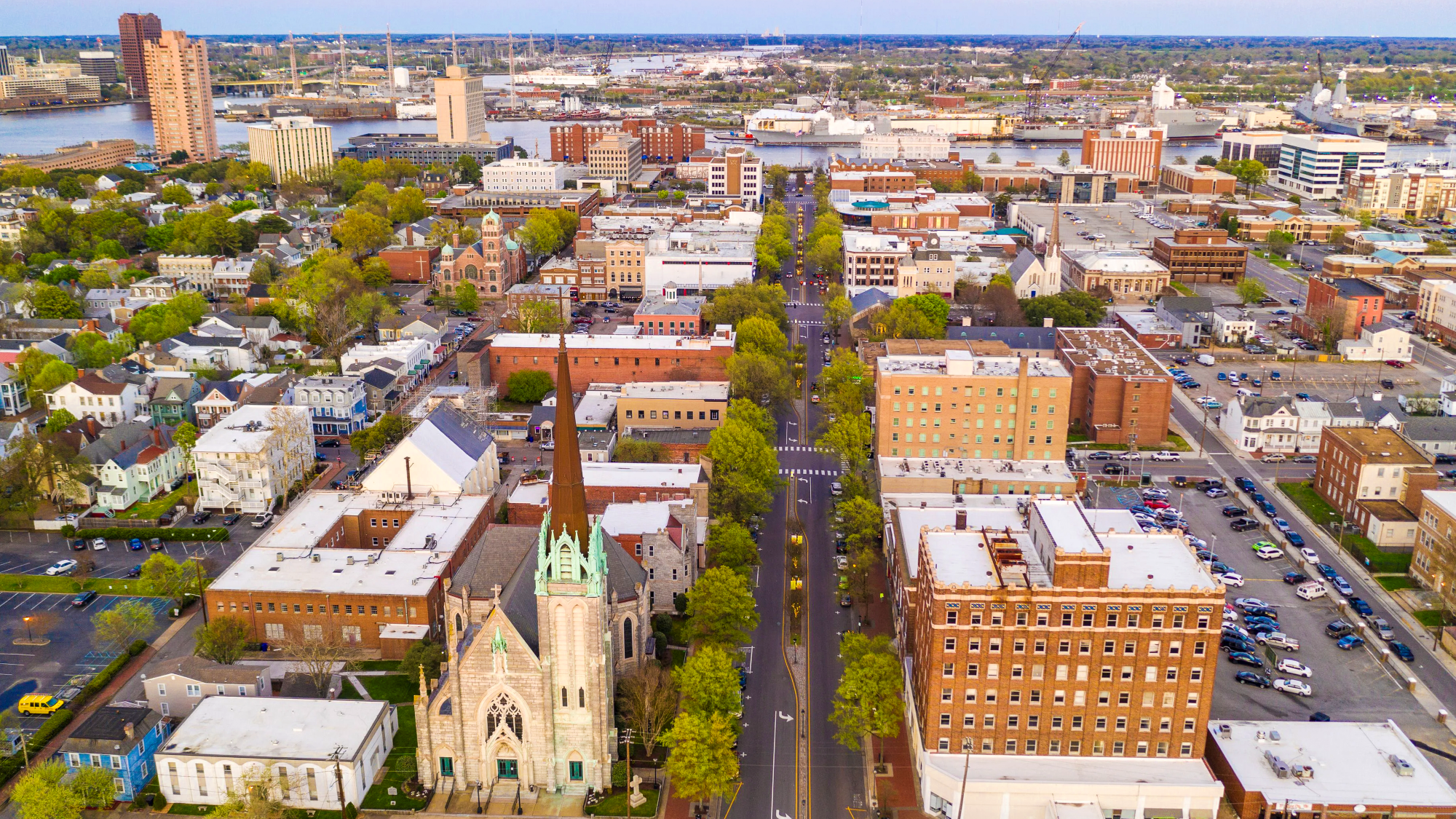
Deep Water at Sewell’s Point
Emptying past Cape Henry, the Chesapeake opens a roadstead deep enough to float anything the Navy builds. Carrier piers and airfields take the northern side. Opposite them lie the Norfolk and Portsmouth terminals of the Port of Virginia. Federal navigation money has deepened and widened the approach channels for larger commercial and naval hulls.
Among the tonnage calling here are ships crewed in part by Pacific Islanders. Their articles of agreement and inspection dossiers arrive in English. What Huri Translations supplies is the Samoan and Tongan counterpart, part of our merchant crew welfare and port state control practice.
Along the river the repair yards issue refit specifications and safety notices in dense technical prose. What a rating signs is a lockout notice or a confined-space entry form. Neither the yard nor the ship’s agent will put those into Gagana Sāmoa. The two documents come to us instead, together with the shipbuilding and refit documentation we handle for Pacific yards. A shipping company then answers its duty of care without a bilingual shipmate pressed into interpreting.
Horatio Hale and the Departure of 1838
On 18 August 1838 six vessels sailed from Hampton Roads under Lieutenant Charles Wilkes, whose conduct on the voyage would bring him to a court martial on his return. Aboard was Horatio Hale, twenty-one years old and lately out of Harvard, rated philologist of the United States Exploring Expedition. He spent four solid years at sea, taking down comparative vocabularies of the Polynesian languages, Samoan and Tongan among them.
Ethnography and Philology, his volume of 1846, went to press first among the scientific reports of the voyage. European and American scholars took it as the founding comparative treatment of Polynesian speech. That the book still underpins research publications is a measure of how little preceded it.
Late in his career Hale turned to a Virginia language rather than a Pacific one. His Tutelo study of 1883 set down a tongue taken north out of the Piedmont by a people already displaced. One career spanning an island record and an exiled one puts the question of cultural and intellectual property plainly. Setting nineteenth-century entries against present-day Samoan and Tongan orthography is slow, specialist labor. That labor Pacific archives and heritage bodies buy from us. A fuller life of him fills his Dictionary of Canadian Biography entry.
An Algonquian Name on the Western Edge
Powhatan Avenue traces the western margin of the peninsula past Lambert’s Point and Larchmont, one of several Algonquian names still fixed to the Norfolk street grid. There has been no speaker of the language behind those names in Virginia since the 1790s. The surviving record holds only two short seventeenth-century vocabularies, the remainder reconstructed from related Algonquian tongues.
Downstream, the Nansemond River and Chesapeake Bay bear two further names out of that family, attached to peoples granted federal recognition in 2018. Recognition rests on documented descent and continuous community, but the filing behind it spans generations.
By contrast, Pacific speech in Hampton Roads occupies another position, still used at home and still written. Macrons and the ʻokina survive intact through the name and title records we prepare for Samoan and Tongan kin groups, one strand of our language revitalization support across the region. To match a mission-school transcript against a modern spelling standard takes archival training, which is why genealogical statements and customary tenure evidence for title and resource claims get the identical editorial handling.
Ocean View, Norview and the Ring of Tunnels
North of the base, the enlisted neighborhoods of Ocean View and Norview absorb much of the fleet’s housing, low against the Chesapeake shore. Tunnels beneath the harbor tie Norfolk to Portsmouth and Hampton, which binds three cities into one hiring pool. Pacific Islander kin therefore spread across several municipalities. One city hall does not govern them.
Specialist medical care concentrates on the Norfolk side of the water, drawing patients from the whole ring. A ward nurse hands the family a discharge sheet in English, and treatment consent forms govern what a patient does after leaving the ward. Those patient-facing materials go out from us in Samoan and Tongan. So do the hospital records a parent files for a posting overseas.
The Floodwall Program and a Subsiding Shore
Two movements converge in Norfolk: the water rises and the ground beneath it sinks. Against them the city has mounted a multi-billion-dollar coastal storm risk management program with the Norfolk District of the Army Corps of Engineers. Miles of floodwall and levee are going up across a decade, tide gates and pump stations behind them.
Atoll communities in the Pacific do this arithmetic on a shorter fuse. Surge barrier and elevation grant belong to a vocabulary crossing two coasts. Residents facing climate adaptation infrastructure consultation get it from us in Samoan and Tongan.
Some property falls outside the wall. For the unprotected margin the program funds home elevation and buyout, instruments familiar from Pacific climate displacement and planned relocation policy. While preparing the notices and acquisition papers for Pacific Islander owners on the low-lying edges of Norfolk, our editors keep the terms legible ahead of a signature.
The Campus Between Two Rivers
Old Dominion University opened in 1930 as the Norfolk Division of the College of William and Mary and went independent in 1962. Its campus lies five miles up from downtown between the Elizabeth and the Lafayette, Powhatan Avenue along one flank. Coastal resilience and maritime modeling dominate much of the research output.
Simulation and port logistics fill another wing of the campus, generating course material for terminal operators and bridge officers. Pacific maritime academies take that material from us under our professional training portfolio.
Findings on subsidence and storm surge bear directly on island populations. Because those reports appear in English, the communities under study cannot use them. It falls to us to produce the Samoan and Tongan versions for the academic institutions behind them, our research dissemination line. The equivalent editions go to the Pacific families around Fort Bragg in Fayetteville and to the naval quarters of San Diego.
Pacific Linguistic Matrix for Norfolk Hub
Huri Translations
Tel. +689 89 205 483
[email protected]
PO BOX 365 Maharepa
98728 Mo'orea
French Polynesia
N°TAHITI 876649


Social