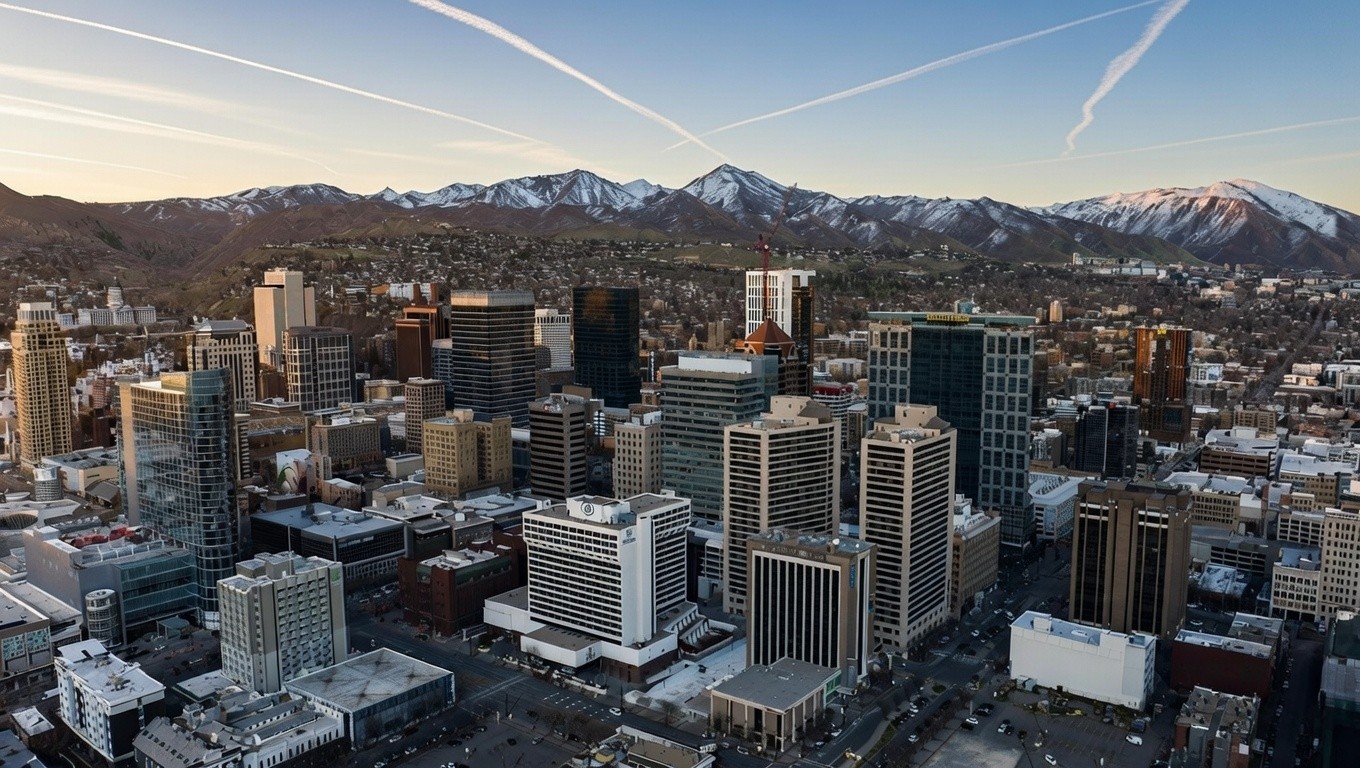
Rose Park and the Blocks Beside the Rail Yards
North of the downtown grid, past the rail yards and the interstate, Rose Park and Poplar Grove received Tongan and Samoan arrivals from the 1960s onward. Congregations along those streets are still conducting Sunday worship in Lea Faka-Tonga, which sustains the language in weekly use. Grandchildren attend Utah classrooms in English, while their grandparents puzzle over a clinic intake sheet or a district mailing drafted for a monolingual audience.
Conversion to the Latter-day Saint faith drew the first Tongan migrants toward Utah during the 1950s. After 1965, reunification provisions widened the flow. The community therefore grew by kinship rather than by recruitment. Consequently, a county notice arrives at an address with two languages and three generations under one roof. Our public notices line answers that address in Lea Faka-Tonga and Gagana Sāmoa.
Utah’s Pacific presence continues past the city limit. Marshallese and Fijian speakers concentrate a few miles west in West Valley City. Farther south, Provo draws Samoan and Tongan students to its lecture halls. One terminology base spans all three Utah nodes: a surname spelled with an okina in a Poplar Grove clinic dossier retains that mark in a Provo transcript.
Haloti Ngata and the Highland Years
Born to Solomone and ʻOfa Ngata, Tongan migrants of the early 1970s, Haloti Ngata arrived in Salt Lake City in 1990 and enrolled at Highland High School. Tongan was the language at his parents’ table, and English, the language of the classroom. For that split our Tongan translation practice exists. The school played him two sports a year, football and rugby.
Four seasons later, Baltimore took him twelfth overall in the 2006 draft. Nine years with the Ravens produced a championship ring in Super Bowl XLVII and five Pro Bowl selections. The College Football Hall of Fame inducted him during 2025, a closing seal on the athletic record. Across Utah prep sport, Tongan and Samoan surnames fill team sheets. Transcribing them for sports and competition paperwork begins with the honorific.
What the Ngata name marks in Salt Lake City is a path from a Salt Lake classroom to the national game, taken by parents who spoke Tonga’s language at home. His uncle Haloti Moala-Liavaʻa had played linebacker for the Utah Utes from 1984 to 1988, putting the surname on a local lineup a generation earlier. On diplomas and on transcripts, our Lea Faka-Tonga localization keeps the okina and the macron intact. The standard biography does date their arrival to 1990.
The Ute Name on a University Jersey
Utah answers to a Ute term. The flagship campus competes under it by permission. Since 1972 the University of Utah has used the Ute word under a memorandum signed with the Ute Indian Tribe, renewed on five-year terms and widened over time to fund scholarships for students from the reservation. Who may use it remains the tribe’s decision.
In practice, the memorandum treats an identity marker as property under tribal control. Pacific communities argue the identical point over tatau patterns and over the ʻie tōga presented at Samoan ceremonies. Huri converts consent language and naming clauses into Tongan and Samoan for cultural and intellectual property agreements, down to the schedules of permitted motifs.
It matters that the arrangement predates most tribal-consultation statutes in American public life. Under its own terms, the document applies only to athletics, leaving academic usage outside its scope. Our clients in the islands bring us the parallel instruments: royalty schedules for recorded chant and permission letters for a tatau design. Once such a clause exists in two languages, no broadcaster can sidestep it. Anyone can consult the signed memorandum, scholarship exhibit and all.
Granite Mountain and the Microfilm Archive
Six hundred feet inside the quartz monzonite of Little Cottonwood Canyon lies the Granite Mountain Records Vault, excavated in the 1960s, its entrance doors weighing several tons apiece. Baptismal and marriage rolls from more than a hundred countries went onto its film. Tonga and Sāmoa number among the collecting grounds. Deep in the rock, six chambers keep the acetate at a fixed temperature.
Church books from Tongatapu and ʻUpolu use spellings older than any standardized orthography. The hand, looped and abbreviated, belongs to a mission clerk. In places the glottal marker drops out altogether. Deciphering them takes a linguist fluent in the modern language and at ease with its predecessor. Archival transcription pairs with language revitalization.
Descendants here order film from the collection to trace a grandparent’s line back to a village on Vavaʻu. In Tongan or in Samoan the entries come through, occasionally in the missionary’s Latin. Our Gagana Sāmoa localization team transcribes them with the macrons intact, then supplies an English version alongside. By the archive’s own description, the holdings come near three billion pages.
A Closed Basin and the Air Above the Valley
Great Salt Lake occupies a closed basin with no outlet to the sea. On an exceptionally flat bed, a one-foot change in elevation floods or exposes roughly seventy square miles of playa. Evaporation alone removes the water. Off its warm shallows, snowfall feeds the Wasatch snowpack, a supply argued over in the basin hearings. That geometry has governed the shoreline since long ahead of the first surveyed street.
Exposed playa gives up dust laden with metals. The prevailing wind drives it toward the neighborhoods nearest the lakebed, and federal hydrologists sample the fallout at fixed stations. While still untranslated, an air quality alert comes to elderly residents secondhand and days late. Huri turns those alerts into Lea Faka-Tonga and Gagana Sāmoa for early warning use.
Islanders in the valley already know the argument from home: a shrinking freshwater margin and a village debating whether to relocate uphill. At watershed scale, Utah repeats that argument, with water claims and mineral leases attached. Bilingual hearing transcripts and mitigation summaries fall under climate adaptation infrastructure. Elevation figures go back to 1847 in the federal survey of Great Salt Lake.
One Terminal and Two Concourses at the Airfield
Because the older layout could no longer absorb Delta’s connecting traffic, the Salt Lake City Department of Airports demolished three terminals and five concourses, then raised one terminal with two concourses in their place. Phase by phase, the rebuilt airfield opened from 2020 onward. The city itself owns and administers the site. Municipal ownership keeps the accounts and the master plan in public hands.
For Tongan and Samoan families in the valley, that airfield is the opening leg toward Nukuʻalofa or Apia, usually by way of Honolulu. Funerals bring the heaviest bookings. A death in Tonga can put a grieving relative onto a flight within two days. Issuing their instructions in English only, airlines and ground handlers leave the elderly to guess at a connection notice. Huri provides the Polynesian wording for passenger services.
Cargo goes the other direction. Taro and kava cross the Pacific into Utah kitchens, with customs declarations attached in English. Either the shipper or the recipient must submit a correct declaration, since one mistranslated commodity entry delays a pallet for weeks. Perishable island produce rarely survives the wait. For gate assignments and cargo procedures alike, the airport authority is the one point of issue.
The Utah Population Database on the Hill
It was the archive downtown that gave researchers their raw material. During the 1970s they linked family files to state vital statistics and to cancer diagnoses, forming the Utah Population Database, kept today by Huntsman Cancer Institute on the University of Utah campus. Pedigrees there stretch across seventeen generations and eleven million individuals. Scholars from outside apply for access under ethics approval.
Pacific Islander participants entered the data late. Against the Utah baseline their numbers stay small. Diabetes and kidney disease appear at rates steep enough to make Islander enrollment a research priority. Handed a form in English alone, an elder declines. Huri prepares the participant packet and the patient information sheet as medical documentation.
Genetic sampling raises a governance question familiar throughout the Pacific. Ownership of a kinship file does not end at the laboratory door. When participants ask about storage terms and withdrawal rights, the answer belongs in their own language. Our data protection texts start there. The record sets appear one by one in the institute’s database listing, a catalogue updated annually by its contributors.
Naturalization Dossiers and Civil Status Papers
Neither a Utah court nor a county office will accept a Tongan birth extract in its original wording. American Samoans have United States national status without citizenship. That gap makes naturalization a recurring errand for Samoan residents. With policy altering the paperwork behind it, the current checklist stays on our rights and remittances page.
Naming causes more trouble than any statute. A Samoan matai title asks for a field of its own. In Tongan usage the honorific precedes the personal element. Once a clerk keys these into boxes designed for Anglo-American conventions, the mismatch follows a claimant through a decade of filings. Our translators annotate that box, then set the English form beside the original for cross-border and diaspora legal matters.
There is no substitute for a translator who has handled the source layout already. Tongan civil documents and Samoan court extracts follow their own formats. To the office receiving them, seals and marginal notations mean something. An unfamiliar eye drops the detail. Huri Translations is online only. From Moʻorea a Polynesian linguist opens a Utah dossier the day it arrives.
Polynesian Linguistic Matrix for Salt Lake City Hub

Huri Translations
Tel. +689 89 205 483
[email protected]
PO BOX 365 Maharepa
98728 Mo'orea
French Polynesia
N°TAHITI 876649


Social