A Kumeyaay Name on the Road East
Along the freeway between the coast and the Imperial County line, Caltrans signage gives the road a Kumeyaay name. Two Assembly resolutions, adopted in 1997 and confirmed in 2002, fixed that designation over the full span. The Kumeyaay were the first people of this river valley and the mountains above it. Their descendants live on federally acknowledged reservations in the back country to the east. Chamorro and Samoan residents raised here know the arrangement well: an Indigenous name on the public map, with governing authority reduced to reservation acreage.
Our Indigenous rights practice handles the paperwork of that survival. Teachers here send us curriculum drafts in Fino’ CHamoru, testimony in Gagana Sāmoa going into hearings conducted in English that afternoon. A district rejects a lesson plan whose spelling contradicts the approving tribal authority. The language revitalization entry lists the file types involved, an orthography note attached to the curriculum among them.
Elsewhere in the county, Kumeyaay names mark lakes and parks, though the freeway designation is the one written into the state code. A public account of Interstate 8 sets out the resolutions behind it. What clients here ask for is the reverse motion, an official filing turned back into the language spoken at the kitchen table. Those instruments the self-determination pages take up at length, the petition for tribal consultation being the heaviest of them.
South Bay and the Southeastern Neighborhoods
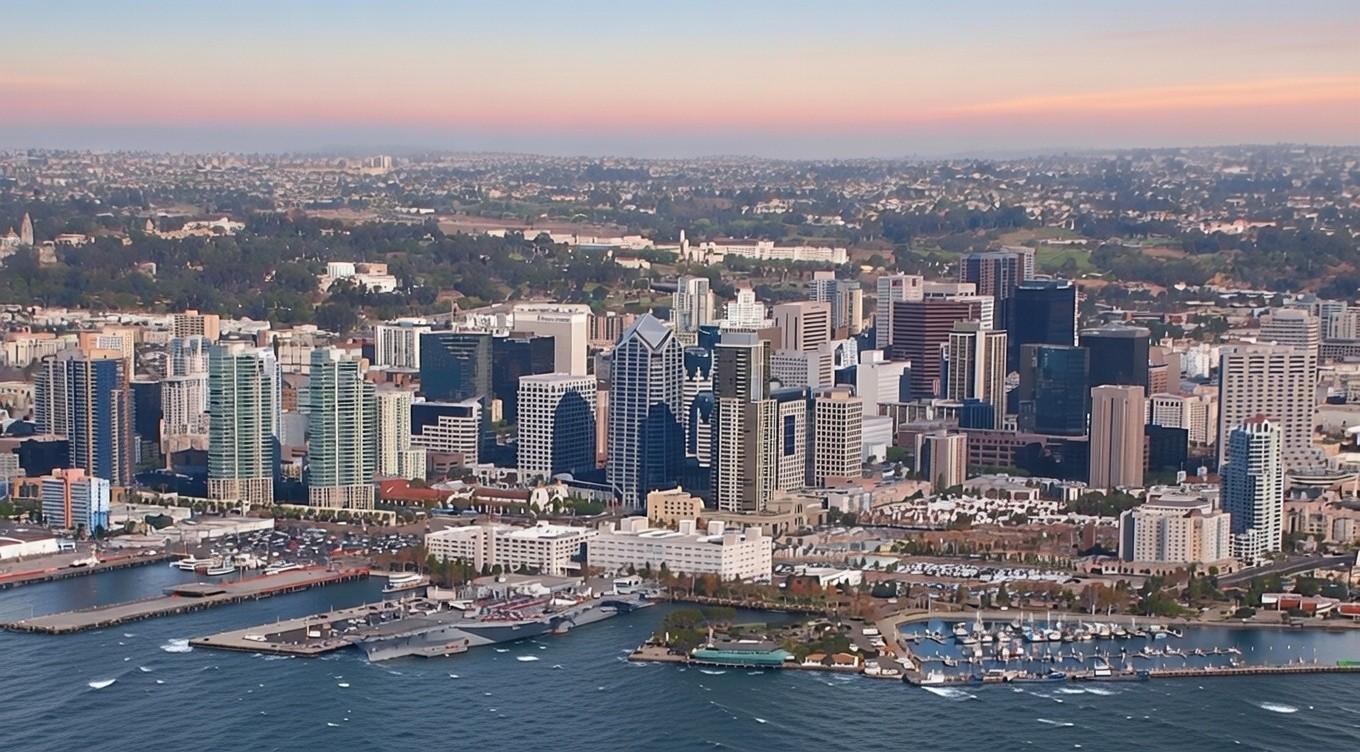
Chamorro families cluster in the South Bay, chiefly National City and Chula Vista, within sight of the shipyard gates. Samoan kin groups concentrate inland through Skyline and Encanto, with a second grouping around Mira Mesa. It was housing near the duty stations that set this map in the 1950s. The parishes and halls raised afterward, modest and heavily used, made the shape permanent. Two generations on, the Sunday bulletin prints its Chamorro column.
Northward, the neighboring stretches belong to sister nodes: the Marine Corps side at Oceanside, the container trade further up to Long Beach. San Diego proper claims the South Bay congregations and the shipyard waterfront. Community papers in these blocks print in two languages. Our diaspora publishing section treats that segment, the yearly gathering program and the funeral leaflet included.
When a Chula Vista family retains an interest in property on Guam, with a niece in Pago Pago named as an heir, two legal systems govern one inheritance. California clerks will not proceed on a Chamorro-language document until an English version accompanies it. The death record goes with it in translation. The cross-border and diaspora pages detail files of that kind, down to the affidavit of heirship.
George Freeth in Ocean Beach
In 1916 George Freeth arrived to teach swimming and to train the lifesaving crews at Ocean Beach, the last post of a Native Hawaiian waterman who had introduced surfing to Southern California nine years earlier. His mother’s people ranked among the ministers of Kalākaua’s court, then conducting its business in ʻŌlelo Hawaiʻi. He brought the Hawaiian words of the sport with him. They stuck. The paid rescue service, the subject of our Pacific maritime heritage material, began with drills written for this shoreline.
Influenza killed him here on April 7, 1919, at thirty-five. Under his training the lifeguard corps outlived him, its rescue can standard issue up this coast. Redondo Beach put up his bust. In San Diego the swimmers on duty at the towers keep the memory. A silent film from 1913 records the technique. Competitive swimming in the islands, examined in sport and competition, traces its Californian foothold to his instruction.
For descendants with relatives in Honolulu and Southern California, the archival trail is Hawaiian on one side and English on the other. To close an estate across that gap takes two archives and one glossary. Court minutes and baptismal entries in ʻŌlelo Hawaiʻi need Hawaiian translation ahead of the California filing. Fuller accounts of George Freeth survive in mission-era ledgers and probate exhibits.
The Repair Yards and the Pago Pago Trade
There are Chamorro and Samoan welders in the repair yards on the eastern shore, and maintenance planners besides. Technical documentation in that setting is English, though a yard supervisor must give the safety talk in Fino’ CHamoru or Gagana Sāmoa. The maritime operations chapter outlines that workflow and names the terminology sheet issued with a yard contract.
Sending its catch to American Samoa through the postwar decades, the tuna fleet of this waterfront left the canning to Pago Pago Harbor and to labor once employed in the South Bay. Under duty-free entry to the mainland market, the cans came north through the Tenth Avenue terminal. NOAA documents the West Coast tuna industry and the immigrant fishermen who built it. Our translators handle that commerce in English and in Gagana Sāmoa alike, under terms set in tuna and RFMO compliance.
Month by month, wages earned on this bay go home by wire. A remittance form and an obligation letter come into the queue together. Crew agreements and port-state inspection notes arrive from the port agents downtown, a stream mapped in merchant crew and port-state control. The muster list goes out localized into Gagana Sāmoa.
Under the Return Path
Bringing a spacecraft back from orbit still means a Pacific splashdown. In December 1972 Apollo 17 came down roughly 350 nautical miles southeast of American Samoa. The carrier Ticonderoga lifted its crew out within the hour. The following summer, Skylab’s first three astronauts splashed down some 835 miles southwest of San Diego. NASA publishes a directory of the Navy recovery ships assigned to those missions. Helicopter squadrons out of Naval Base San Diego fly the pickups.
Samoan boat owners below the return path take the practical consequence. Notices to mariners and fishing closures come out in English from a federal office. Unless the closure text appears in Samoan translation, it does nothing for the vessels on the track. Our splashdown and launch heritage section sets out that traffic, along with the radio version and its spoken phrasing.
At the other end, the Mariana Islands take the tracking and range support tied to launches in the western Pacific. For a fishing family in Fagatogo, the operative paper is a two-page closure notice with dates and coordinates. Translating the coordinates into Gagana Sāmoa on the day of publication gives the boats a usable warning. The Marianas ranges post theirs just as late.
Research Ships at Point Loma
While the Navy owns the Sally Ride and the Roger Revelle, Scripps Institution of Oceanography staffs and schedules them under a charter agreement with the Office of Naval Research. Designers gave the two hulls a thirty-year service life, since extended by midlife refits. The National Science Foundation pays for much of the instrumentation aboard. Vessels out of the Nimitz Marine Facility on Point Loma sail into waters administered from Hagåtña and Pago Pago.
Consent letters go to island fisheries authorities well ahead of a sailing date. Because a community hearing does not proceed in the idiom of a grant application, word to the villages near a survey line goes out in the local language beside the English. Our ocean science and research sequence begins with the permit annex, a schedule of the sampling planned inside another government’s waters.
In Hagåtña and Fagatogo, the usable output is the advisory drafted after a cruise. Scripps publishes its own account of the ships. A plain-language summary in Fino’ CHamoru goes to the village council, while the raw data stays in the appendix. Bleaching alerts take the shorter form, one page with a map. A year later, the council still cites that summary in its minutes.
Pacific Linguistic Matrix for San Diego Hub

Huri Translations
Tel. +689 89 205 483
[email protected]
PO BOX 365 Maharepa
98728 Mo'orea
French Polynesia
N°TAHITI 876649


Social