
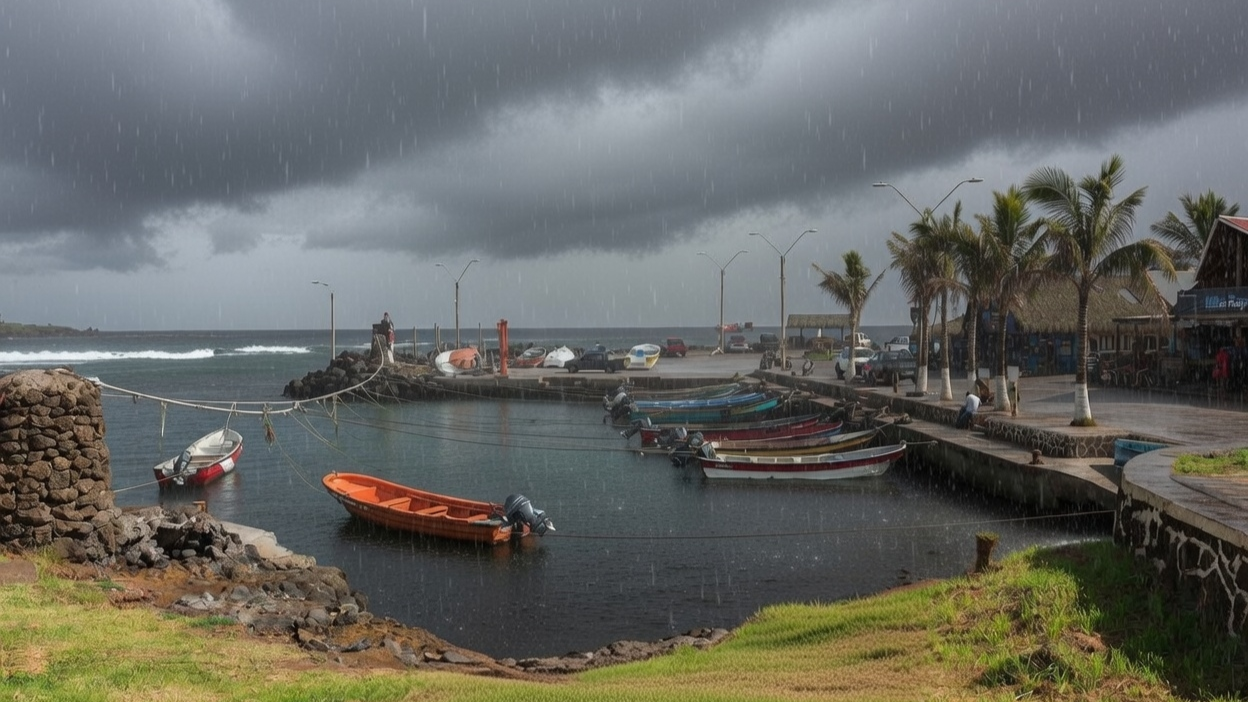
The Spanish-Speaking Exception in Oceania
Shaped by Polynesian tradition under South American and Mesoamerican influence, the music and dance of Hangaroa sound unlike anything else in Oceania. The repertoire itself belongs to our traditional arts practice. Among Pacific territories, this island alone answers to a Spanish-speaking administration, an exception in a region otherwise governed in French or English. Ōrongo interpretive material and the account of the Tangata Manu (the Birdman) ceremony go into English for visitors, a strand of drafting inside our tours and activities service.
There is one line of longitude common to Rapa Nui and Phoenix, Arizona. Island time falls six hours behind UTC, an offset matching central North America, which puts a Hangaroa reviewer and a Chicago editor inside a shared afternoon. Kāinga, the Rapanui word for the homeland, heads the glossary applied by our linguists to tenure and heritage files.
Ties from Tahiti to Santiago
Neither Tahiti nor Chile alone accounts for Hangaroa. While keeping ancestral Māʻohi kinship with Papeʻete, the island answers administratively to the Valparaíso Region, a bond fixed by the agreement of 1888 between the ariki and the Chilean navy and documented in the Easter Island entry. Santiago has since become the metropolis of the diaspora, drawing many Rapanui into study and professional life.
Title deeds and the marine paperwork of Motiro Hiva (the Sala y Gómez islets) come to us in two languages, their Rapanui terms verified on the island and their Spanish legal wording verified on the continent. For heritage and rights instruments, our Polynesian colleagues in French Polynesia join the file, drafting the community submissions on land and resource rights.
Angata and the 1914 Rising
Born around 1853 into the Miru clan, María Angata Veri Tahi was a Catholic catechist in Hangaroa through the years when the Williamson-Balfour Company had fenced the Rapanui into the village and closed the fishing grounds. She preached in the Reʻo Rapa Nui, the language handled today by our Rapanui linguists. In 1914 her vision to retake the pastures and share out the company herds became a rising for customary title and self-rule, put down that August by a Chilean naval detachment.
Angata died in Hangaroa in December 1914. It was the naval commander himself who afterwards judged the islanders wholly in the right. None of them faced punishment. A century later the community won a measure of her claim, taking over the care of its own sacred sites. Mission archives and company ledgers hold the paper trail of her name, transcribed by us into Rapanui and Spanish for the families tracing it. Her life is set out in the Angata biography.
Rapa Nui National Park
What the park protects is most of the island surface: close to nine hundred carved moai on their ahu platforms, with petroglyphs and painted caves among them. At Rano Raraku unfinished figures stay locked in the quarry rock, the workshop of the tradition and a record of its abrupt halt. Between the tenth and sixteenth centuries a Polynesian society raised that sculptural tradition in near-total isolation. UNESCO inscribed the park on the World Heritage List in 1995 under three cultural criteria, filing it as property number 715 in the inscription record.
Governing the park falls to the Rapanui community through its own institution, a measure of the self-rule sought in 1914. To administer in two tongues takes paperwork in two tongues, from management plans to the Ōrongo visitor material. Our teams draft that cultural property documentation with the Rapanui text first and the Spanish following it.
Digital Archaeology and RongoRongo
Since Katherine Routledge’s expedition of 1914, the year of Angata’s rising, scientific study of Rapa Nui has continued through heritage research teams from several nations, with Hangaroa as their base camp. Excavation permits and community consent forms circulate in Spanish and in the Reʻo, the consent wording checked clause by clause with the families holding customary interest in the site.
New instruments document the statues in fine detail. Under laser scanning and photogrammetry, one moai becomes a model accurate to the millimeter, tool marks and pigment traces caught outside the eye’s range. The scans show that pigment survives on surfaces long thought bare. On measured evidence, researchers can weigh the old questions of carving and haulage. Metadata standards behind those field methods arrive for translation with the datasets.
RongoRongo, the island’s undeciphered script, yields to these tools too. Of that corpus, twenty-seven inscribed objects survive, all taken abroad in the 1860s, their tablets digitized in high resolution to recover signs once thought rubbed away. One scanned tablet alone revised a sign count unchanged in scholarship since the 1950s. In 2024 a team in Bologna radiocarbon-dated four of the objects, one of them returning a date near 1500, a measurement set out in the published study and feeding the debate over an independent Rapanui invention of writing. The 1862 deportations to Perú took the chant keepers, leaving the signs unvoiced. On the Peruvian side, the Callao manifests naming them stay with our Lima node. Our Leqo article on the script and its Mesoamerican echoes takes up the decipherment question.
Mataveri International Airport
Mataveri International Airport occupies the southern edge of Hangaroa, its lone runway nearly as wide as the island itself. In 1987 NASA extended that runway as an emergency abort site for the Space Shuttle. The program planned the landing but never needed it. Close to 3,300 meters of asphalt bring wide-body jets to a coast some 3,500 kilometers west of continental Chile. No alternate airfield lies within 1,900 kilometers of it.
One runway is a slender thread for an island economy, a closed question for an aviation regulator: Chilean rules admit a solitary aircraft into the airspace at a time. Crews plan fuel accordingly. From Mataveri the air link joins Rapa Nui to Santiago and onward to Papeʻete, the island a rare stepping stone across the South Pacific. Cargo manifests and dangerous goods declarations for that line come through our cargo and freight service, with tower phraseology and air traffic control notices issued in Spanish alongside the Reʻo.
Rapa Nui Linguistic Matrix for Hangaroa Hub

Huri Translations
Tel. +689 89 205 483
[email protected]
PO BOX 365 Maharepa
98728 Mo'orea
French Polynesia
N°TAHITI 876649


Social


