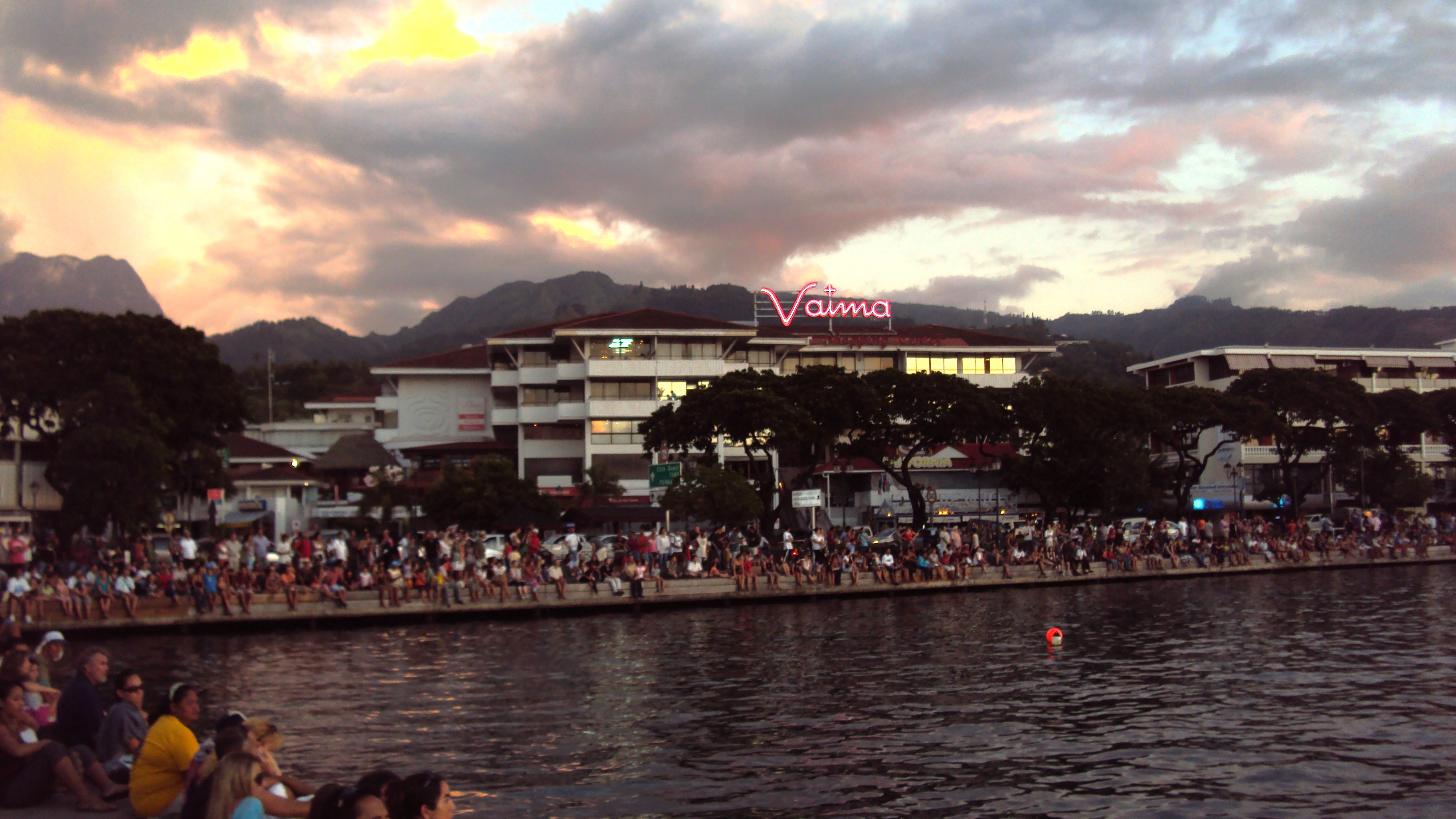
Port Districts of the Papeʻete Waterfront
Along the northern shoreline of Tahiti, the commune of Papeʻete gathers its industrial ground into two adjoining quarters. Warehouses and cold storage occupy Fare ʻUte, while the reclaimed islet of Motu Uta takes the inter-island freight. For atolls two days away by sea, dockers load construction materials and fuel drums. Most of the shipping documents behind those pallets exist only in French. Tahitian and Tuamotuan speakers make up much of the labor force there. What they want is the Tahitian one.
Eastward, Taunoa and Māmaʻo are residential. Light industry fills the valley of Tīpaeruʻi above the city, together with the petroglyph adopted as an emblem by Te Fare Tauhiti Nui. Papeʻete counts fewer residents inside its own boundary than the neighboring communes of Faʻaʻā and Pīraʻe, which raise the daytime population of the capital several times over. Between morning and dusk, commuters from those two fill the offices. Their domestic Tahitian differs from the administrative French of the forms.
Merchant families of Hakka descent have kept shops in the center of Papeʻete since the cotton plantation era of the 1860s. At the market counters, French and Tahitian cross. Through price lists and supplier contracts, family trading and retail localization follows that pattern. Recruits from France on 3-year appointments bring metropolitan usage with them. Those tours of duty fall under French Pacific civil service postings. Among that mixed readership, municipal notices issue from the town hall of Papeʻete.
Pouvanaʻa a ʻŌʻopa and the Tahitian of Public Life
Born at Maeva on Huahine in 1895, Pouvanaʻa a Oʻopa built his political base in Papeʻete and died in the city in January 1977. He campaigned in Reo Tahiti at a time when the administration admitted French alone. His speeches therefore survive as a corpus for Tahitian translation. Elected deputy in 1949 and senator in 1971, he took statutory drafting into Tahitian argument. Two of our lines feed on that record: Legislative materials and Decolonization and Self-determination.
In 1959 a tribunal convicted him of arson in Papeʻete and sentenced him to 8 years in prison and 15 in exile. Charles de Gaulle pardoned him during 1968. Fresh proceedings opened in June 2014 on a ministerial motion. 59 years after the conviction, on 25 October 2018, the French court of revision quashed it, the police testimony against him having been fabricated or extracted under threat of violence. That ruling did overturn the verdict, but it arrived 4 decades after his death. Its judges declared the original trial unsound.
A bronze figure of the metua faces the territorial assembly. One of the main avenues of the capital bears his name. Along that avenue the Tahitian academy keeps its rooms. As scans, judgments and mission-press Tahitian of this vintage arrive for judicial transcription, with the spelling of the period intact. The fuller account rests with the encyclopedic biography of Pouvānaʻa a ʻŌʻopa.
The Toʻatā Stage and the Heiva Texts
Beside Te Fare Tauhiti Nui, the esplanade of Toʻatā opens onto the lagoon with an auditorium seating between 3,200 and 6,000. Heiva i Tahiti, staged in Papeʻete since 1881, ranks among the oldest surviving festivals of the Pacific. For the annual competitions, troupes come down from the Tuāmotu and the Marquesas. A troupe composes its hīmene texts and its spoken introductions in its own language.
Judges score those compositions on the strength of the wording. Subtitling a competition text for an overseas tour falls to dance and traditional arts localization. Because the venue is full for two weeks of July, the surrounding institutions issue schedules and safety warnings in two languages. Official status dictates the phrasing of those documents.
To the groups themselves, ownership of the repertoire matters. Choreography and chant belong to their composer. Licensing and festival contracts turn on cultural and intellectual property. Through streaming platforms, recordings from the Toʻatā stage circulate worldwide, putting Tahitian metadata into catalogs shaped by French. The culture house of Tahiti sets the program and announces the season.
Motu Uta and the Inter-Island Cargo Quays
Established on 5 January 1962, the Port autonome de Papeʻete is a public body of the country. Over two decades of construction, the harbor gained a reef breakwater of 2.2 kilometers and a deep-water container berth. Copra comes in from the atolls in sacks, while cement and fuel go out on the schooners of the Tuāmotu quay. The vessels, small and low in the water, sail for the western Tuāmotu on a twice-monthly rotation. At sea those aboard speak Tuamotuan. It follows that a manifest drafted in French governs a cargo loaded in another language.
In 1993 Fare ʻUte took a quay of 150 meters and an auction hall for fresh catch bound for export. Between them, sanitary records and quota declarations cross several administrations at once. Fisheries management untangles the overlap. Signing on alongside, longline crews from Asia make their engagement contracts a translation matter as much as a legal one. Those governing instruments appear on our merchant crew and port-state control pages.
Within a few minutes of the town center, liners tie up along the seafront of Boulevard Pōmare. Operators sell their shore excursions in five source markets, which multiplies one itinerary into parallel texts for the cruise sector. Farther along, the ferry terminal for Moʻorea keeps a commuter timetable. Berthing windows and tariff schedules are the province of the port authority of Papeʻete.
Honotua and the Atoll Networks
Fiber came ashore on Tahiti in 2010 at a shore station on the north coast at Papenoʻo. Honotua faced out to Hawaiʻi, Natitua, inward to the atolls: the newer cable tied ten islands of the Tuāmotu and the Marquesas to Tahiti during 2018. In 2020 Manatua added the Cook Islands and Sāmoa. A southern branch followed in 2023 toward the Australs. Switching for the whole network is in Papeʻete.
With the outer groups connected, the administrations have put tax forms and school enrollment onto digital portals. Officials also found that a portal in French answers only part of the country. Away from Tahiti a community expects either a Tahitian interface or a Tuamotuan one. Reko Pakumotu localization supplies it. For that reason the technical detail belongs on our subsea cable systems and software localization pages.
Training a model on French and English produces poor Tahitian. Against that shortfall, our fine-tuning and evaluation datasets bring in speakers drawn from the archipelagos. The link closed the distance, yet the vocabulary gap remains. Ownership and capacity appear in the published record of the Honotua system.
Deep Seawater Cooling at the Taaone Hospital
Off the Taʻaone shoreline, a pipeline of 3.8 kilometers draws seawater from roughly 900 meters down at a temperature near 5°C. Exchangers in a technical building at Pīraʻe transfer that cold into the freshwater circuit of the Centre hospitalier de la Polynésie française. Since July 2022 the plant has been cooling the wards. Electricity use on the site has fallen by around 35%, the island total by some 2%.
Financed by the territory with a European investment loan, the installation belongs to the country, a national asset with a lifespan of 30 years. Once drafted in French, an impact study is argued again in Tahitian at consultation with the districts. To cool 400 beds without fossil generation changes the arithmetic of the grid. The Tahitian half of that file goes to climate adaptation infrastructure.
Hospital text arrives in two very different varieties of French, the clinical and the administrative. Patients arrive from the archipelagos for treatment unavailable at home. It is the geriatric and dialysis units that ask us for Tahitian consent material. Public health teams draft it. Design parameters and monitoring data are documented by the territorial energy service.
Fare Vānaʻa and the Spelling of Reo Tahiti
Which spelling should govern a Tahitian place name stayed an open question until 1972. On 2 August of that year, a deliberation of the assembly created the Académie tahitienne, or Fare Vānaʻa, to normalize the vocabulary and the orthography of the language. 20 members chosen by their peers have exercised that authority 5 decades and more.
Its grammar appeared in December 1986 and was corrected for a 2nd edition in 2009. In the 2017 update, the Tahitian and French dictionary of 1999 gained more than 2,300 entries. Compare the first printing with its 2009 correction. Those volumes fix what no in-house glossary could decide alone: the placement of the ʻeta and the tārava, the glottal mark and the vowel length of written Tahitian. For language revitalization, the academy is the reference of first resort.
The institution also promotes translation of world literature into Tahitian, a program needing typesetting built for the diacritics. Research publications teams provide it. If a Tahitian coinage exists, Fare Vānaʻa does not borrow from French. It gives translators one form for new terms. That standard, taken from the Fare Vānaʻa, Huri applies to its Reo Tahiti deliverables.
The Velar Nasal and the Glottal Stop
Created on 23 December 2008 by decree of the council of ministers, Kāruru Vānaga takes its name from the house of the word. From Te Reo o te Tuamotu it grew, an association formed in 2000 to press the case of the archipelago. Fourteen members answer for the seven speech areas, Fagatau and Maragai among them. Those two entries show the decision: the velar nasal goes down as a plain G, the Sāmoan convention, instead of the NG digraph familiar from Aotearoa.
Outside the Latin alphabet no phonetic character enters its lists. There are two spellings in circulation for many Tuāmotu place names. Ganā appears as Nganā, Ragiroa as Rangiroa. A gazetteer entry admits the pair. So does a search index. 18 months later they took their seats. Codification comes first in the declared order of Kāruru Vānaga, ahead of the dictionary and the grammar.
Huri holds to the ʻokina and the macron, the practice of most Polynesian languages, with accents kept back for tone and stress. Because many systems still substitute an apostrophe for it at export, testing and quality assurance guards that line through delivery. Reo Tahiti localization files leave here with the mark intact. Our Tuamotuan glossaries follow the academy on that letter, the older form stored alongside for retrieval.
Polynesian Linguistic Matrix for Papeʻete Hub

Huri Translations
Tel. +689 89 205 483
[email protected]
PO BOX 365 Maharepa
98728 Mo'orea
French Polynesia
N°TAHITI 876649


Social