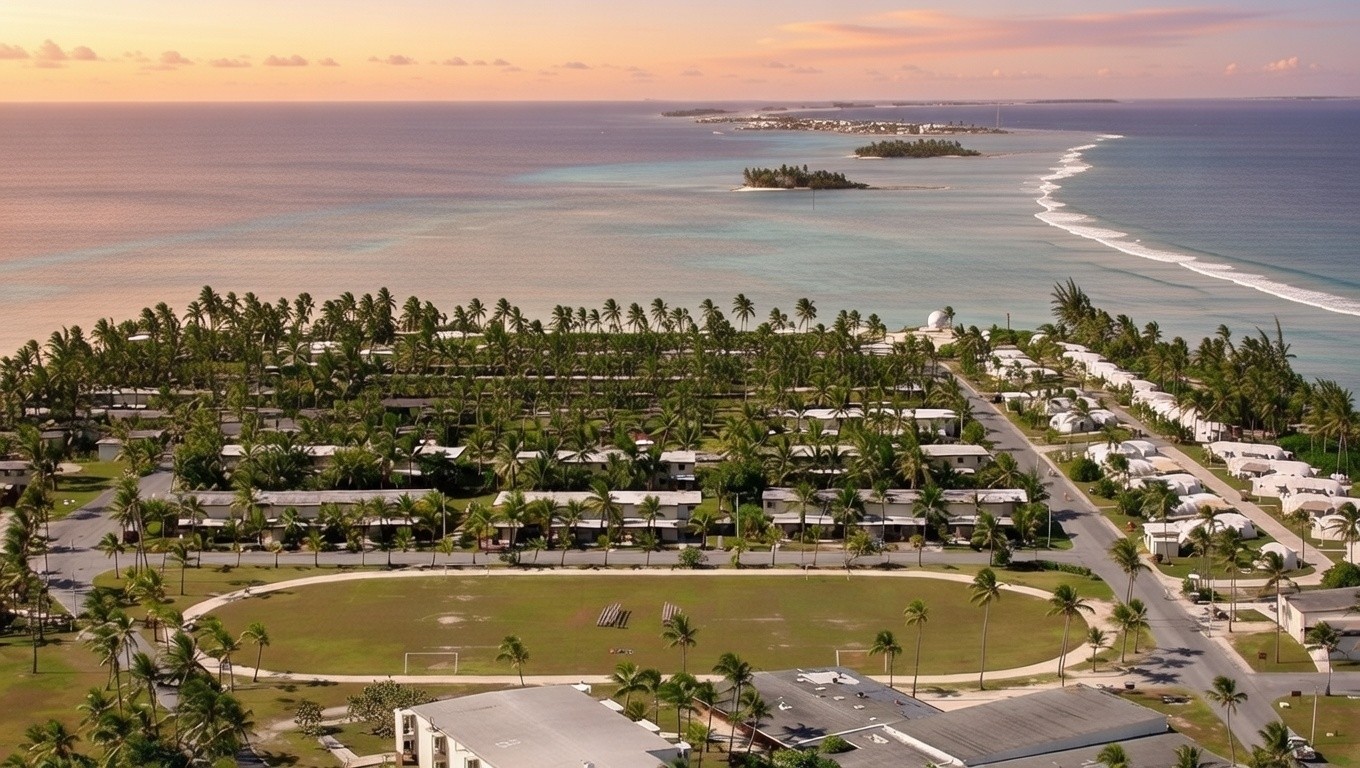
Districts Along the Majuro Lagoon
Along the eastern rim of the atoll, three islets joined by 1944 causeways form Delap-Uliga-Djarrit, known in daily speech as DUD. Ministry offices cluster in Delap, while the schools of Djarrit teach families at the northern tip, still called Rita by many residents. In Marshallese the district appears as Teļap-Wūlika-Jarōj. A default keyboard does not supply those cedillas and macrons. Marshallese orthography means that a stripped mark changes the consonant beneath it, which is enough to turn one surname into another. From street signage to ballot material, our Kajin M̧ajeļ localization line reproduces the marks in full.
There is one road out of DUD. It stops at Laura, on the highest ground of the atoll, under three meters above sea level. Northwest of Uliga lies Ejit, an islet allotted to Bikini families displaced by the testing program of the 1940s and 1950s. That community also lives on Kili in the Ralik chain, which puts two atoll names in one family file and leaves the land and resource rights claims open. Genealogies and property papers of this kind go into English with the Marshallese spellings unchanged. The entry for Delap-Uliga-Djarrit lists population and reclamation figures for the urban islets.
Tony de Brum and the Marshallese Case Abroad
Born in 1945 and raised on Likiep, Tony de Brum watched the Castle Bravo flash from a fishing boat at the age of nine. Decades afterward he described that morning to judges and to climate conferences. From Majuro he led the foreign ministry three times, taking the independence talks of the 1980s through to the coalition of small states at Paris in 2015. He argued in Marshallese for his own people and in English abroad, the two directions our Marshallese translation practice takes daily. Nuclear claims and Compact negotiation filled his cabinet years, the twin subjects at the center of legal documentation and self-determination alike. He died at his home in the capital in 2017.
What survives of the family outside politics is photographic: glass plates from Joachim de Brum, on loan to the archive in Uliga, with the Likiep title unbroken since the 1870s. The pairing has consequences, because cabinet papers in English and survivor testimony in Marshallese describe one event from two sides. To keep the terms of a nuclear claim stable across that gap, we put native Marshallese translators on the source. His published biography tracks the three foreign-affairs terms and the 2014 filings at the International Court of Justice.
Purse Seine Traffic Inside the Reef
Sheltered water inside the reef gives the capital a deepwater anchorage rare among atolls. Skipjack transfers from the western Pacific fleet into refrigerated carriers there, under licenses worth much of the public budget. Observers report in English aboard ships crewed in Tagalog or Bahasa. Fisheries management translation squares the observer sheet with the vessel log.
It was the Parties to the Nauru Agreement office, opened in Majuro in 2010, that brought day-to-day management of the fishery down from Honiara. Under the vessel day scheme, eight island governments, from Tarawa to Palikir, sell fishing days rather than tonnage. Ministerial sessions proceed in English only, while the drafts behind them return in Marshallese and Gilbertese. The annual cap on those days makes the count itself a negotiated number in Marshallese as much as in English.
Because a seiner takes crew from a dozen countries, the contracts and wage papers coming ashore rarely share one language. Port state inspection adds further English text on vessels manned from Southeast Asia and the islands. Our crew welfare and port state control translators put those findings back into Marshallese for the shore side. The eight-party Nauru Agreement of February 1982 sets the legal base for the day-selling arrangement.
Sail Freight and the Training Deck
Her rig partly automated and her cells charged by surplus wind, the Juren Ae returned sail power to inter-atoll shipping in 2024. Under German climate financing, the hull came out of a yard in Geoje. Fuel burn falls by as much as 80% against comparable diesel tonnage. In Marshallese, Juren Ae names a spar of the outrigger canoe, a word older than any engine in the fleet. Hardware at that level, however, ships with English manuals for a Marshallese-speaking engine room. Rig diagrams and battery schematics cross into Kajin M̧ajeļ as renewable energy material.
It falls to the College of the Marshall Islands to train the crews. Its maritime center puts students aboard her for watchkeeping under the international convention on seafarer standards. Between voyages she hauls cargo and passengers out to the outer atolls for the state shipping line. Watch tickets in English then accompany those graduates to foreign ports, which turns seafarer training paperwork into the most portable asset in a young sailor’s kit. A statute of 1992 charters the institution, with the maritime program listed in its published catalog.
The National Archive in Uliga
A purpose-built floor of 1974 beside the courthouse, the national museum and archive has been collecting video of atoll life since the 1980s. What it keeps on microfilm dates from the trust territory administration. Exhibition rooms downstairs, small and closely hung, show stick charts, the meddo and rebbelib of navigators who plotted swell refraction by hand. No English equivalent exists for that vocabulary. Such terminology belongs to cultural and intellectual property handling.
Transcribing an oral history is the first job on a tape with no written source. Digitization has been under way in the building since 2017. Metadata in English then opens the collection to scholars overseas, though transcription does come first. Research publications support takes transcription and metadata alike. The Alele charter goes back to a 1970 incorporation and includes the reopening after renovation in 2013.
Records for Families Under the Compact
Marshallese citizens may live and study in the United States without a visa, a provision of the Compact of Free Association negotiated in the 1980s and amended in 2003. Communities have grown in Hawaiʻi and in Springdale, with enrollment there resting on paperwork issued in Marshallese. Once a file crosses the Pacific it turns bilingual, with the Marshallese original kept alongside its English version. Vital records and transcripts go outward, diplomas and medical summaries back.
Neither the school office nor the clinic accepts a document in Marshallese alone. Referral to hospitals in Honolulu adds a second stream of text, from consent forms to discharge summaries. However, public health notices for the atolls start in English and end in Marshallese. How a name is spelled decides how it sorts in an American database. When translated for enrollment abroad, a Marshallese birth record keeps its clan names intact and its home atoll in Marshallese spelling.
Marshallese Linguistic Matrix for Majuro Hub

Huri Translations
Tel. +689 89 205 483
[email protected]
PO BOX 365 Maharepa
98728 Mo'orea
French Polynesia
N°TAHITI 876649


Social