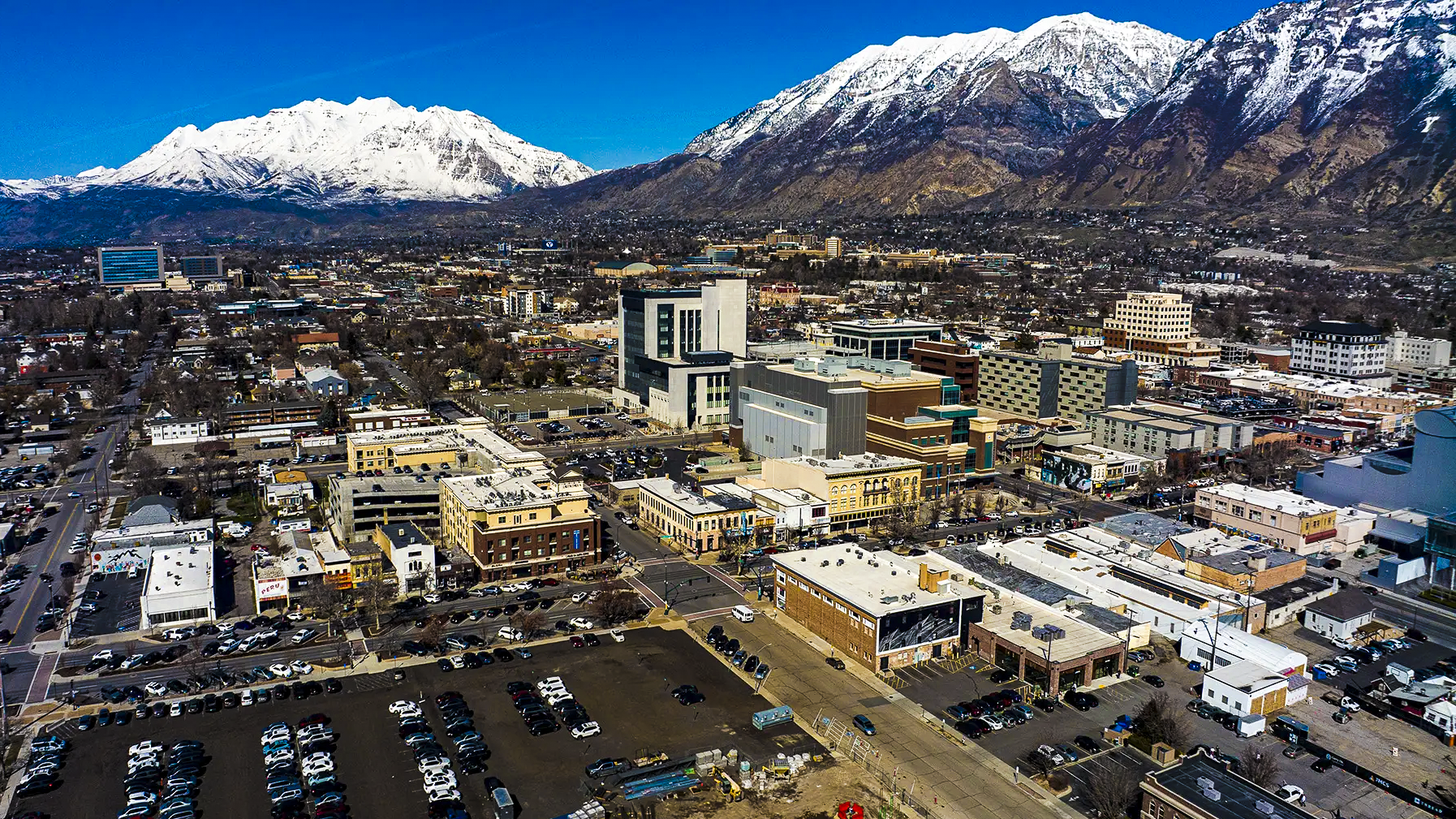
Provo, Orem, and the Southern Wasatch
Pacific settlement in Utah began in the 1870s with Hawaiian converts placed on ranchland west of the Great Salt Lake. The Utah Valley filled a century afterward. As Brigham Young University enrollment drew Samoan and Tongan students to Provo through the 1950s and 1960s, relatives followed them into Orem and, further south, into Springville. Two counties consequently divide the Pacific population of Utah between them, our Salt Lake City hub answering for the north while Provo takes everything below Point of the Mountain.
Arriving at a kitchen table in Orem, a rental agreement or a school enrollment packet looks unremarkable. Its consequences are not. Huri Translations puts such papers into Samoan or Tongan at the point of signature, together with the cross-border and diaspora legal paperwork kept between Provo and Apia. The Provo entry gives the city its incorporation date and its later boundary changes.
Congregations across the valley conduct their meetings in Samoan or Tongan, an arrangement in place since the 1970s. Weekly bulletins and funeral orders come out of them in quantity, most produced by volunteers translating after midnight. When the wording touches money or medicine, an amateur draft costs more than it saves. Typesetting and phrasing then go to our diaspora publishing team.
Eni Faleomavaega and the Samoan Seat in Congress
Born at Vailoatai on Tutuila in 1943 and raised on Oʻahu, Eni Faleomavaega completed a political science degree at Brigham Young University in 1966, leaving Provo for the Army and a tour in Vietnam. He returned to American Sāmoa as lieutenant governor, then occupied the territorial seat in the United States House from 1989 until 2015, thirteen terms in a chamber granting him no floor vote. His legislative material appeared in English while constituents argued it out in Samoan. In 2001 he took the case for self-determination across the territories to the United Nations Special Committee on Decolonization.
Faleomavaega died at his Provo home in February 2017. The valley schooling him at twenty-two became the valley of his retirement, a sequence familiar across Utah County. What survives him is documentary, committee testimony and hearing transcripts still itemized in his member biography at the House of Representatives archive. Much of it gets discussed at the table in Samoan decades after the English original. Putting that older testimony into Samoan for descendants is ordinary Gagana Sāmoa localization, matai titles and honorifics included.
Language Instruction at the Missionary Training Center
Since 1978 a thirty-nine-acre campus beside the Provo Utah Temple has taught more than fifty languages, Samoan and Tongan among them. Its predecessor, the Language Training Mission, did the teaching inside university classrooms until the site opened. Few American towns concentrate formal instruction in Pacific languages at that scale. Departing missionaries drill Lea fakatonga vocabulary here, then fly out to Nukuʻalofa. The encyclopedia article for the institution counts twenty-one buildings on the site.
Talking with a Tongan grandmother across her kitchen, a returned missionary can still stall at a benefits notice or an academic appeal. Conversation does not teach those documents. Our Lea fakatonga localization service handles the written end. Professional training manuals produced across the valley arrive with linguists drilled on published prose.
Across the road the university keeps Samoan and Tongan on its own course list, third-year sequences graded alongside French or Japanese. Utah Valley therefore raises two kinds of speaker, one shaped by coursework and one by birth. Formal writing is another discipline. Language revitalization programs of the valley fill that gap by sending their printed lessons out for editing.
Polynesian Collections on Canyon Road
The Museum of Peoples and Cultures, the archaeology and ethnology museum of Brigham Young University, catalogs tapa cloth and pandanus mats from Polynesia. Its holdings exceed a million objects, the Polynesian pieces among the older strands, much of it accumulated by donors whose surnames stay attached to the boxes. It was along church networks joining Utah to Sāmoa and Tonga that fans and carved figures came north, the way the students did.
On a display label, a provenance claim occupies forty words. A Samoan or Tongan term inside it either survives the crossing into English or quietly disappears. Communities of origin increasingly ask for catalog entries in their own language, a question of cultural and intellectual property rather than courtesy. Research publications drawn from the collections raise the difficulty one level up. The museum itself publishes scope and study access.
The Rebuilt Delta at Utah Lake
Excavating 260 acres of former farmland at the south edge of Provo, the Utah Reclamation Mitigation and Conservation Commission has turned the final mile and a half of the Provo River into a braided delta. A federal body created under the Central Utah Project Completion Act of 1992, the commission shares the lead with the Central Utah Water Conservancy District. One fish explains the expense: the June sucker, native to Utah Lake and its tributaries alone, had lost the shallow nursery water at the river mouth.
Restoration on that scale generates filings in volume, impact statements and consultation notices first, then decades of monitoring, the whole of it summarized on the Interior Department project page. Pacific agencies produce documents of that class for reef and fishery programs, which is why climate adaptation infrastructure is regular practice for our translators. Community engagement writing is the harder half, since a landowner letter must be legible to the person receiving it.
Papers Sent Between Utah County and the Islands
A Samoan birth record and a Tongan school transcript cross the Pacific at no great size. Because delay in one of them costs a semester or a job, Utah County families need civil papers in hand when a child starts school. Employers ask for proof of qualification. There is no room in a filing for a guess at a village name. Which spelling arrives on the page decides whether a claim clears. Support letters and remittance receipts go the other way, the worker rights and remittance guidance familiar to anyone split across an ocean.
Huri Translations operates entirely online. A Provo clinic emailing an intake form at four in the afternoon has patient-facing translation back within the week, without an appointment at a counter. Island ministries are revising their paperwork while Utah revises its statutes, which leaves two versions of one civil record in circulation. It falls to our Samoan and Tongan linguists to reconcile the pair, matching name order and diacritics across the two.
Polynesian Linguistic Matrix for Provo Hub

Huri Translations
Tel. +689 89 205 483
[email protected]
PO BOX 365 Maharepa
98728 Mo'orea
French Polynesia
N°TAHITI 876649


Social