Roi Mata and the Oral Record of Efate
North-west of the capital, along the coast of Efate, lies Chief Roi Mata’s Domain, two of its three parts on the islets of Lelepa and Artok. Roi Mata, the last paramount chief of central Vanuatu, died around 1600 AD, his residence and his grave governed by tabu ever since. In 2008 UNESCO inscribed the three sites, the first such listing in the country. Custody belongs to the descendant communities of that shoreline, who speak for the ground under customary law.
Because the account of this Domain lives in speech, its transfer into text asks more than vocabulary matching. Genealogy and tabu boundary arrive in Bislama from the custodians themselves, granted lineage by lineage. It falls to the community to set the restrictions on such recordings, a discipline detailed in our cultural and intellectual property pages. No phrase enters a client glossary without the custodian’s word.
The inscription file kept by the World Heritage Centre remains the reference for spellings and for the core zone of 888 hectares. When drafting in English or French, our Bislama linguists consult it to fix a spelling, since a misspelt place name in a heritage claim can weaken that claim decades later. What the archive needs is orthographic stability: the UNESCO listing for Chief Roi Mata’s Domain supplies it.
Nafsan and Ifira-Mele Around the Bay
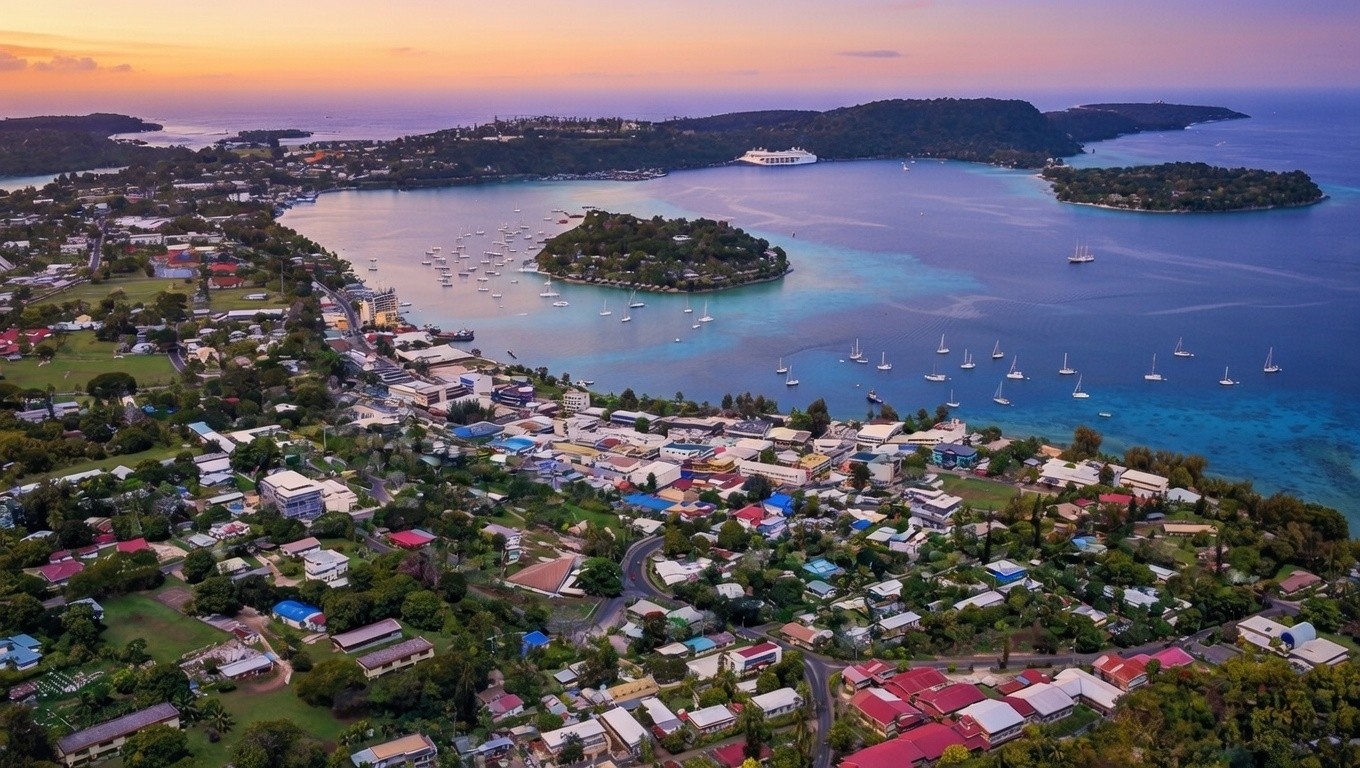
Two village languages ring the bay besides Bislama. On Ifira island and at Mele, families speak Ifira-Mele, a Polynesian outlier brought into Melanesia by voyagers from the east. Along the Erakor and Pango peninsulas the local tongue is Nafsan, a Southern Oceanic variety. Neither peninsula nor islet gives up its speech at supper, whatever the signage of the town suggests.
For a ministry circular at Pango, Bislama does the job. With a school programme in Nafsan the task changes: the orthography is younger, its dictionary the product of field research rather than of long print tradition. Bislama is absorbing English and French words at speed, while Nafsan borrows sparingly. Under our language revitalisation practice, we build term lists for these smaller varieties, checking entries against speakers born to the variety.
In 2015 the communities renamed their language Nafsan, retiring the older label. Some 6,000 people use it along the south coast. Ifira lies in the harbour itself, some 1,500 metres offshore. In official text, names of this kind need care. To write Eratap for Erakor is to send a dispute to the wrong committee of custom, one syllable of Nafsan deciding the venue. Our place-name list for Efate, drawn from speakers at Erakor and Pango, fixes the spelling across our Bislama localisation deliverables for Port Vila clients. For phonology and distribution, the published profile for Nafsan is the reference.
Grace Mera Molisa and the Blackstone Imprint
Born on Aoba in 1946, Grace Mera Molisa took her degree at the University of the South Pacific in 1977, the first Ni-Vanuatu woman to be awarded one, and spent the remainder of her life in Port Vila. She joined the committee drafting the constitution of the young republic, the sort of legislative material central to our legal files today. Her poems went out through an imprint of her own, Blackstone Publishing, whose catalogue put Ni-Vanuatu writers into print.
English she used against itself, naming it the tongue of the coloniser in verse composed in English. For Pasifik Paradaes in 1995 she chose Bislama, one of the few literary volumes in the national language, which is why our Bislama translation team keeps a poet’s vocabulary alongside the administrative one. Her campaigning for women in politics belongs to the independence generation, whose papers fall under decolonisation and self-determination.
Molisa died in Port Vila in January 2002, her titles still on Pacific studies syllabuses abroad. Cataloguing them correctly is a small piece of bibliographic care: Blackstone as one word, Pasifik Paradaes with its Bislama spelling intact. Across our publishing dossiers for Pacific presses, that discipline applies to author names and publisher lines. Her encyclopaedia biography gives the dates and the public offices.
The Lapetasi Berth and the Liner Quay
Reclaimed fill at Lapetasi added a 200-metre berth to the harbour in 2018, financed by a loan from Japan and granted under concession to the Ifira title-holders. Container vessels have moored apart from the liners since that year, an arrangement ending decades of shared quay space. Inter-island traders load at the older wharf, as do the coastal services linking Port Vila with Nouméa.
A ship arriving under a foreign flag brings documents in a language of its own, from muster rolls to inspection reports. Ni-Vanuatu deckhands and stewards join cruise fleets on contracts drafted in English and explained at home in Bislama. Under merchant crew and port-state control, owners send us those papers, the Bislama and English columns returned side by side on one page.
One call puts several thousand people ashore in a morning. Shore excursions sell in English to visitors from Australia and New Zealand, while the guides handling them speak Bislama among themselves. Accordingly, safety notices and tour sheets go out in two versions, right down to the wording of the tender queue. Our cruise-sector dossiers hold that pairing season by season. The Vanuatu Project Management Unit keeps the construction record for Lapetasi.
Bauerfield and the Wartime Airstrip
American engineers cut an airstrip out of a coconut plantation north of the town in 1942. The first strip, short and coral-surfaced, grew to three times its length under the Seabees. It was a Marine aviator lost at sea off Guadalcanal in November of that year who supplied the name. Military flying ended in February 1946. Jet services from Australia and New Caledonia use the runway today.
Aviation English governs the tower and the cockpit, while ground staff and travellers switch to Bislama across the counter. Foreign airlines hand the terminal their cabin-safety cards and handling manuals in English or French, a Bislama version needed for crew instruction. On the flight plan, a notice to airmen does not admit a local variant, its code fixed internationally. Under aviation training, our editors prepare the rest, matching the phraseology approved for the region.
Medical evacuation forms and freight declarations go through the terminal in three languages, a recurring load for our airport templates. The 1942 naming still complicates the filing: Efate Field and Bauer Field turn up across one set of holdings, catalogued as separate places by anyone unfamiliar with the island.
The Warning Centre at Numbatu
At Numbatu, a national warning centre watches the archipelago day and night, drawing seismometer and tide-gauge data to one screen from stations in all six provinces. The islands ride the New Hebrides subduction zone, one of the most seismically active margins in the Pacific. Between November and April, the cyclone season adds a second hazard across the group. Staff in this building grade the volcanic alert levels for Yasur and Ambrym from zero to five.
Notices go out in Bislama alongside the English bulletin. Wording does decide whether a fisherman off Pango leaves the water. For that reason, early warning systems material never waits on a slow afternoon. For the alert vocabulary, our terminologists maintain master Bislama versions, from tsunami evacuation phrasing to ashfall advice. A 2 am dispatch then needs only its numbers altered. Radio remains the first channel to the far provinces, its Bislama script drafted well in advance.
Financed in 2013 by the World Bank with Japanese development lending, the centre outlives its funding cycle by design: sirens in the capital and telemetry from the outer islands. Our climate adaptation infrastructure glossaries take their terminology from the source itself, including the Bislama used in school drills. The department publishes hazard levels and network detail on its geohazards pages.
Emalus Campus and the Law of Twenty Jurisdictions
The University of the South Pacific placed its law school in Port Vila, on an estate belonging to the people of Erakor. Students arrive from a dozen member countries, taking their examinations in English while discussing custom in Bislama over lunch. Also at Emalus is a Pacific Languages Unit, with the tongues of the region taught for degree credit. Magistrates across the island states have qualified here since the 1990s.
From that campus, PacLII publishes the statutes and rulings of twenty Pacific jurisdictions, a free archive built with Australian technical help. Judgments from Vanuatu appear in English, though the testimony behind them came in Bislama or in Nafsan. Transcription therefore involves a language change at the moment of record, the territory of our court interpretation and judicial transcription practice.
Anyone citing a Pacific case knows that the PacLII string is the standard. A mistyped neutral citation sends a researcher in Honiara to the wrong judgment, an error caught against the database itself. For research and teaching material, thesis abstracts and course notes come to us in English or French, with Bislama summaries added for community distribution. Course structures and entry rules appear on the Emalus campus pages.
Melanesian Linguistic Matrix for Port Vila Hub

Huri Translations
Tel. +689 89 205 483
[email protected]
PO BOX 365 Maharepa
98728 Mo'orea
French Polynesia
N°TAHITI 876649


Social