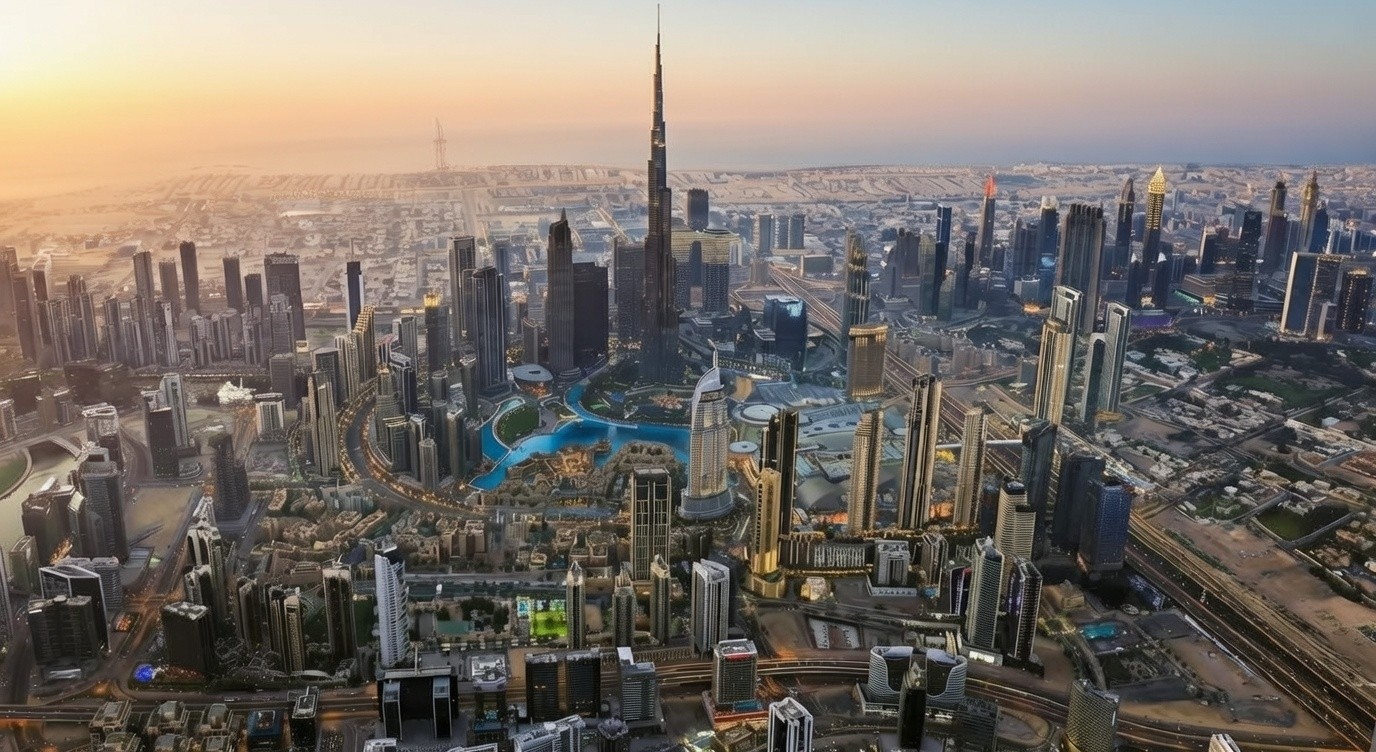
Sheikh Saeed and the Creek Air Agreement
Saeed bin Maktoum bin Hasher Al Maktoum ruled Dubai from 1912 until his death in 1958, the longest reign in his house, conducted from a coral-block dwelling at Al Shindagha on the northern lip of Khor Dubai. In July 1937 he sealed an air agreement leasing a stretch of the creek to Imperial Airways for about 440 rupees a month, the guards’ wages included. Short Empire flying boats came down on the water weekly at first, four times a week by February 1938, mooring off Deira on the mail chain from Southampton through Karachi to Australia.
After 1940 the wartime Horseshoe service pushed more traffic onto the inlet. BOAC gave Deira a permanent jetty, eight arrivals a week by 1944, feeding the Qantas legs onward to Sydney and Auckland. Tasman Empire Airways then took the Short Empire hull as its first aircraft, putting Gulf and Pacific flying boat stages on one timetable, the deep prehistory of our island air links. Under the customs-free harbour his father had opened in 1901, Persian merchants from Lingah crossed to the Bur Dubai bank, the beginning of the entrepot international trade of the emirate.
His dwelling at Al Shindagha, built about 1896, survives as a museum of the coins and harbour maps of the reign, a family archive kept in Arabic. Along that aviation chain, counterpart holdings in Auckland and Suva answer the lease of 1937. Matching a Gulf document against a Pacific one is archival translation, the ground of our Pacific maritime heritage translation. Fuller account: the biography of the ruler.
The Pearl Market Behind Khor Dubai
The first written notice of Dubai belongs to a Venetian pearl merchant, Gaspero Balbi, who described the fishery off this coast in 1587. For three centuries afterwards the diving season set the town calendar, the ghaus fleet crewing from the Deira and Shindagha shores on credit advanced against the catch. Khor Dubai gave the fleet its shelter, a saltwater inlet of 14 kilometres dividing the settlement into Bur Dubai and Deira.
Inside a decade in the 1930s the fishery broke, undercut by the Depression and by the cultured gem coming out of Japan. Grafting had turned a found object into a farmed one. The divers of the creek lost their market to a technique.
That technique arrived in the Tuamotu in 1961 with Churoku Muroi, a grafter sent from Japan to nucleate black-lipped oysters at Hikueru. By 1965 Jean-Marie Domard had harvested about a thousand cultured pearls from the experiment, the start of the Tahitian pearl and of the farms sustaining atoll economies across French Polynesia. Grading sheets and export declarations from those lagoons come to us in Tahitian translation and through our aquaculture development casework. The pearling dossier of Khor Dubai is published on the UNESCO tentative list.
Deep Water at Jebel Ali
Jebel Ali lies on reclaimed ground 35 kilometres down the coast, a harbour dredged out of sabkha for hulls too deep for the old town moorings, opened by Queen Elizabeth II on 26 February 1979. Container berths and bunkering wharfs displaced the old dhow quays, giving the emirate deep-sea capacity and a berth long enough for a carrier.
Tankers flagged in Majuro ply the Gulf in numbers. The Marshall Islands administers one of the principal open flags of world shipping through branch offices including Dubai, keeping a place on the white lists of the Paris and Tokyo memoranda. For Asia and Europe, its ensign rides on hulls loading at Jebel Ali, Micronesian statute attached to a Greek or Emirati owner.
Port-state inspection follows the flag rather than the owner, putting Marshallese law and Emirati surveyors on one deck. Detention notices and crew agreements arrive for a ship’s company in Marshallese translation, the daily substance of our merchant crew and port-state control practice alongside the seafarer and crew mobility docket. Full particulars: the Port of Jebel Ali.
The Sand Runway Outside the Town
Rashid bin Saeed Al Maktoum, son of the ruler who leased the water to Imperial Airways, ordered an aerodrome on dry ground in 1959. It opened on 30 September 1960 on wasteland outside the town, a strip of compacted sand 1,800 metres long, capable of nothing larger than a Douglas DC-3. In 1965 came asphalt, 2,800 metres of it, and with it a de Havilland Comet of Middle East Airlines.
Position decided the rest. The emirate kept an open skies policy from the sand years onward, taking the airlines of the world on the strength of position alone. Half a century after the DC-3, Concourse A dates from 2013, built for the A380 alone.
Fiji Airports administers the Nadi flight information region at the Pacific end of the chain, six million square kilometres of ocean, the airspace of five countries. One authority governs a thick sky, the other an empty one, under one set of ICAO instruments. By treaty English holds the frequency. Fijian belongs to the training record and the incident statement. Those come to us in Fijian translation, the air traffic control half of our aviation casework. The airport authority: Dubai Airports.
Expo City and the Loss and Damage Fund
Expo City Dubai occupies the permanent core of the exposition grounds at Dubai South, retained by the Government of Dubai as a district of offices and pavilions once the fair closed. The United Nations climate conference of 2023 convened there in a domed plaza raised for the fair.
On the opening day the parties agreed to operationalise the loss and damage fund, a dedicated instrument for states least responsible for the warming behind their losses. Pledges followed within hours from the host government and from Germany.
The claim underneath the decision is Pacific and old. Vanuatu tabled an insurance pool for small island states in 1991 on behalf of the Alliance of Small Island States, three decades ahead of the Dubai text. Across the sessions between, the archipelago pressed that argument without interruption. Its governing papers and national submissions arrive in English and in Bislama for a country tending that dossier, our international climate cooperation remit. The convention itself is documented by the UNFCCC secretariat.
Records Crossing to the Emirates
An islander taking a contract in the Emirates handles paper ahead of anything else, a birth certificate and a qualification transcript, legalised through a sequence of stamps and filed with an Arabic translation. That sequence is a fixed cost of the crossing, quoted in weeks.
Even so, the Emirates stay outside the one-step certification used among the Hague members of the Pacific. Stamps and competent authorities are revised more readily than the need beneath them.
What endures is the need itself: identity and service documents arriving intact, legible to an administration in Arabic. The current checklist lives on our immigration and labour mobility page beside the notarial documentation and apostille detail, edited once as the rules turn over. What we supply in Dubai is the sworn translation of those documents, formatted for filing.
Pacific Linguistic Matrix for Dubai Hub

Huri Translations
Tel. +689 89 205 483
[email protected]
PO BOX 365 Maharepa
98728 Mo'orea
French Polynesia
N°TAHITI 876649


Social