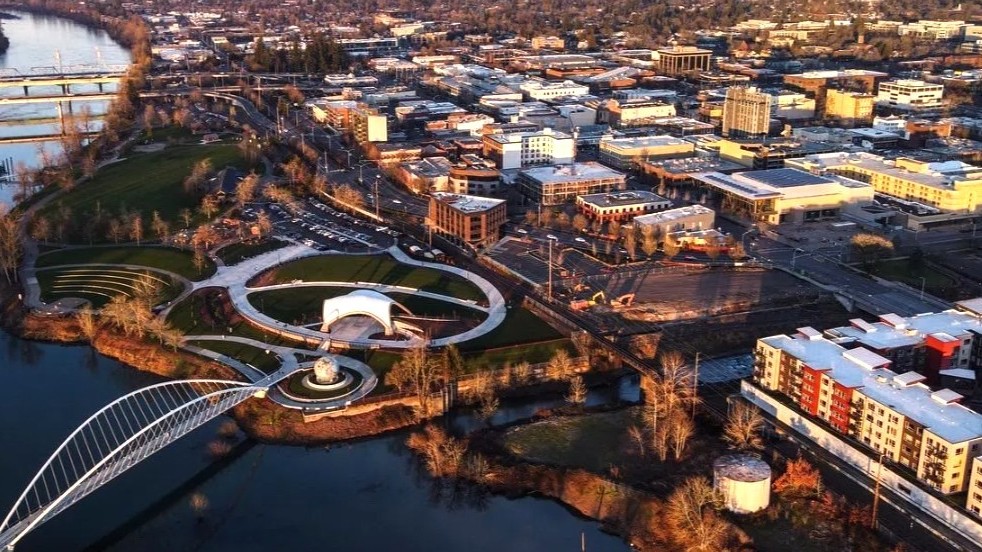
The Kalapuya Name Beneath Salem
Its Kalapuya name Salem never lost. Chemeketa, the Santiam village word for this bend of the river, endures on Chemeketa Street NE and on the community college of Marion County. In the 1840s Methodist missionaries relabeled the site. Legislative staff give the older address daily without noting its origin.
Under the Willamette Valley Treaty concluded at Dayton in January 1855, the Kalapuya bands ceded the greater part of their country. Forced removal to Grand Ronde followed the next winter. Congress terminated the federal trust relationship in 1954 and restored it in 1983. Governing today from a reservation an hour west of Salem, the descendants of Chemeketa maintain a culture and history program whose heritage-language teaching parallels the language revitalization we assist across Polynesia.
It takes one keystroke to lose a macron and a morning of clerical time to put it back. Samoan surnames come out of Oregon forms shortened, the vowel length gone with the diacritic. Our Gagana Sāmoa localization line keeps the macrons intact from source document through to the printed notice.
Samuel Thurston and the Donation Land Claim Act
While drafting the Donation Land Claim Act in 1850, Samuel Royal Thurston argued in writing that Hawaiian men leaving the Hudson’s Bay Company should be ineligible. Congress gave married white couples 640 acres. It did not give the Hawaiian crews of the fur trade anything at all.
Thurston died of fever off Acapulco in April 1851, a week short of his thirty-fifth birthday. Two years later the territorial legislature voted to bring his remains north. It was public money that raised the marble monument above his grave in Salem Pioneer Cemetery. Because Hawaiians made up a large share of the territorial labor force through the 1840s, the bar emptied the valley of its Pacific population for close to a century. The fuller account of his delegacy lists the votes behind the 1850 bill.
Property title in this valley descends from a racially drawn instrument, an exclusion still legible in nineteenth-century claim files. In probate and naturalization matters, Samoan and Tongan families in Marion County encounter those files under title and resource rights and legal documentation. Sworn statements arriving from Sāmoa and Tonga cross into English through our Samoan and Tongan translators for the court file.
Woodburn and the Valley Floor
North of the capital, the valley floor from Keizer to Woodburn concentrates the food processing and nursery production of Marion County. Cannery signage looks bilingual until the safety label appears. A line supervisor has probably never seen a lockout procedure in Samoan, a sequence for cutting power at the machine ahead of maintenance.
Since a mistranslated chemical sheet ends in a compensation case, plant procedure belongs with regulated text under food production and processing. Clinic intake is the other half of the problem: interpreters are plentiful in Spanish and Russian, while Polynesian languages have a much smaller pool. Neither the packing floor nor the waiting room gets a Samoan version by default. Patient-facing translation fills that omission.
Willamette University Across from the Capitol
There has been a university on the south side of State Street since 1853, chartered that year out of the Oregon Institute of 1842. Waller Hall, a brick building completed in 1867, has occupied the Willamette University campus ever since, renamed in 1912 for the missionary Alvin Waller.
To match a Tongan course name against an American credit hour takes a specialist. Consequently, admission offices in the capital are handling school papers issued half an ocean away. A transcript from the National University of Sāmoa or from ʻAtenisi in Nukuʻalofa arrives with its grading scale and its seal in the original language. Which equivalence an Oregon reviewer accepts decides the student’s placement. Under academic institutions we convert those papers without flattening a course name into an American approximation.
Scholarship flows the other way as well. Pacific-studies findings published in Salem circulate in Apia once a Lea faka-Tonga edition exists. Preparing that edition falls to our research dissemination practice.
McNary Field and the Guard Aviation Base
Two miles southeast of downtown, McNary Field has belonged to the City of Salem since it opened. In March 1944 the council named the airfield McNary, after the Oregon senator born on a farm outside the city. Scheduled airline flights came and went across later decades, but the Oregon Army National Guard aviation support facility and the Oregon Department of Aviation stayed.
Rulemaking for Oregon airports is drafted two miles from the terminal. Island authorities issue the Pacific counterpart of that paperwork, from airworthiness directives through to handling rules for cargo, freight and dangerous goods. Freight documentation between Oregon and Apia fails on a misdeclared hazard class.
Guard crews, part-time by definition, rotate through maintenance courses a weekend at a time, a syllabus mirrored by the aviation training material our linguists prepare for island airlines. The public record of the airport lists two runways and an ILS approach, the technical baseline for any translated manual.
Earthquake Warning for the Willamette Valley
Sensors from the coast to the Cascades feed ShakeAlert, managed by the United States Geological Survey with the Pacific Northwest Seismic Network and with the Oregon stations under the Hazards Lab at the University of Oregon. On detection of a rupture along the Cascadia Subduction Zone, the 600-mile fault offshore, Salem gains seconds ahead of the shaking. The last full rupture struck on January 26, 1700, sending a tsunami across to Japan.
Wireless emergency alerts go out in English and Spanish only. Samoan and Tongan families in Salem therefore get no automatic message. In advance of an event, preparedness material closes the distance. Our disaster preparedness and early warning systems lanes translate the drill sheets issued to Oregon schools.
What the siren allows is one instruction. An alert must arrive in a breath. Count the syllables in the polite Gagana Sāmoa construction: a siren cannot afford them. The ShakeAlert program publishes the English wording, our localization team the Polynesian equivalents used by valley employers.
Polynesian Linguistic Matrix for Salem Hub

Huri Translations
Tel. +689 89 205 483
[email protected]
PO BOX 365 Maharepa
98728 Mo'orea
French Polynesia
N°TAHITI 876649


Social