Sir Jacob Vouza, Scout of Guadalcanal
Born at Tasimboko on Guadalcanal around 1900, Sir Jacob Vouza joined the Solomon Islands Protectorate Armed Constabulary in 1916 and rose to sergeant major across twenty-five years of policing. After Japanese forces landed in 1942, the retired officer went back to active patrol as a scout for the United States Marines during the Guadalcanal campaign. Captured behind the lines and bayoneted, he gave his interrogators nothing. Across the islands he commanded posts in Pijin, the working tongue of our Solomon Islands Pijin translation for police and court records today.
After the war, Vouza took civilian office as a district headman and later president of the Guadalcanal Council, a policeman turned local governor whose duties root our law and government filings in the older civic memory of the colonial order. His rank as the islands’ foremost war figure shaped how a young nation honoured its own, the bedrock beneath our Indigenous rights and self-determination documentation. Sober accounts note a degree of official polishing in that hero-making. Knighted by Queen Elizabeth II in 1979, he lived out his years in Honiara.
Outside the Rove police headquarters in Honiara, a bronze statue of Vouza was raised in 1992 for the fiftieth year after the Marine landings, the only such monument to a Solomon Islander. His grave lies on the Guadalcanal coast of his old patrols. In war-service citations and the honours cut into a headstone, our heritage and title records keep that Pijin-speaking name in the nation’s public memory. His published biography traces his path from the 1942 capture to the 1979 knighthood.
The Point Cruz Waterfront
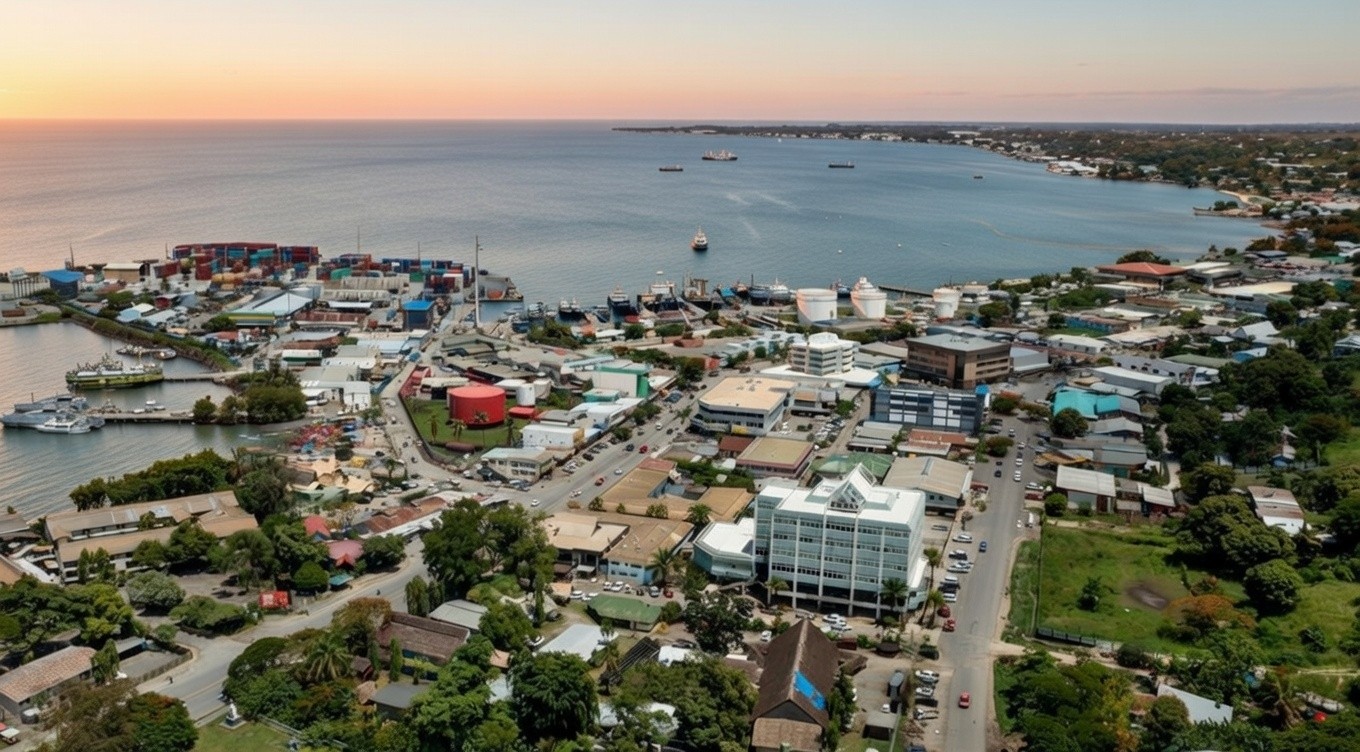
Along the Point Cruz shore, the American wartime base left a road and a working harbour behind it. Once the guns fell silent, the colonial administration transferred its capital from Tulagi to that ground. The point remains the commercial heart of Honiara, the exchange between island produce and imported goods. Timber and minerals leave the country through these wharves, which draws the waterfront into our mining and resource sector translation, from shipping manifests to export permits.
Because the sea lanes bind the Melanesian capitals, our Honiara linguists keep close company with the crews behind Port Vila and Nouméa, the nearer nodes between the Solomons and New Caledonia. On the Guadalcanal wharves, a document may need Pijin on one shore and French on the other. The shared network handles such crossings in a day. The 1942 Guadalcanal campaign opened this harbour as a deep-water supply port.
Henderson Field and the Honiara Airfield
Eight kilometres east of the centre, Honiara International Airport began as a Japanese airstrip in 1942 and fell to the United States Marines, who finished it and named it Henderson Field for an aviator lost at Midway. Months of fighting centred on the runway during the Guadalcanal campaign. The field reopened to civil traffic in 1969 and took the Honiara name in 2003. Today it is the country’s principal international airfield.
When storms or earthquakes sever the sea links, the runway becomes the lifeline of relief and medical evacuation for a nation of close to a thousand islands. That role outlasts any timetable, which is why our disaster response and emergency management translation readies flight clearances and aid manifests in Pijin and English against the hour they are needed. Under the ICAO code AGGH, the airfield appears in world aviation charts as Honiara International Airport.
The Coral Sea Cable Landing
West of the town, the Coral Sea Cable System comes ashore at its Honiara landing station, the first subsea fibre link ever brought to the Solomon Islands. Funded by Australia with the Solomon Islands administration, the 4,700-kilometre line ends at the Sydney internet hub. The connection retired the country’s long dependence on costly satellite hops. A domestic spur joins Honiara to the provincial centres of Auki and Noro.
Engineered for a quarter-century of use, the installation endures as a fixture of Honiara for a generation. Its terminal logs and regulator filings cross between English and Pijin, a task for our technology and innovation translation in the telecoms sector. Owned by the Coral Sea Cable Company, the line has linked Honiara to Sydney since February 2020.
The Tina River Hydropower Plant
On the Tina River in central Guadalcanal, some thirty kilometres south of the capital, the Solomon Islands Government has built the country’s first utility-scale hydropower plant with the World Bank and the Green Climate Fund. The scheme replaces imported diesel with water power and will supply the greater part of the Honiara grid. Korean and overseas engineering firms back the dam and the transmission line into town.
Since customary tribes own the ground beneath the new reservoir, royalties and lease income go to the landholding lines, a benefit-sharing model written into the founding agreements. Turning that model into a durable written record needs careful energy and climate infrastructure translation of tenure accords and power-purchase terms across Pijin and English. The development-bank file lists the scheme under project reference 50240.
Papers for Seasonal Labour Mobility
Year by year, Solomon Islanders take up seasonal jobs in Australian orchards and New Zealand vineyards under the region’s labour-mobility schemes. The paperwork behind them shuttles between Pijin and English. Contracts and identity papers must ring true in the worker’s tongue and the employer’s, checked clause by clause and approved by a consular officer.
Because the checklists change with the labour agreements, the current terms are maintained on our immigration and labour mobility page and updated whenever the programmes are revised. The underlying need does not change: a worker’s file turned faithfully into Pijin, then into the English of the receiving country. Our Pijin localisation service prepares those documents to the standard a foreign embassy will accept.
Melanesian Linguistic Matrix for Honiara Hub

Huri Translations
Tel. +689 89 205 483
[email protected]
PO BOX 365 Maharepa
98728 Mo'orea
French Polynesia
N°TAHITI 876649


Social