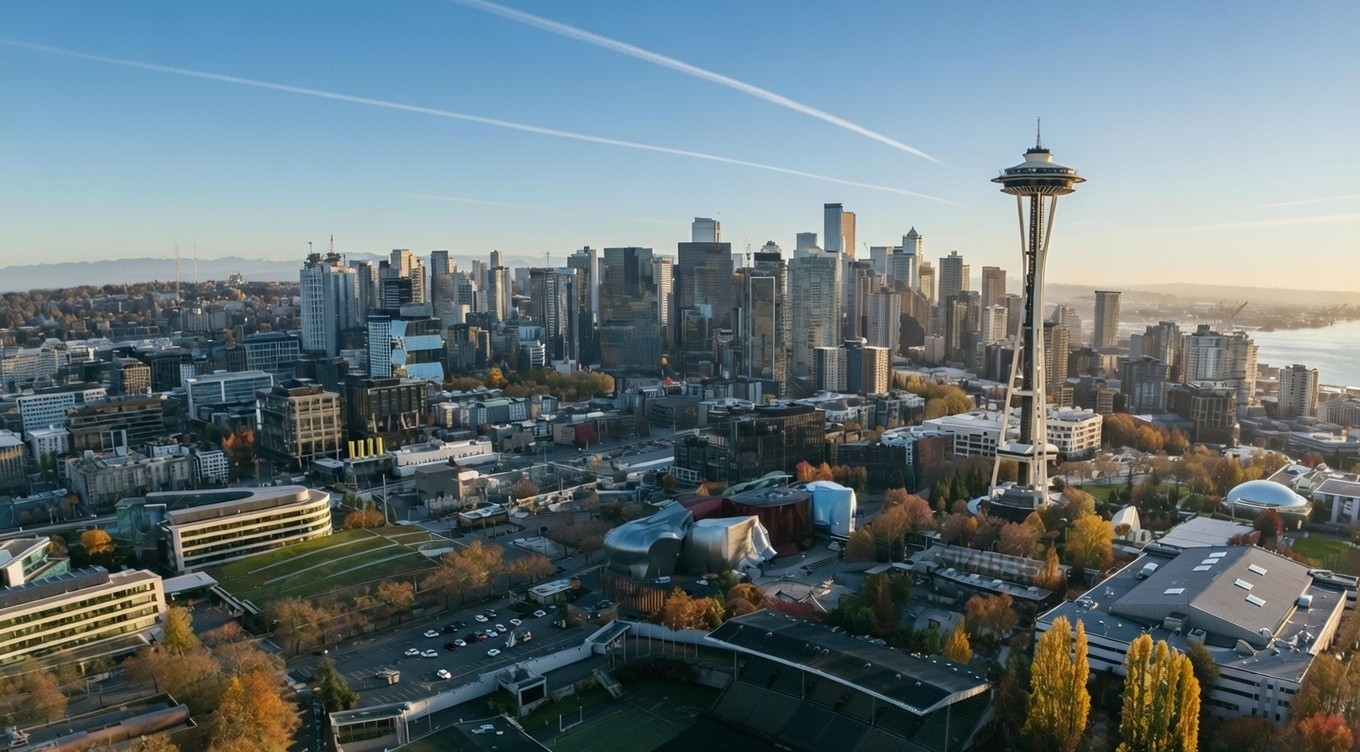
White Center and the South County Towns
Although the city line has never taken them in, White Center and Burien have housed Samoan and Chamorro families since the 1950s, when a first generation arrived for shipyard and cannery employment. Marshallese and Chuukese newcomers came decades later, mostly to Kent and Federal Way. Washington ranks third among the states for Native Hawaiian and Pacific Islander residents, more than half of them in King County and Pierce County, by the count of the county public health department.
Most weekday mornings, the districts strung along Pacific Highway South send out enrollment packets and immunization letters in Gagana Sāmoa. Our Marshallese translation team prepares the Kajin M̧ajeļ editions for parents in Kent and Auburn. Highline and Federal Way between them enroll pupils from more than a dozen island nations and territories.
Redrawing a municipal boundary changes the map and leaves the population in place. For that reason our glossaries follow only the district and the parish. A kinship term keyed into a Highline enrollment file stays legible to the clerk who opens it a decade on.
The Name Written on the City
Seattle owes its name to siʔaɫ, a Duwamish and Suquamish leader, whose mark appears on the Point Elliott treaty of 1855. In the treaty texts, colonists wrote it down as Sealth. That form survives on Chief Sealth International High School in Delridge and on the Chief Sealth Trail above Beacon Hill. The Lushootseed original uses a glottal stop and a lateral fricative, two characters missing from the English alphabet.
Across the river on West Marginal Way, Duwamish descendants teach Lushootseed at their longhouse, a language committed to paper in three competing alphabets. Orthography of this kind governs our language revitalization files: a spelling mis-set by one character stops matching the tribal roll and the county birth record.
When set against Pacific orthographies of comparable diacritic load, that discipline transfers directly: the okina in ʻŌlelo Hawaiʻi and the cedilla-marked consonants of Kajin M̧ajeļ. A clinic stripping those marks at intake produces a chart at odds with the passport. The mismatch will probably surface at the pharmacy counter weeks afterward, once a refill fails an identity check. Our export routines protect the cedillas through the handover into hospital systems.
The Quarterback from Tutuila
Born on Tutuila in 1956 and brought to White Center at the age of one, Jack Thompson grew up between Gagana Sāmoa at home and English at Evergreen High School. He threw for 7,818 yards at Washington State, the highest college total on the books in 1978. Cincinnati took him third overall in the 1979 draft. Pullman retired his number 14.
After six professional seasons, Thompson returned to Seattle as a mortgage banker and coached quarterbacks at Ballard High School without pay. A Spokane columnist had given him the nickname Throwin’ Samoan in 1976. In 2013 the inaugural class of the Polynesian Football Hall of Fame admitted him. Families across Highline still use the nickname, three generations on from the flight out of American Sāmoa.
It takes decades for a life of that shape to stop generating bilingual paperwork. The transcripts go to Samoan translation, the coaching manuals and match citations to sports and competition. Highline coaches order the professional training material in two languages. The published biography sets out the rest.
Salmon Bay and the North Pacific Fleet
To give a scattered fleet one address, the Port of Seattle dedicated its first property on Salmon Bay in January 1914, a fishing dock in the freshwater channel between Ballard and Magnolia. Fishermen’s Terminal still berths about 400 commercial vessels, the deepest concentration of North Pacific boats at one moorage. A mile west, the Chittenden Locks hold the basin in fresh water. Consequently hulls have wintered here for over a hundred years.
Samoan and Marshallese deckhands sign on for the season. By default, employment terms and injury notices go out in English, drafted against Alaska statute and federal maritime rules. The Kajin M̧ajeļ version of the merchant crew and port-state control conditions is aboard while the boat is still at the dock.
By contrast, the container trade in the harbors to the south belongs to a separate documentary tradition, treated on our Tacoma page. Salmon Bay produces catch logs and vessel repair estimates. At the head of the docks, a memorial lists the crews lost from those hulls. A deckhand signing a Bristol Bay agreement must be able to check the pay clause in the tongue used by his relatives on Majuro.
The Sand Point Laboratory and Pacific Warnings
On the Lake Washington shore beside Magnuson Park, a nine-building federal campus fills the ground of a naval air station decommissioned in 1970. The Pacific Marine Environmental Laboratory opened in Building 3 in the early 1980s, alongside a vessel staging pier and the fisheries science center next door. Federal study at Sand Point dates to 1957, when marine mammal researchers arrived from Edmonds.
It was engineers at Sand Point who developed the DART buoys, deep-ocean pressure recorders underlying basin-wide tsunami detection. Within minutes of a seafloor rupture, bulletins go to island governments from Palau to Sāmoa. The English text is the fast one. Behind it, island-language versions follow at the pace of the receiving ministry. A duty officer on Majuro is waiting on two numbers.
What our early warning systems translation turns on is speed. On file we store pre-approved Marshallese and Samoan bulletin templates, with the variable fields limited to wave height and arrival time. The wording does stay constant between events. Filling two numbers into an approved template occupies a translator for under a minute.
The Rosling Center and Global Health Data
Construction finished in 2020, the Hans Rosling Center for Population Health houses the Institute for Health Metrics and Evaluation together with the Department of Global Health. A gift of $210 million from the Gates Foundation paid for the building, with $15 million more from the Washington Legislature. In 2016 the regents had set the parent initiative on a twenty-five year horizon.
Researchers at the institute publish disease burden estimates for the Marshall Islands and Sāmoa inside the Global Burden of Disease series, a count of years lost to illness as well as deaths. Back in the region, those figures arrive as English ministry papers, several hundred pages at a stretch. Converting them into Kajin M̧ajeļ and Gagana Sāmoa for the clinics and radio stations belongs to our public health unit.
Radiation exposure data on the Marshall Islands dates to the Castle Bravo test of 1954. Several thousand miles from the atolls in question, statisticians here still model its consequences for the affected populations. Marshallese patients at King County clinics bring that history into the consulting room. We therefore fix the vocabulary of dosimetry and thyroid screening across the research paper and the patient leaflet alike.
Canoes and Textiles at the Burke
Cataloging a Pacific canoe means recording two names for it, the collector’s and the community’s. The Burke Museum, founded in 1885 and declared the Washington State Museum in 1899, holds over 16 million objects and specimens. Its canoes, model and full-size, come from across Oceania. Its preserved fishes alone number more than 12 million, drawn mostly from the North Pacific and the Bering Sea.
Alongside the fossils and the fish, the ethnographic material draws Pacific Islander students, testing entries by family memory. Catalog descriptions from the 1920s give island and object designations as a collector heard them rather than as the community writes them. Correcting those descriptions is a translation task with an archival edge. Our cultural education practice absorbs such files.
Provenance notes list atoll and lineage detail in wording chosen by a donor a century ago. The older transcription we keep beside the current Kajin M̧ajeļ and Gagana Sāmoa forms, with a note on its year. A curator can then print the two together on one catalog line, the arrangement our cultural and intellectual property reviews ask of a museum record.
Compact Status and the Civil Record
There are three freely associated states with visa-free entry to the United States under the Compacts of Free Association. The earliest compacts entered into force in 1986, with Palau following in 1994. That status is not citizenship. Even so, the paperwork proving it turns up at county counters daily, usually in the hands of a relative acting as interpreter.
At the counter in Kent, staff process Ebeye birth records and Koror graduation papers into forms drafted for a different documentary tradition, with no field for an atoll of origin. Clerks learn quickly that a Marshallese given name may include an inherited title. The federal checklist changes with the budget cycle, which is why our Compact of Free Association page keeps the current version.
Guardianship petitions and estate filings recur in Seattle, many of them turning on customary adoption. Down the coast, our Portland and Los Angeles pages treat the Oregon and California ends of the migration. Our cross-border and diaspora legal matters group handles the Seattle petitions. The Kajin M̧ajeļ localization glossary is with the county courts. A registrar can mark a petition complete without calling a second appointment.
Pacific Linguistic Matrix for Seattle Hub

Huri Translations
Tel. +689 89 205 483
[email protected]
PO BOX 365 Maharepa
98728 Mo'orea
French Polynesia
N°TAHITI 876649


Social