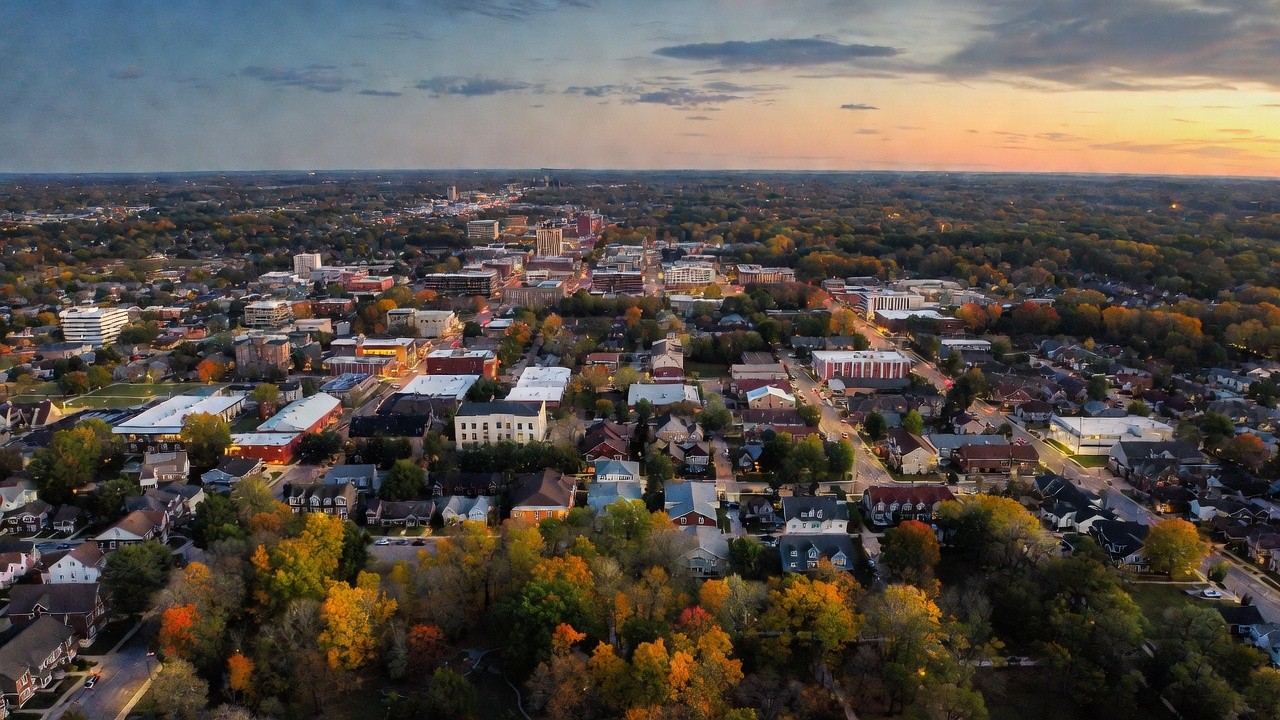
Spring Creek and the Benton County Line
On the Springfield Plateau, Springdale straddles the boundary between Washington and Benton counties, which its 1878 incorporation drew. The 2020 census counted 84,161 residents inside that divided municipality, fourth largest in Arkansas. Petitioners for a post office in 1872 found another Shiloh already on the Arkansas rolls. Sarah Reed Meek proposed Springdale instead, for the springs in the dale. The older name survives on the hall raised in 1871, with Spring Creek crossing downtown below it and the regional greenway alongside for 36 miles.
It was the 1881 Frisco railroad that fixed the business center on Emma Avenue, half a mile east of the old church ground. Broiler houses replaced the fruit orchards after 1930, leaving the plants short of labor from Ozark farms alone. Marshallese arrivals filled that shortfall from the 1990s onward, most of them renting inside the Springdale school district or north into Lowell. Three buildings of the early poultry trade, two on East Emma and one on East Meadow, entered the National Park Service listing on 23 September 2011.
Our food production and processing pages list the document types issued by a Springdale plant in a year. An induction packet for a first-week hire means lockout tagging and chemical labeling in Kajin M̧ajeļ, prepared against the English original and never summarized from it. The district admits Marshallese children across its elementary schools, putting the enrollment form into the second language of the house. Relatives who go on to the capital find the equivalent through the Little Rock hub. Our Independence node takes the Missouri end of this diaspora. Crew-change notices and heat-stress warnings issued in July arrive in Kajin M̧ajeļ within the day.
John Moody and the First Ozark Arrival
Late in the 1970s John Moody left the Marshall Islands on a scholarship for a college in eastern Oklahoma. He reappeared in Springdale a few years later, with a poultry job. The 1986 compact between the two governments gave the migration behind him its legal footing. Kajin M̧ajeļ was his mother tongue. Our Marshallese translation and Kajin M̧ajeļ localization lines handle it today. Islanders still come onto American campuses on scholarships of that kind, generating the transcripts and course outlines listed in our academic institutions chapter.
What Moody sent home was a wage figure and an address. Relatives followed through the 1980s. Cousins and in-laws followed them, until the Marshallese population of Northwest Arkansas exceeded 12,000 and Springdale became the largest Marshallese place outside the islands themselves. The migrants recruited one another, without brokers and without a resettlement program behind them. Marshallese speakers gave the town a nickname along the way, Baotail, chicken tail. A community club presented Moody with a plaque of thanks in 1999.
Older Marshallese files raise a spelling problem. The standard orthography dates from the 1970s. Papers of earlier date spell one person two or three ways. A clan name may occupy the surname slot on an Arkansas form. A courthouse clerk must match those variants to one applicant. We attach an equivalence note to the translated birth record when the spellings diverge, keeping the diacritics of Kajin M̧ajeļ intact in the target text. The Encyclopedia of Arkansas sets out the fuller account of the Marshallese in Arkansas.
Fitzgerald Station and the March West
There was an inn beside the spring by 1839, built by John and Mary Fitzgerald on the road between Springfield and Fort Smith. Eleven of the thirteen overland Cherokee detachments travelled through Northwest Arkansas by that wagon line. One diary of the march gives fifteen miles to Cross Hollows, in present-day Lowell, and five more to Fitzgerald’s. The Butterfield mail contract made the place an official stop in 1858. Its station and farmstead remain among the listed historic properties of Washington County.
Ferried across the Mississippi in November 1838, the Benge detachment crossed into Arkansas at the Current River in December and halted at Fayetteville on 13 January 1839. Congress named the overland march the Trail of Tears National Historic Trail in 1987. Signs mark the designated highways through Benton and Washington counties today. Telegraph wire went up along the track after the Civil War, leaving Old Wire Road in local usage. Springdale kept one of the earlier removal markers, placed decades ahead of the federal designation.
Two displacements share the one road, a forced march west in 1839 and a compact-era arrival from the atolls in the 1980s. Neither community chose the ground. Our truth and reconciliation section deals with the language of removal claims and nuclear compensation dockets, including the testimony transcripts behind them. Marshallese claimants give evidence in Kajin M̧ajeļ. A tribunal weighs it in English. The state encyclopedia entry for the Trail of Tears lists the detachments and the Arkansas markers.
Ozark Collections and the Atoll Testimony
Documenting the Ozarks costs Springdale money in its annual budget. The Shiloh Museum of Ozark History opened on 7 September 1968, three years after the council bought the artifact collection of Guy Howard, a Springdale lawyer who had gathered some 10,000 pieces over sixty years. Its name comes from the 1840s congregation that preceded the town. Its collecting area spans six Ozark counties. Six historic buildings occupy its two wooded acres downtown. Two thirds of the people using it live outside the municipal limits. The city pays for the institution anyway.
Under the title From the Atolls to the Ozarks, the museum publishes an account of the migration written by Marshallese residents themselves. Its library holds more than 500,000 photographs of Ozark life, plus 300 linear feet of manuscripts, the Marshallese donations among them. The image series called Vanishing Northwest Arkansas numbers past 100,000 frames. Objects given by island families entered those cases within a generation of the earliest flights east, alongside the hatchery ledgers and the orchard photographs of the 1920s.
To transcribe an elder’s recording takes more than a bilingual ear. Kosraean changes its vocabulary according to the rank of the person addressed. Marshallese elders use clan and inheritance terms absent from school speech. Finding aids for the image archive appear in the museum’s own collections guide. Our audio-visual adaptation material sets the timing and glossing rules for those tapes, a method built on a reviewer from the island itself. The Kosraean side of an oral history goes to our Kusaie localization team.
Pediatric Care West of Interstate 49
Arkansas Children’s Northwest, the only pediatric hospital in the region, opened on 27 February 2018 west of Interstate 49. The 37-acre campus houses five surgical suites and a Level IV pediatric trauma unit. Angel One, the air transport of the wider system, refuels at the helipad. Marshallese parents drive minutes to that emergency department. Arkansas Children’s backs the site from its Little Rock flagship, a statewide network giving the Springdale hospital its transport link and its specialist staffing.
A discharge sheet does not explain itself: insulin timing and follow-up dates fail differently in translation. Clinical studies at the University of Arkansas have documented high rates of type 2 diabetes among Marshallese adults. Kajin M̧ajeļ has no fixed equivalent for insulin resistance. A translator supplies a plain gloss for the parent. Consent packets and nutrition instructions therefore matter as text. A relative interpreting in the hallway leaves the chart empty.
Our health literacy guidance sets the plain-language bar for consent packets in Kajin M̧ajeļ. Parents do ask for the Marshallese version at admission. Dosage figures keep their numerals throughout. Requests arriving from Kosraean-speaking parents in the one waiting room go to our Kosraean translation linguists. Arkansas Children’s publishes the clinic index for the northwest campus. Discharge instructions leave the building in English and Kajin M̧ajeļ on one sheet.
Civil Records and the Two Compacts
It matters to a diaspora city that the sending state keeps a consular function inside it. Passport renewals and absentee ballots for elections at home define most of that errand in Springdale. Compact status gives residence and employment without citizenship. That distinction shapes the document list at intake and at admission. The country keeps two further American posts, in Honolulu and Los Angeles, with its embassy in Washington above them. The Springdale post dates from September 2009, the first of its nation on the American mainland.
The consulate issues documents without translating them. Arkansas school districts want English, while Majuro wants Kajin M̧ajeļ. Marshallese voters in Arkansas mail their national ballots four thousand miles. Kosraean speakers come under a second instrument, dating from the 1986 compact with the Federated States of Micronesia. Citizens of the two republics live and take employment in the United States without visas. Kosrae lies west of Majuro, with an orthography of its own. The Marshall Islands counts 29 atolls and five islands across its ocean territory.
The paperwork divides cleanly. Compact terms belong to our COFA compacts schedule, the notarial chain to our notarial documentation annex. A family filing for a marriage record from Majuro sends us the Marshallese original and receives a version formatted for the county office. We keep the source pagination in the translated packet. Death papers go the other way, into Kajin M̧ajeļ, for burial arrangements made at home.
Micronesian Linguistic Matrix for Springdale Hub

Huri Translations
Tel. +689 89 205 483
[email protected]
PO BOX 365 Maharepa
98728 Mo'orea
French Polynesia
N°TAHITI 876649


Social