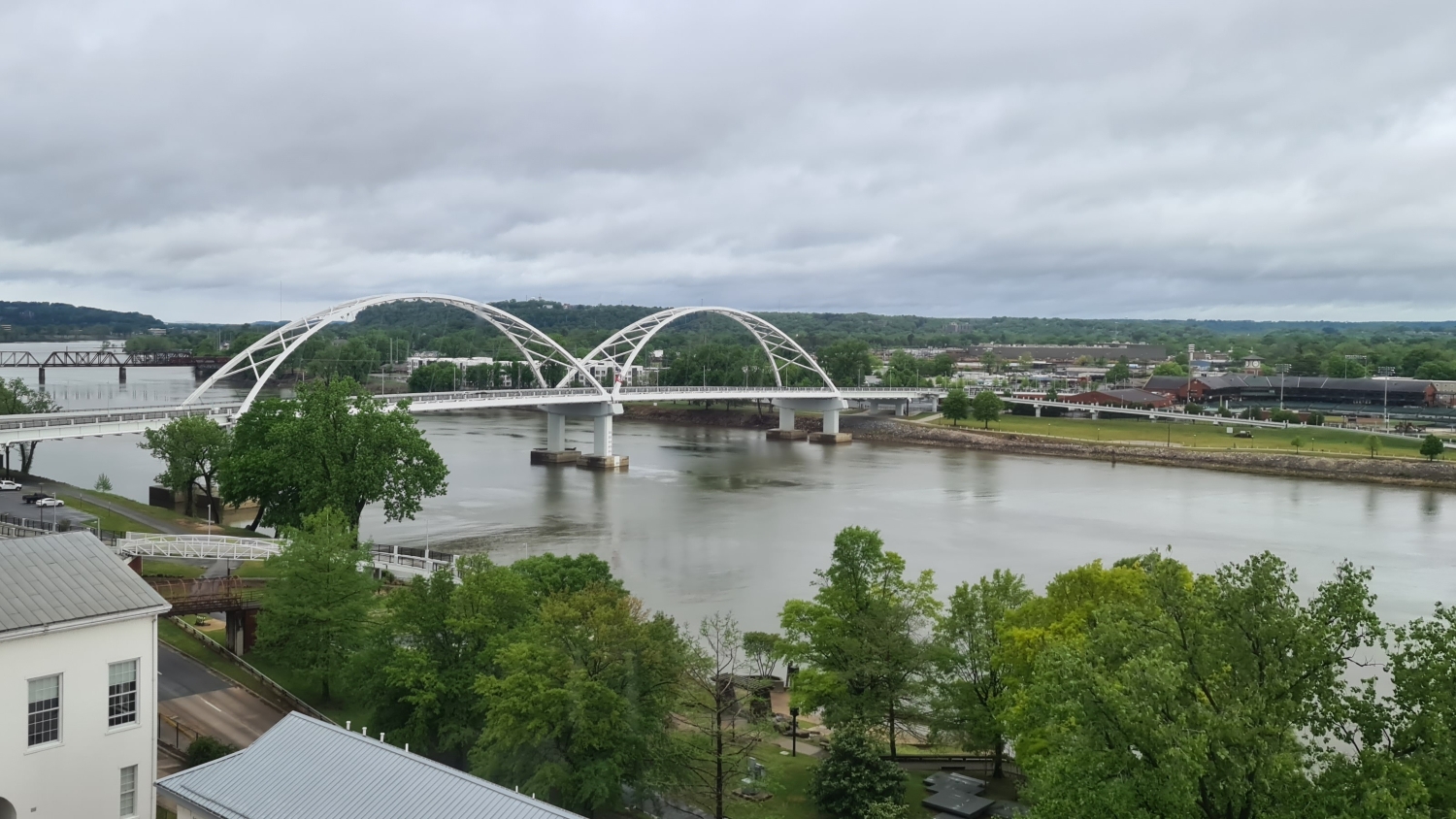
The Tower Building and the Pacific Command
Inside the Tower Building of the Little Rock Arsenal, on 26 January 1880, an infantry captain posted to the garrison saw the birth of his third son. Four decades on, Douglas MacArthur commanded the Southwest Pacific against Japan, afterward governing the occupation from Tōkyō as Supreme Commander for the Allied Powers. Japan had administered Chuuk and the Marshall Islands under its South Seas Mandate until 1944. Dismantling the Japanese empire placed Micronesia within a United Nations trusteeship in 1947, the arrangement from which the modern COFA compacts descend.
Falling to a separate Central Pacific command, Kwajalein and Chuuk left Micronesian memory of the war attached to other names. His local commemoration is narrow and fixed: a park laid over the old parade ground, plus the military museum in the tower, a National Historic Landmark since 1994. What the two histories left behind is paperwork. Trusteeship administration generated birth certificates and title deeds in English. Neither the certificates nor the deeds exist in a Micronesian tongue.
Families in Pulaski County bring us the original and nothing else. We prepare extracts and deeds for federal status submissions, taking them out of English into Marshallese or into Chuukese as the family needs. Arkansas offices take the reverse direction as legal documentation. Fuller biography rests with the Encyclopedia of Arkansas. MacArthur died in 1964, his Arkansas tie amounting to one arrival in 1880 and one return in 1952.
The State Namesake in Bikini Lagoon
It was the Baker shot of 25 July 1946 that sank nine target ships in Bikini lagoon, among them the battleship USS Arkansas. The state namesake lies inverted today beneath roughly 180 feet of water. Bikini residents had already been displaced from their islands. Sixty-seven devices followed across the Marshall archipelago between 1946 and 1958. UNESCO inscribed the atoll on the World Heritage List in 2010 to fix the physical testimony, the sunken fleet together with the Bravo crater.
On 1 March 1954 the Bravo device showered Rongelap and Utrik with fallout. Nuclear Remembrance Day marks the date across the Marshall Islands. Tribunal findings on personal injury and property damage are still arriving in Arkansas paperwork three generations later. The originals arrive duplicated and faint.
Because the testing history underwrites claims filed decades afterward, Marshallese petitioners in Arkansas assemble affidavits and medical-monitoring dossiers in two tongues. Atoll names survive the crossing only when the translator knows the spelling conventions of Kajin M̧ajeļ. The 2010 inscription record appears in the World Heritage listing for Bikini Atoll. We prepare such papers for land and resource rights filings, with atoll spellings taken from the standard Marshallese-English Dictionary of 1976.
Credentials at the Justice Building
Since 1999 Arkansas has credentialed foreign-language court interpreters through the Administrative Office of the Courts. Judges appoint from that list ahead of anyone else. A judge may name an unlisted interpreter only in the absence of a qualified candidate. While ranking second among requested languages in Arkansas proceedings, Marshallese waited until 2013 for the country’s first certified interpreter, admitted in the Supreme Court courtroom here.
District courts upstate also log requests for Chuukese and Pohnpeian. The examination probes sight translation alongside consecutive and simultaneous delivery, leaving the documentary half of a case file untouched. Interpreters take the hearing, and translators, the appeal. Qualification steps come from the Arkansas Judiciary. We handle the written half as court interpretation and judicial transcription, returning the exhibits in the sequence the clerk already uses.
An Indigenous Print Archive on the University Campus
In Tucson in 1983, two English professors salvaged a discarded set of Native American newspapers and drove it home. That rescue became the American Native Press Archives at the University of Arkansas at Little Rock. The unit took the name Sequoyah National Research Center in 2008. Its collection numbers more than 2,800 periodical titles from tribal governments and Indigenous language programs. The name honors Sequoyah, who devised the Cherokee syllabary during his years in Arkansas.
Micronesian print faces the identical problem of survival. Mission presses and island newsletters produced the earliest sustained texts in Marshallese and Chuukese. Archival cataloguing did not follow. Diacritics disappear early, then whole orthographies.
Kajin M̧ajeļ places a cedilla under four consonants and a macron over two vowels. Optical capture drops them. Search indexes fail on the corrected form, which leaves a grandchild hunting a grandparent with nothing to type. When the scan is poor, we key the text by hand. The Sequoyah National Research Center publishes its collection description in full. Older Micronesian material goes from us into cultural and intellectual property deposits, matched to source orthography character by character.
Telehealth Across Seventy-Five Counties
Out of an older distance-medicine program, the UAMS Institute for Digital Health and Innovation built e-Link, a video network of roughly 800 endpoints binding clinics and public-safety premises to the medical school in Little Rock. There is a connection point in all seventy-five Arkansas counties. A specialist downtown consults a patient two hundred miles north within the hour. However, the wording on a consent form does not keep pace.
To counsel a patient in Kajin M̧ajeļ, the clinic needs the sheet written in advance. The link does deliver the voice. We produce consent papers and discharge instructions for public health programs, plus patient-portal strings through Chuukese localization. The Institute for Digital Health and Innovation lists its programs publicly. Discharge instructions leave us in two shapes, plain text for print and portal strings for the app.
Downriver Pine Bluff and the Northwest Counties
Forty-five miles downstream from the capital, Pine Bluff keeps one of the smaller Marshallese communities in the state. Berryville and Huntsville keep others. The weight of the population is northwest, in Washington and Benton counties. Our Springdale node takes up that ground. The Ozark plateau begins well north of Pulaski County.
Which office issues the civil document decides the trip. Pulaski County issues most of them. A family in Benton County therefore deals with Little Rock for a certificate and a benefit appeal. Missouri sends comparable traffic through Independence. We translate what arrives from either direction, appeal letters and vital extracts alike, as part of cross-border and diaspora legal matters, returning the file in the page order the reviewing office expects.
Pacific Linguistic Matrix for Little Rock Hub

Huri Translations
Tel. +689 89 205 483
[email protected]
PO BOX 365 Maharepa
98728 Mo'orea
French Polynesia
N°TAHITI 876649


Social