The Islets Behind the Capital
Around Te Namo, the largest lagoon in Tuvalu at 275 square kilometres, lie 33 islets totalling 2.4 square kilometres of surface. Fongafale accounts for almost all of it, a sliver 12 kilometres long and between 10 and 400 metres wide. In 2022 census takers counted 6,602 residents on the atoll, close to 60% of the national population. Lofeagai marks the northern end of its seven villages and Vaiaku the southern. The encyclopaedia article on the atoll lists Funafala and Amatuku among the smaller inhabited islets.
Vaiaku houses the ministries and the National Bank of Tuvalu, but the village is not the capital. Since the government there answers for all 33 islets, that title belongs to the whole atoll. It is the clerk who writes Funafuti into the address line and the village beneath it. On a form naming Vaiaku by itself, the jurisdiction is wrong. Huri writes the atoll above the village on the address line.
During the Pacific War most Tuvaluans on Fongafale went south to Funafala, along with the hospital. After 1945 the islanders brought their speech back to the strip. Funafuti and Vaitupu together supply te gana māsani, the common language of print and of Parliament. Across the seven other islands the dialects differ, a spread handled under our supporting language revitalisation material. Nui is the outlier: its people speak a Gilbertese-derived language. For the Nui files we pair Tuvaluan translation with Gilbertese, the administrative language of the colony until 1975.
Toaripi Lauti and the Tuvalu Language Board
There are three foreign postings in the early career of Toaripi Lauti. Lauti, born in 1928 at Toaripi village in the Territory of Papua to Pastor Lauti Kae of Funafuti, took his schooling at Elisefou on Vaitupu between 1938 and 1944. From 1954 he taught at King George V School in Tarawa. Twelve years as an industrial relations officer for the British Phosphate Commissioners on Nauru followed. In 1974 Funafuti returned him to Parliament, the seat of his political career.
Speaking Tuvaluan in the falekaupule and English at the council table, Lauti led the Ellice Islands out of the Gilbert colony. He became Chief Minister in 1975 and Prime Minister at independence in 1978. In 1977 he added the finance portfolio. Transcripts from those years survive in Tuvaluan and in English. Our Tuvaluan translation and Gana Tuvalu localisation pages set out the method for the public sector operations of that period.
The Tuvalu Language Board tied Lauti to the written form of the language. As president of the Funafuti Town Council he answered for its administrative form. His premiership ended on 8 September 1981, after his government placed most of the national funds with an American investor at a quoted 15%. Between 1990 and 1993 he was Governor-General. For language revitalisation and for the safety and occupational health glossaries behind phosphate labour, our linguists draw on sources of that kind. The fuller biography records the rest of the career. Lauti died at Funafuti on 25 May 2014.
The Boring at David’s Drill
What the Royal Society sent to Funafuti in 1896 was a diamond drill and a question open since Darwin put it in 1842. Three seasons of boring followed. Under William Sollas of Oxford the opening attempt stopped near 31 metres when the machinery failed. Two later parties went deeper, under Edgeworth David of Sydney and then under Alfred Edmund Finckh. In 1898 the bore struck 1,114 feet. The cores came up shallow-water carbonate throughout. Our linguists still draw on the maps of those seasons.
Two years after the third season closed, the Royal Society published a 400-page report on the atoll, a volume still on our ocean science and research annex. Charles Hedley of the Australian Museum had sailed with the opening party as naturalist. His zoology and ethnology filled Memoir III at Sydney between 1896 and 1897. Meanwhile Sollas took down an oral history of the atoll from Erivara, the chief of Funafuti, through an interpreter, Jack O’Brien. Sollas published that account in 1897 as The Legendary History of Funafuti.
The drill site bears a Tuvaluan name today, Te Vili o Tavita. Under that name the atoll’s geoheritage listing records the site. Clan names and island names in the 1904 report went down as an 1890s English ear heard them. They diverge from modern Tuvaluan usage. Under research publications our translators align the old scientific report with current orthography, the 1897 maps still serving as the coastal baseline.
The Kogatapu on the Western Reef
In June 1996 the Funafuti Falekaupule set aside the western rim of the reef as a kogatapu, a protected place in Tuvaluan. The area spans 33 square kilometres of reef and lagoon and encloses six islets, about 8 hectares in total. Green turtles nest on those beaches. On Fualopa a black noddy colony breeds. Roughly 20% of the atoll’s coral reef lies inside the 1996 boundary, as the conservation area listing sets out.
Within two decades weather had remade a third of the six. Cyclone Keli stripped Tepuka Vili Vili of its vegetation and most of its sand in 1997. Cyclone Pam reduced Vasafua to a sand bar in 2015, which leaves a survey team without a fixed coastline. For reef translation the marine conservation terms give the islet in Tuvaluan and the habitat in English, a division applied across the survey files.
A conservation ordinance on Funafuti does take drafting twice. In Tuvaluan the Falekaupule debates it. Its executive, the Kaupule, issues building approvals for family plots on Fongafale. Government-leased ground goes instead to the Lands Management Committee. The ordinance itself is enrolled in English. Against the survey file and against customary law and statutory integration our translators match that wording. They assign the protected islets a fixed Tuvaluan label.
Four Fibre Pairs Ashore at Fongafale
Relying on satellite left Tuvalu’s international link exposed to heavy rain. The Tuvalu Vaka Cable ended that exposure, a branch off the Bulikula trunk bringing four fibre pairs ashore at Funafuti. The Government of Tuvalu and the Tuvalu Telecommunications Corporation delivered the project. For the technical engineering they turned to Google. In November 2024 the shore build opened with a beach manhole and duct. Engineers switched the cable on for traffic on 24 October 2025.
Because donors funded the build entirely by grant, the reporting conditions are written in English. The Australian financing facility puts the project at USD 56 million. Australia gave up to USD 37 million and four other governments made up the balance. Along the duct trench the families receive their notices in Tuvaluan. Our subsea cable systems schedule sets the wording for an easement and a wayleave notice.
There remains a second consequence for language. A national administration putting its forms online must publish them in Tuvaluan alongside English. For a session timeout Tuvaluan has no inherited term. Much of that vocabulary does not exist ready-made, from the label on a two-factor prompt to the phrasing of an outage bulletin. Term by term our e-government and digital platforms glossary supplies those strings.
Raised Ground on the Lagoon Shore
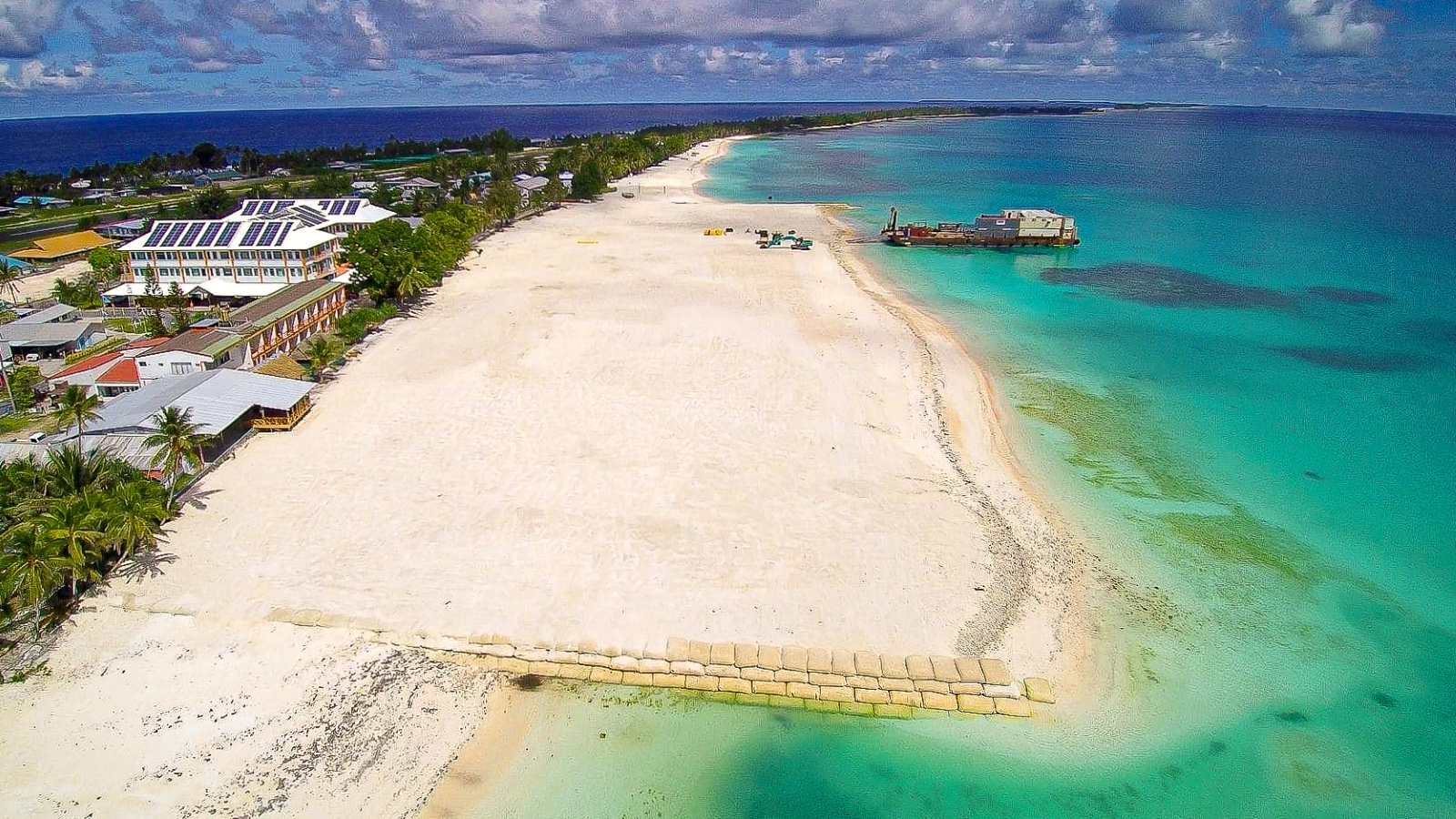
The Tuvalu Coastal Adaptation Project opened in 2017 under the Green Climate Fund on a budget of USD 40.2 million. To raise ground above storm-wave height was the stated purpose. UNDP executed the coastal build with the Ministry of Home Affairs and Rural Development. Through the drawings and the public notice our terminologists fix a Tuvaluan label per component. Across three islands the design put protection along 3,090 metres of coastline, 730 metres of it at Funafuti.
By late 2023 the opening phase had finished 7.8 hectares of raised, flood-free ground at Fogafale. Onto that platform came a second phase of fill, funded at USD 17.5 million by three partner governments, Australia and New Zealand among them. It added about 8 hectares and 800 metres of shoreline protection. In our climate adaptation infrastructure chapter revetment and freeboard have a fixed Tuvaluan equivalent. That second phase closed in October 2025.
Between 2050 and 2060, on worst-case projections from the Intergovernmental Panel on Climate Change, routine monthly high tides would flood nearly half the surface of Funafuti. Down to the 160 metres of shore in front of the church, consultation with the Falekaupule shaped the design. Ground raised this way, safe from storm wave yet new in law, needs a tenure file. The documents behind that step belong under climate displacement and planned relocation.
Civil Records for the Mobility Ballot
Twice since 2025 the ballot under the Falepili Union has opened. Australia and Tuvalu signed the treaty in November 2023 and brought it into force on 28 August 2024. Under its terms up to 280 places a year go by random ballot to permanent residence in Australia. A registration includes a spouse and dependent children alongside the adult applicant. A mismatch between the registration and the birth papers stops the application, an obstacle of orthography rather than of law.
Tuvaluan practice treats the island of origin as an identifier. On an outer island a family may own a plot while keeping a house at Fongafale. The birth papers may give Nukufetau while the tenure file gives Vaitupu. On the outer islands court rulings use the older orthography. The treaty itself is contested at home. In 2024 a former prime minister campaigned to end the mobility article. Our translators reconcile the island names across the dossier without inventing a third.
For the annual round the short list of documents stays constant. Birth papers and a name-equivalence note for a spelling changed between systems account for most of it. Year on year, the ballot office alters only the closing date and the fee. Those details belong on our Falepili mobility pathway entry, alongside the cross-border and diaspora legal work behind the rest of the family file.
Tuvaluan Linguistic Matrix for Funafuti Hub

Huri Translations
Tel. +689 89 205 483
[email protected]
PO BOX 365 Maharepa
98728 Mo'orea
French Polynesia
N°TAHITI 876649


Social