Valleys of Nuku Hiva
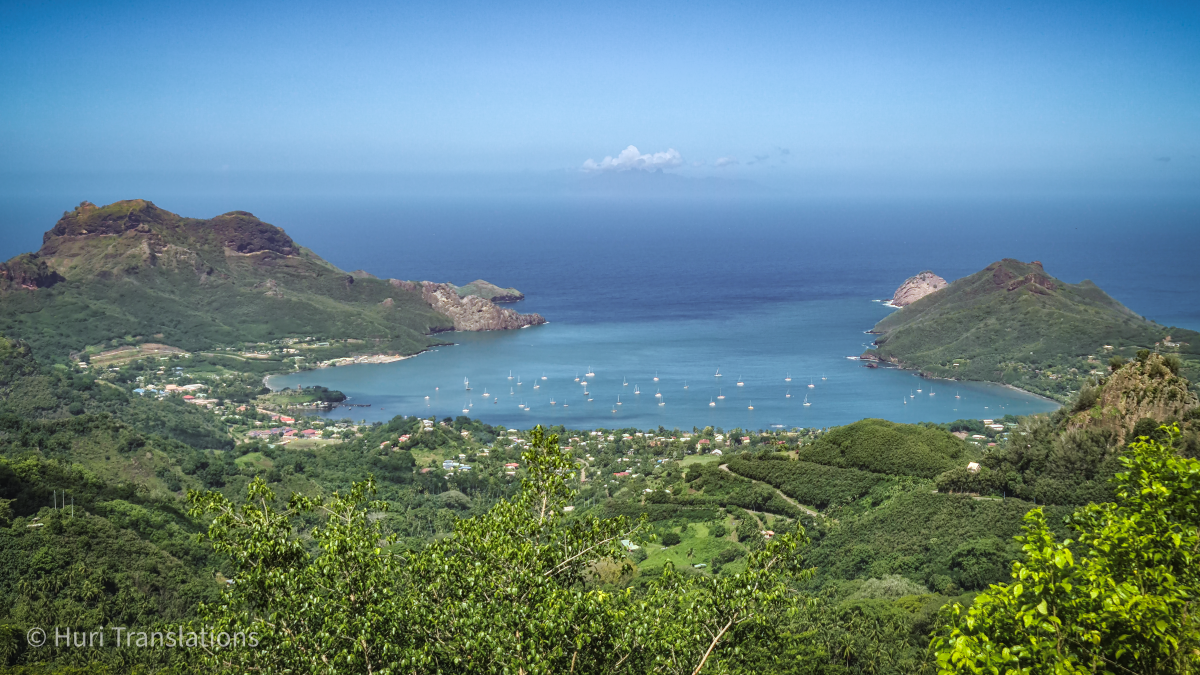
Beneath the 864-meter ridge of Muʻake, on the south coast of the island, Taiohaʻe gathers 2,218 of the 3,025 residents counted commune-wide during 2022. Primacy over the archipelago is what Atuʻona on Hiva ʻOa gave up to this bay last century. Notices for valleys 2 days off by sea are printed here. Clerks at the wicket answer in 2 languages all morning, the administrative French of the form and the ʻEo ʻEnana of the applicant.
Eastward, the valley of Taipivai shelters 415 people and the inlet used by copra barges. Its name compounds Taipī, the clan of the valley, with Vaiʻī, the river draining it, the clan Herman Melville printed as Typee during 1846. Hatiheʻu faces the north coast, its bay a stopping point for inter-island shipping. Rising to 800 meters inland, the Toʻoviʻi plateau takes the pasture and pine of the interior, ground under family title, cadastral survey trailing behind. Deeds from the interior go to the customary title and forestry queue with 3 generations of heirs named on one page.
Aircraft from Papeʻete, 1,400 km to the southwest, put down at Nuku a Taha on the arid tableland of Te Henua a Taha, an hour and more of mountain road from the wharf. Paperwork out of the capital crosses the distance intact, whereas the northern speech of Nuku Hiva diverges from the southern ʻEo ʻEnata of Hiva ʻOa. Dossiers moving between the 2 archipelagos pause at our Papeʻete hub. Common affairs of the 6 inhabited islands go through the intercommunal authority of the Marquesas.
Lucien Roʻo Kimitete, Mayor and Academician
Born at Hatiheʻu in 1952, Lucien Roʻo Kimitete took the town hall of Taiohaʻe in 1991 and kept it until 2002. He argued in French at the territorial assembly and in Marquesan at home, a doubling few contemporaries managed. Contemporaries called him Teʻiki Keuhina, his name in the language of the island. That record supports 2 of our lines: self-governance and autonomy and heritage transcription.
During June 1989, at the 1st arts festival of the archipelago, dancers from Nuku Hiva restored the Hakamanu, the bird dance, unperformed for close to a century. Kimitete had gathered its legend from elders of the interior. Thereafter the text went into print, a Marquesan version facing the French. Choreography and chant recovered then support our dance and traditional arts output. His politics drew opposition in Papeʻete throughout his lifetime.
Elected academician in 2000 at the founding of the Haʻe Tuhuka, he was lost at sea on 23 May 2002, a light aircraft with him and 4 others aboard disappearing during an election tour. A schoolmaster from Taipivai filled the vacancy that year. What survives for translators is the corpus: Oral transcription and mission-era hands, delivered with the spelling of the manuscript untouched. Editors draw cultural education material straight from it. The institutional roll records the man and the date: Marquesan academicians.
The Marquesan Academy and Its Two Names
Deliberation 2000-19 APF of 27 January 2000 created the institution by vote of the Assembly of French Polynesia, with its mother house overlooking Taiohaʻe Bay. There are 13 chairs, allotted island by island. Members from Nuku Hiva convene there on Wednesdays. Two names answer for one body, Haʻe Tuhuka o te ʻEo ʻEnana in the north beside Faʻe Tuhuna o te ʻEo ʻEnata in the south. Northern usage keeps h and k against the f and n heard further south.
On 15 October 2001, a year after its creation, the academy adopted the graphie liée, a simplified orthography drawn from 19th-century Catholic mission practice and argued for by the Tahitian linguist Turo Raʻapoto. Anyone trained in the system marks the glottal stop with a grave accent on the vowel following (in place of the ʻokina), except between two vowels. The academy maintains that the penultimate vowel lengthens on its own, leaving the macron unused. Disputed since publication, that spelling still governs language revitalization printing in the 6 islands.
Academicians in these rounds produce word lists, among them a bilingual 700-entry table closed during February 2024. They also christened the Marquesan ocean project Te Tai Nui a Hau, the great sea of peace, a naming decision our terminology development and teaching support lines absorb. That graphy we do judge unfit for learners: An accent doing the office of a consonant misleads anyone starting out. Huri therefore writes all Marquesan dialects with the ʻokina and the macron, the norm across the rest of Polynesia. Our ʻEo ʻEnana localization files leave in that hand, the academy form relegated to an optional choice. The competing standard issues from the Haʻe Tuhuka o te ʻEo ʻEnana.
Te Henua ʻEnata on the World Heritage List
During its 46th session in New Delhi, on 26 July 2024, the World Heritage Committee inscribed Te Henua ʻEnata, the Marquesas Islands, as a mixed serial listing of 7 components. Seafarers arriving around 1000 CE had given the archipelago its chiefdoms and stone platforms. The words mean the land of men. They double in the identical fashion as the academy, Te Henua ʻEnana in one dialect group and Te Fenua ʻEnata in the other.
Accordingly, criteria for human occupation joined 3 natural ones in the committee vote, Marquesan waters counting among the last marine wilderness of the planet. Conservation plans and boundary descriptions exist today in French, with Marquesan toponyms attached. Our marine conservation editors handle the monitoring reports on endemic seabirds and upland forest. Offices at Taiohaʻe answer for the archipelago share of the reporting.
Nomination dossiers amount to thousands of pages, toponymic lists forming their spine. Ownership of the vocabulary belongs to the islands, the premise of our cultural and intellectual property handling. It is the phrasing ratified at Taiohaʻe that binds a management plan filed in Paris the following quarter. Fuller account: Te Henua ʻEnata on the World Heritage List.
Charts and Freight of the Taiohaʻe Roadstead
An old caldera fell in on its seaward side, opening the bay and giving the archipelago its principal harbor. Motu ʻUa guards the eastern approach, and Motu Nui, the western. Mariners called the pair the East and West Sentinels. No barrier reef fringes Nuku Hiva. Ocean swell strikes the shoreline directly, a condition governing the sea defenses along it. David Porter of the United States Navy raised Fort Madison above this water in 1813, an American post abandoned inside 2 years.
Meanwhile, mixed cargo and passenger vessels out of Tahiti supply fuel and building stock to the wharf, lifting copra and citrus southbound. Declarations for dangerous goods are drafted in French, while the stevedores handling those pallets speak ʻEo ʻEnana. To berth a freighter here takes a pilot at home in 2 languages, which is why soundings and docking instructions belong to our hydrography and pilotage line, together with the berthing vocabulary of the northern islands, ʻEo ʻEnana against French or Tahitian.
Because the shelf drops away within a mile, the tuna grounds stay within a day of the quay. Skippers learn the Marquesan names of banks and seamounts on the catch reports. Our fisheries management files keep them as written. Charting of these approaches falls to the French naval hydrographic service, whose surveys of the archipelago began under sail: SHOM.
Fiber Terminal of the Natitua System
After 2,800 km of laying from Tahiti, crews were splicing the shore end at Taiohaʻe on 2 October 2018. Commercial service opened that December. The campaign gave the village fiber to the premises, a 4G network added in the first half of 2020. Design capacity of the system amounts to 10 terabits per second. The public postal and telecommunications establishment of French Polynesia financed the build, with state subsidy and a development-bank loan behind it.
Cabling the schools and linking the hospital to specialists formed the stated case for the investment. Even so, outer valleys of the commune keep only their satellite dishes. Bandwidth still governs how school books get distributed to Taipivai, and how patient-facing wording arrives at a dispensary 40 km from the terminal. Deliverable format follows that constraint, a printable sheet or subtitled video.
Elder recordings come as uploads, an oral corpus of 4 dialects entering the editing suite the day it is made. Live sessions with academicians follow across 1,400 km of new fiber. It follows that a word approved on a Wednesday morning appears in the delivered glossary by Thursday, ʻokina and macron surviving the transfer unchanged. Technical detail on the domestic system belongs to the operator: Groupe OPT.
Polynesian Linguistic Matrix for Taiohaʻe Hub
Huri Translations
Tel. +689 89 205 483
[email protected]
PO BOX 365 Maharepa
98728 Mo'orea
French Polynesia
N°TAHITI 876649


Social